



Flat Pack Accommodation Units – Modular Living Solutions for Every Project
The demand for rapid, high-quality, and scalable housing options is increasing day by day. Flat pack accommodation units are the pinnacle of modular engineering and provide a flexible solution for industries from mining and construction to disaster relief and emergency responses. These units are designed to be low-cost and efficient as they are prefabricated in a factory-controlled environment, which minimizes on-site assembly and results in major savings while dramatically reducing the amount of time spent on-site building.
Large-scale projects that have tight timelines and have many logistical hurdles are best suited for ZN House because they produce precision-engineered units that provide a combination of structural superiority and the flexibility of modular building systems. Whether you need temporary accommodation for remote camp workforces or need to provide temporary housing for an emergency, our flat pack accommodation units are designed to give reliable, high-quality performance in any type of environment.
What Are Flat Pack Accommodation Units?
Flat pack accommodation units are a premium class of modular housing units that are designed for maximum transport efficiency and rapid deployment. Unlike traditional construction methods or fully assembled shipping containers, they manufacture each ‘Flat Pack’ as separate components, namely roof, floor, and wall panels; and compact ‘flat’ for transport.
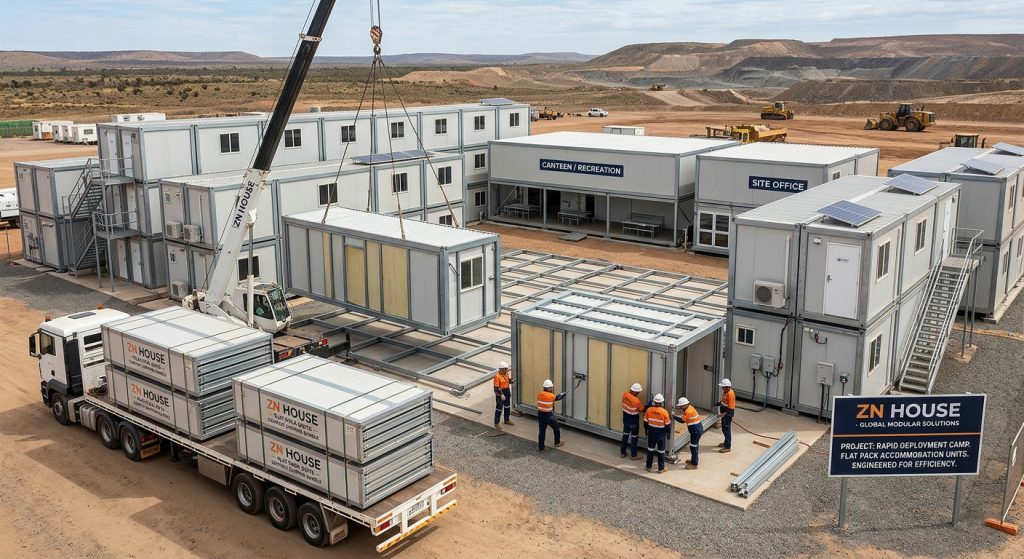
With four flat packs fitting within a standard ISO shipping container, Flat pack units significantly lower both marine freight costs and domestic transportation costs. The major engineering advantage of a flat pack accommodation unit is its use of standardised interchangeable components. Every flat pack unit has a heavy-duty galvanised steel framing system that provides structural integrity for multi-storey stacking (typically up to three) to provide all necessary support. Once flat pack units arrive at a project site, they can be assembled using bolt-and-nut connections with limited specialised heavy equipment when compared to traditional builds. Flat pack units can easily connect side-by-side or end-to-end to form larger communal areas such as dining areas, offices, or large dormitory wings. With 90% of construction done in the factory, ZN House can make sure every unit meets strict quality control standards, lessening risks from labour on-site and unpredictable weather conditions.
Key Advantages
Fast Installation (Up to 70% Time Saving)
The length of time needed to complete industrial or emergency construction projects is the most important variable in terms of project success or failure. Flat-pack accommodation units can be put together much more quickly than traditional masonry or stick-built structures. For example, the average crew of four workers will normally take less than three hours to assemble the structural portion of one unit. Therefore, in large-scale projects, there is normally a 70% reduction in the overall construction schedule. Since the units are delivered with all of the necessary electrical and plumbing conduit already installed, they will also allow for an accelerated finish phase, which results in an almost instantaneous move-in to the units.
Lower Transportation Cost
The main reason for selecting flat pack designs is that they are logistically efficient. Standard containers are high-cost to ship because they contain “space”. Our flat pack units are compressed for transportation. For example, we are able to fit 4 x 20ft units into a single 40ft High Cube shipping container, or onto a flatbed truck. This 4:1 ratio translates to a reduction of transportation cost by 75%, making it the best cost option for international projects or sites located inland, where transportation infrastructure is not developed as much as in other areas.
Relocatable & Expandable
These units’ modular aspect offers complete flexibility for projects. As such, if projects change in requirements, then these units can no longer be used as fixed installations and can then be reassembled, relocated, and then flat-packed again. Therefore, allowing companies that have projects that will rotate in location to use these as an asset. In addition, they have a ‘Lego’ factor to their size since they allow project managers to start with a smaller footprint and then be able to expand their camp vertically or horizontally by adding additional units without having to interrupt current operations.
Durable Steel Structure
Every unit has been designed using a heavy-duty galvanized steel frame capable of standing up to the harsh environment found in industrial-type applications. Steel frames are not only durable but will also not be prone to rot, insect damage, or fire like temporary buildings built from timber. The design of each unit will support the weight of multiple stories, and the structural design can support significant weight on the floor (2.5kN/m² in the standard range). This high level of durability will enable the units to last over 20 years with little to no maintenance, thus providing an excellent return on investment for projects with long lifecycles.
High Insulation Performance
We use high-density sandwich panels (usually Rockwool, PU, EPS) to manage thermal efficiencies. These panels provide a much better R-value than any traditional temporary structure; therefore, providing a comfortable interior and reduce energy use for heating and cooling systems. In addition, they have tongue-and-groove joints, which contribute to the panels being air-tight and creating a thermal bridge prevention system to protect the occupants from external temperature variations; this is important both in terms of cost savings and occupant comfort.
Suitable for Harsh Climates
The engineers of ZN House create a variety of prefabricated modular buildings suitable for use in various countries around the globe. They have created modular homes and buildings that can be shipped around the world and assembled anywhere on earth. The modular houses are pre-fabricated to withstand high moisture content and sub-zero temperatures. For this reason, ZN House has included heavy-duty anti-corrosion coatings and reinforced roofing for snow load and wind speeds to a maximum of 120 km/hr. Regarding roof drainage, an integrated gutter system has also been designed within the roof frame to drain heavy rainfall efficiently and to direct water away from the roof through internal corner columns to reduce the chances of ponding or leaking and ensure that the building’s interior remains dry, regardless of external conditions.
Applications
Construction Camps
On-site housing for many labourers and engineers is frequently needed when major infrastructure projects are being constructed. Flat pack accommodation unit provides a professional, clean, and organized environment for workers to enjoy, improving their morale and productivity. Accommodation can be configured into private rooms, dormitory-style shared accommodation, or offices for use on site. As construction work is generally temporary in nature, this makes use of modular units the most cost-effective long-term solution for construction firms to provide housing to employees, as there is the ability to dismantle and relocate the entire camp to wherever the next new construction project is located.
Mining Camps
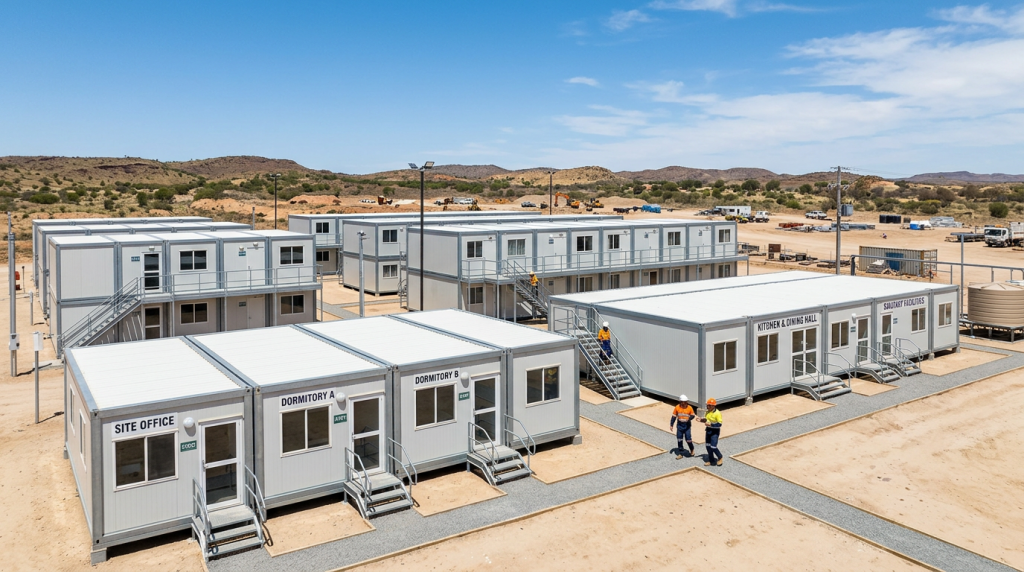
Mining sites are situated in many of the most remote and harshly inhospitable areas of the world. Industry standards for the construction of “man camps” at mining sites require transporting those camps using flat pack units over rugged terrain. Flat pack units are so simple to assemble that once they have been transported to the site, it takes minimal time to commence operations. In addition to the construction materials used, the level of comfort provided by these flat pack units, such as an ensuite bathroom and climate-controlled living quarters, is necessary to keep skilled labour in these remote areas. Because they are constructed primarily from steel, these units will be able to endure the dusty and highly impacted environments found at any active mine site.
Oil & Gas Sites
Safety and compliance are the highest priorities for the oil and gas industry. Our flat pack units can be custom built using fire-resistant materials and explosion-proof electrical components to comply with stringent safety regulations at a refinery or drilling; because these projects typically have intermittent workforces, the modular design of flat pack units offers flexibility in scaling lodging capabilities for companies as their workforce expands and contracts rapidly; in addition, the portability of flat pack units provides another benefit for “moving” drilling rigs as they must move with the camp.
Disaster Relief Housing
Immediate shelter following a natural disaster, such as an earthquake or flood, is essential, and flat-pack shelters are pre-manufactured and easily transportable. The flat pack units can be assembled by local communities or NGOs to accommodate thousands of people in a matter of days, rather than using tents, which offer limited security, have little to no privacy, and offer little to no protection from the weather. Flat-pack shelters provide a secure, hard-walled space for those affected, with the added benefit of having some sense of dignity and privacy during their long-term recovery and psychological well-being.
Refugee Camps
Finding housing options that are not only temporary but also do not include emergency housing solutions after long-term dislocation takes place is a challenge. Flat-pack units are being utilized more frequently to manage the refugee camps and to provide “transitional” housing; they provide better sanitary conditions, more insulation, and a longer life than interim housing solutions. They can be configured into organized communities, including schools, clinics, and distribution centres. ZN House collaborates with multiple agencies from around the world to produce mass-producible units at lower costs while meeting the international community’s requirements for both space and safety.
Student Dormitories
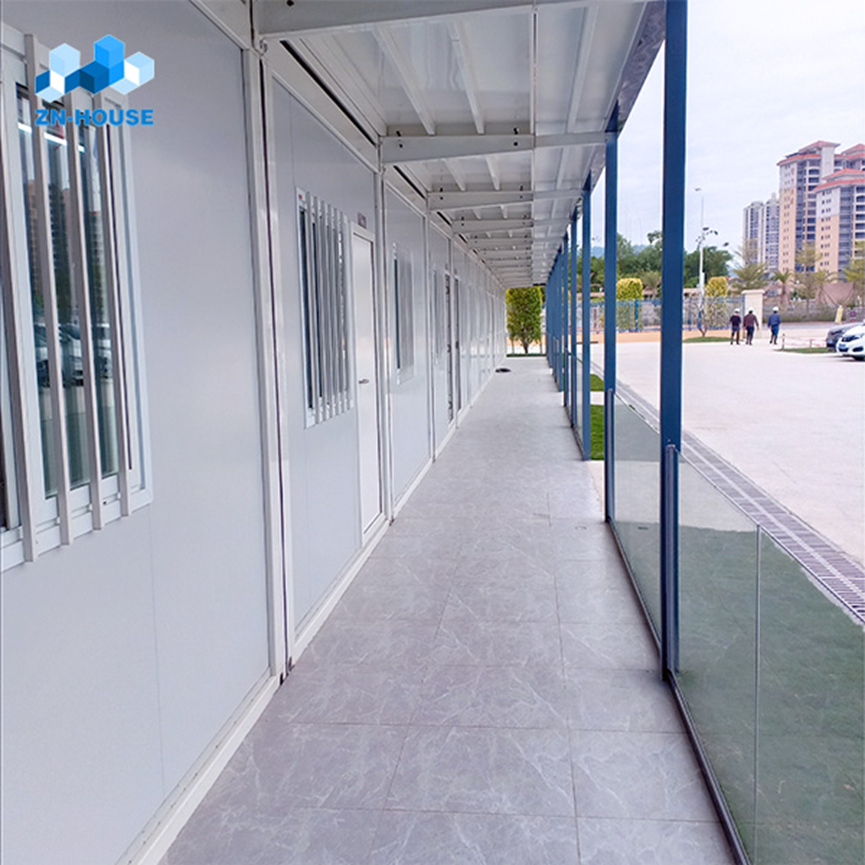
There’s no doubt that educational institutions experiencing sudden increases in enrolment or going through ease of campus renovations often look for flat pack units as options to quickly expand and create housing stock. These types of units can be completed with high-quality interior finishes, which allow for the creation of modern, comfortable student dormitories. In addition, these units can be stacked and have customizable large glass windows, as well as vibrantly painted exteriors, which will result in an aesthetically pleasing, permanent-looking solution that can be placed in one summer recess, therefore allowing the uninterrupted operation of the academic calendar.
Remote Workforce Housing
The flat pack units are a “second home” for scientists, farmers, and other researchers working on projects in remote locations like forests or rural areas. Typically, these buildings will be totally self-sufficient with built-in solar panels, water filtration systems, etc. Because of how easy it is to ship them by boat, and small trucks (or similar vehicles) to remote islands and deep forests, these flat-pack units represent by far the best quality housing option available for field-based researchers and specialist workers.
Technical Specifications
| Feature | Specification |
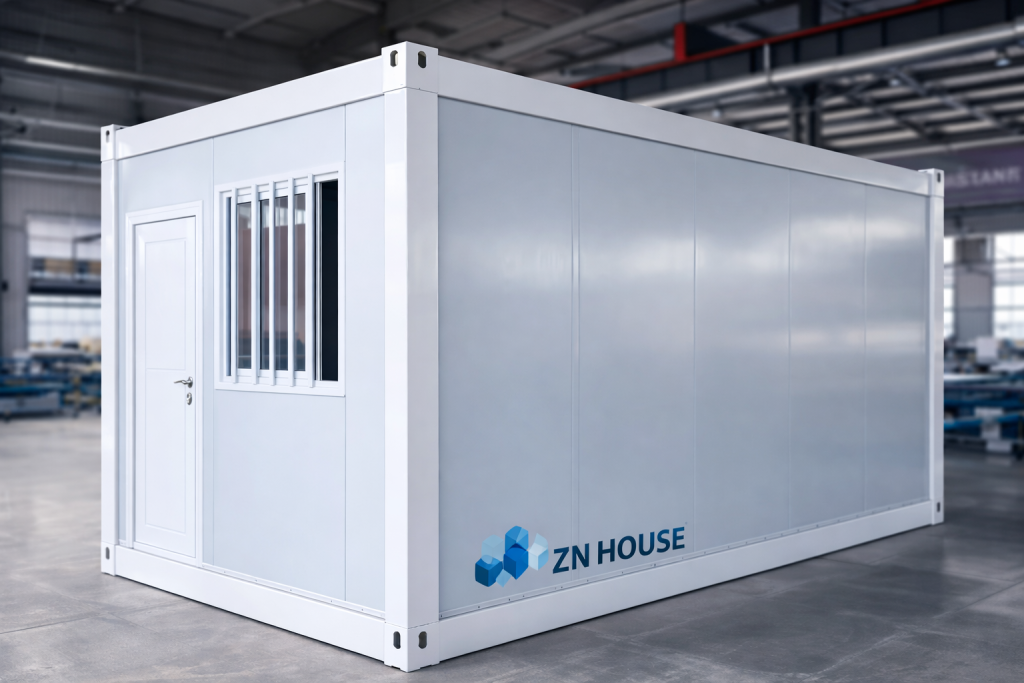
| Standard Size | 20ft (Option for 40ft custom lengths) |
| Width | 2400 mm |
| Length | 6000 mm |
| Height | 2600 mm (Internal height: approx. 2400 mm) |
| Frame | Hot-dipped galvanized steel, Q235B/Q355B |
| Wall Panel | 50mm – 100mm Sandwich Panel (Rockwool / PU / EPS) |
| Roof | Insulated system with integrated drainage and 0.5mm steel sheet |
| Floor | Fiber cement board / MGO board with PVC vinyl finishing |
| Wind Resistance | Grade 10 – 11 (up to 120 km/h) |
| Seismic Resistance | Grade 8 |
| Floor Load | 2.5 kN/m² |
| Roof Load | 1.0 kN/m² |
Modular Camp Configurations
Turnkey camp solutions are ZN House’s area of expertise. To guarantee effective land use and occupant flow, our engineering team can offer optimized layouts for a range of capacities.
80-Person Camp
Normally, elements will be made up of 20 living units (4 people each) or 40 living units (2 people each). There are two dedicated modules for doing laundry; 4 communal restroom/shower blocks; and one combined kitchen and dining area consisting of four modules for a total of about 30–35 modules altogether.
100-Person Camp
For moderately sized industrial projects. This includes a total of 50 double occupancy units, 6 shared ablution units (WC/Shower), 1 medical clinic module, 2 office modules, and a large 6-module dining hall. About 65 modules in total.
196-Person Camp
Multi-family building unit made primarily of industrial container modules with 98 double occupancy dorm rooms, 10 central shower/WC units, a large commercial kitchen, a 10-unit dining hall, a recreational area, and group office space. Total units ~125.
Customization Options
Customization on Demand is what we at ZN House are all about. We provide a wide range of modifications to satisfy particular project needs, even though our base units are standardized for efficiency:
- Interior Layout Customization: You can move partition walls to make multi-room clinics, open-plan offices, or private suites.
- Bathroom & Kitchen Integration: It is possible for units to be delivered “wet-ready” with kitchenettes, showers, toilets, and plumbing already installed.
- HVAC Systems: Options include high-volume ventilation systems, split-unit air conditioning, and heating designed specifically for arctic regions.
- Solar Energy Systems: PV panels on the roof and battery storage for off-grid uses.
- Smart Systems: Incorporating energy-monitoring sensors, high-speed data cabling, and smart locks for contemporary site offices.
- Exterior Color Options: Custom powder coating in any RAL color for camouflage in delicate settings or to match corporate branding.
Project References
Disaster Relief Camp (Southeast Asia)
After a major earthquake, ZN House supplied 500 units in less than 30 days. Over 2,000 people were given shelter by the project, which complied with all international emergency housing standards.
Refugee Camp Project (Middle East)
We provided 1,200 flatpack housing units as part of a transitional housing community. These units were built with improved thermal insulation to withstand the heat of the desert and met the durability requirements set forth by the United Nations.
Mining Camp Project (Western Australia)
A fully equipped 150-person camp with all supporting facilities: offices, laundry, and dining facilities. The entire process from order to full on-site delivery took 12 weeks, adhering to the strict Australian building codes.
Emergency Housing Project (Europe)
Quick assembly of 200 units for local government housing overflow requires stacked configurations to optimize urban area outcomes; we used high energy-efficiency standards as defined by European Union legislation.
Price & Cost Factors
Pricing of flat-pack accommodation facilities will be determined by the technical requirements of your project rather than a single fixed price per unit. Important considerations include:
Unit Size & Configuration
Because they are produced in large quantities, standard 20-foot units are the most economical, whereas custom 40-foot or extra-wide units are more expensive.
Quantity
There are significant economies of scale; large-scale procurement lowers the manufacturing cost per unit for camps with more than 100 units.
Level of Customization
High-end interior finishes, specialized electrical configurations, and premium insulation materials (like PIR/PU) will affect the final quote.
Transportation Distance
Although flat packing reduces expenses, local logistics (such as renting a crane at the site) and the final destination still play a role.
Foundation Type
The decision between basic concrete footings and a complete slab will have an impact on the overall project budget, even though these units require little ground preparation.
Local Regulations
Structural reinforcements may be necessary to comply with particular regional building codes (wind ratings, snow loads, or fire ratings).
Frequently Asked Questions (FAQS)
How long do flat-pack accommodation units last?
Our flat pack accommodation units were designed to last for 20 to 25 years with regular maintenance and under standard operating conditions. A hot-dipped galvanized steel frame provides great structural strength in coastal and humid areas due to its anti-corrosion treatment. For temporary use, they can be reused at different locations as long as they are properly disassembled and handled according to the manufacturer’s detailed engineering guidelines.
Can they be used in extreme climates?
Yes, our units are specifically designed to be deployed throughout the world. When dealing with very low temperatures, we use high-density polyurethane (PU) or rockwool insulation combined with double-glazed windows to retain heat inside the unit. For very hot climates, we use reflective roofing material in conjunction with high-efficiency HVAC systems. Also, the unit’s structural design is rated to withstand high wind speeds and heavy snowfall, which means they can be used in climates as diverse as the Siberian winter to the Saharan summer. We will determine the panel thickness and material we will use based on the climate data for the location of your project.
Are they suitable for permanent housing?
Flat pack units are often used in short-term or semi-permanent situations, but are now being used as long-term housing solutions due to their strength and ability to comply with current codes. When flat pack units are installed on a permanent foundation and finished with quality exterior cladding and interior finishes, the finished product will meet the same living conditions as a traditional home. Flat pack units offer an ideal alternative to several types of affordable housing projects, dormitories, and permanent site offices, where time and cost are the driving factors for construction.
Can units be relocated?
The key advantage of flat pack technology is that it can be relocated. Traditional buildings cannot be moved in a flat pack form and will generally require major renovations before they can be reassembled somewhere else. These units may be quickly taken down into their flat pack form and shipped to a new location with all of their parts intact; this method saves time by allowing the unit to be reused in its entirety at the next location. However, if the distance between the new and old location is not too great, the unit can simply be lifted with a crane and placed on a flatbed truck. This means that flat pack systems are ideal for industries that have moving operational centres, such as the mining or construction industries, where the location of operations changes every few years.
How many units fit in one shipping container?
A significant feature of our design is the logistical efficiency. Our standard 20ft units can have 4 “flat”, or 2D, units contained within the same external footprint as a standard ISO container and therefore contain 4 flat pack units within a single 20ft shipping container. All but a few of our international customers ship in 40ft High Cube (HC) containers. Generally, a 40ft HC container will hold six to eight 20ft flat pack units, depending on the internal layout of the units and the inclusion of any additional (furniture) or (wet) modules. This is quite a considerable savings in ocean freight transportation costs.
Do you provide installation support?
ZN House provides constant support to make sure your project goes well. For every one of your projects, we supply all the documentation necessary – giving you a detailed assembly manual, video tutorial, and set of technical drawings. For large projects or for clients who have not constructed using modular construction before, we can provide a team of technical supervisors on-site to supervise the local workforce and ensure that the units are assembled in accordance with the engineering specifications. Additionally, we offer “turnkey” service in select regions where our certified partners will handle the entire process, from preparing the ground to connecting the utilities.
Ready To Scale Your Project?
Flat Pack accommodation is the quickest, strongest, and most cost-effective option for providing housing for people in any type of environment. With ZN House’s factory prefabrication and flat-pack shipping, we combine both speed with flat-pack shipping to provide you with an alternative to conventional building. ZN House has a demonstrated history of providing large-scale modular camps for the most stringent industries throughout the world.
Don’t let construction delays and logistical hurdles slow your progress. Choose ZN House, which possesses the expertise to deliver quality on a large scale.
Similar Posts
The Evolution of Prefab Steel Container Housing
Modern construction is evolving. For a long time, brick and mortar were the only options for…
How Rock Wool Insulation Impacts the Temperature of Container Mining Camps
Container rock wool insulation plays a vital role in container mining camps in stabilizing and keeping…
Transforming Modern Living with Innovative Flat Pack Homes
The architectural industry continues to evolve with groundbreaking solutions that challenge conventional construction methodologies through advanced flat…
Beyond the Box: Key Modular House Design Trends—Open Concept, Multi-Unit, and Sustainability
According to Forbes, modular housing can reduce construction times by up to 50 per cent, costs…

Flat Pack Tiny Homes Portable Comfort
In the ever – changing housing landscape, flat pack house, flat pack container house, and flat…


