



Folding Container House Structural Integrity Testing
The global demand for versatile, rapidly deployable, and robust housing solutions has surged, driven by needs ranging from disaster relief and remote workforce accommodation to cost-effective temporary structures and innovative permanent dwellings. At the forefront of this evolution are innovative designs like folding container house, foldable container house, and fold out container homes, which promise unparalleled portability and speed of assembly. However, the very feature that makes them revolutionary – their ability to fold and unfold – introduces unique structural challenges. Ensuring these structures can withstand environmental loads, repeated deployment cycles, and long-term habitation demands rigorous structural integrity testing. ZN House, a pioneer founded in Suzhou in 2005, entered the market with a mission to fill the gap for high-quality, high-safety container houses. Driven by the purpose “Building Mobile Homes For The World,” ZN House leverages years of global trade experience, exporting its custom solutions to over 50 countries through a network of more than 30 international agents. As a professional manufacturer operating at scale, ZN House understands that the reliability of its folding container house designs hinges on comprehensive structural validation protocols, ensuring safety and longevity for diverse applications worldwide.
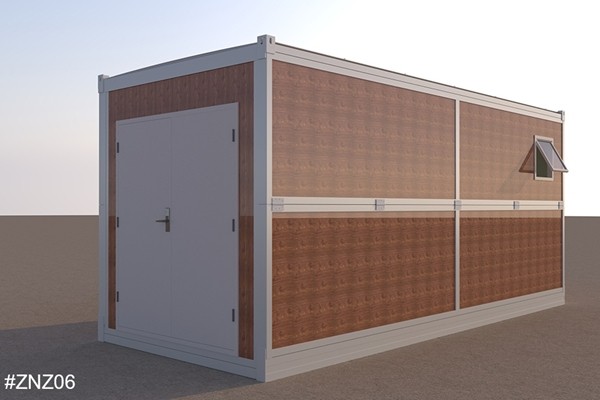
Critical Structural Testing Protocols for Folding Container House Designs
The core challenge of a folding container house lies in its dynamic elements – hinges, locking mechanisms, and foldable wall/floor/roof panels. Structural integrity testing must simulate real-world stresses far beyond static loads. ZN House subjects prototypes and production samples to extensive cyclic loading tests, repeatedly folding and unfolding the unit hundreds or thousands of times while monitoring for metal fatigue, hinge wear, deformation in panels, and integrity of welded or bolted joints. Simultaneously, static load tests assess the structure’s capacity when fully deployed, applying forces equivalent to heavy snow accumulation, high wind pressures (uplift and lateral), and realistic live loads (occupants, furniture). Finite Element Analysis (FEA) software complements physical testing, modeling stress distribution across the entire structure during folding, transport, deployment, and under various load scenarios to identify and reinforce potential weak points inherent in the folding mechanism.
Material and Design Innovations Enhancing Foldable Container House Resilience
The inherent strength of a foldable container house starts with material selection and intelligent engineering. ZN House utilizes high-tensile corten steel or specially treated weathering steel for the primary frame and folding mechanisms, chosen for its superior strength-to-weight ratio and corrosion resistance. Critical hinge points employ hardened steel alloys and oversized bearings, designed to distribute forces evenly and withstand repeated articulation without failure. The foldable panels themselves are engineered composites, often combining a structural steel frame with insulated sandwich panels (featuring steel skins and fire-retardant cores like rockwool or PIR). This construction ensures panels remain rigid when deployed yet can flex slightly during folding without cracking. ZN House’s commitment to “high-quality, high-safety” means every foldable container house design undergoes material certification testing (yield strength, impact resistance, corrosion resistance) and full-scale prototype testing before mass production.
Verifying Weather and Environmental Resistance in Fold Out Container Homes
A fold out container home must offer the same protection and durability as a conventional building once assembled. Structural integrity testing extends to environmental performance. Units undergo rigorous water ingress testing (simulating wind-driven rain) on all seams, joints, and especially around folding mechanisms to ensure no leaks compromise the interior or cause corrosion. Accelerated weathering tests expose materials to intense UV radiation, humidity cycling, and salt spray (for coastal applications) to assess long-term resistance to fading, degradation, and rust. Thermal cycling tests evaluate how repeated expansion and contraction from temperature extremes affect the folding mechanisms, seals, and panel integrity. Air permeability testing ensures the structure maintains energy efficiency. ZN House’s global experience, supplying diverse climates, informs these stringent environmental test standards, ensuring their fold out container homes perform reliably whether in arid deserts, humid tropics, or freezing mountains.
FAQs About Foldable Container House
How does transporting a folding container house impact its structure, and how is this tested?
Transport induces vibrations, impacts, and dynamic loads. ZN House conducts vibration testing on shaker tables simulating road transport conditions and drop tests on critical corners/edges. Units are also transported over test tracks to validate real-world resilience before shipping to clients.
What materials are used in the folding mechanisms of a foldable container house to prevent failure?
High-strength, low-alloy steels and hardened steel pins/bearings are standard. Critical hinges undergo specific heat treatment and are oversized for the load. Corrosion-resistant coatings or stainless steel components are used in high-wear areas, validated through salt spray and cyclic fatigue testing.
Can a fold out container homes withstand extreme weather like hurricanes or heavy snow?
Yes, when designed and tested accordingly. ZN House designs to specific regional building codes (e.g., wind speed maps, snow load requirements) and subjects units to static and cyclic load testing that exceeds these standards, ensuring structural integrity under extreme conditions.
Does the folding/unfolding process weaken the structure of a folding container house over time?
Properly engineered and tested systems are designed for hundreds of deployment cycles without significant degradation. Cyclic testing explicitly measures performance over repeated use, ensuring hinges, panels, and locking systems maintain integrity well beyond the expected operational lifespan.
How does structural testing differ for a permanent fold out container homes versus a temporary one?
Permanent installations typically require adherence to stricter, long-term building codes (e.g., seismic design, higher live load factors, enhanced corrosion protection). Testing protocols are thus more extensive, including long-term fatigue analysis, seismic simulation (if applicable), and more rigorous environmental exposure testing compared to temporary structures designed for shorter lifespans.
Structural integrity is the non-negotiable foundation upon which the promise of folding container house, foldable container house, and fold out container homes rests. The ability to collapse for transport and rapidly deploy into habitable spaces demands engineering solutions rigorously validated through comprehensive testing. ZN House, leveraging nearly two decades of expertise and a global perspective gained from exporting to over 50 countries, has embedded this commitment to structural safety into its core. From exhaustive cyclic and static load testing on prototypes to stringent in-process quality control and final functional checks on every mass-produced unit, ZN House ensures that its innovative folding designs deliver not just convenience and speed, but the unwavering strength and durability required for safe, reliable, and long-lasting mobile housing solutions worldwide.
Similar Posts
Efficiency of Flat Pack Modular Buildings in Site Organization
The rise of flat pack modular buildings has transformed how construction sites manage space, logistics, and timelines….
Customizable Designs in Pre Built Houses for Sale
In the vibrant world of real estate, pre built houses for sale are winning hearts with their…
Flat Pack Homes Price Guide: Affordable Housing Solutions
The demand for cost-effective, sustainable housing has made flat pack homes for sale a popular choice worldwide. These flat…
Upcycling Shipping Containers into Modern Homes
The rise of modular container homes for sale marks a transformative shift in sustainable architecture. By repurposing…
High-Grade Factory Direct Fabricated Homes for Sale Wholesale
The construction industry is undergoing a transformation with the rise of Pre Fab Houses for Sale, offering…
Tiny Home Flat Pack: The Future of Compact and Efficient Living
As more people seek affordable, sustainable, and flexible housing solutions, the concept of tiny home flat…


