



Foundation Options for a Modular Container House
The rise of prefabricated and sustainable construction has positioned modular units as a leading solution for diverse building needs, from residential dwellings to commercial establishments. At the heart of any successful permanent installation lies a critical, yet often overlooked, component: the foundation. Selecting the appropriate base is paramount for ensuring the longevity, stability, and safety of the structure. For enterprises and large-scale projects seeking reliable and innovative building solutions, understanding these foundational options is the first step toward a successful build. Since its inception in 2005 in Suzhou, ZN House has been at the forefront of this industry, driven by a mission to fill the market gap for high-quality, high-safety container-based structures. As a professional container manufacturer with years of global trade experience, its products are exported to over 50 countries, supported by a robust network of international agents. This article will explore the essential foundation systems suitable for permanent installations, detailing how the right choice supports the integrity of your project.
Choosing the Right Base for Your Permanent Modular Container House Installation

A permanent foundation transforms a mobile unit into a steadfast building, integrating it seamlessly with the land. For a modular container house intended for long-term use, the foundation must bear the load consistently and resist environmental pressures like frost heave or soil settlement. ZN House, beginning with modular houses in 2005, provides high-quality structures designed for such permanence. The choice of foundation depends heavily on soil analysis, local climate, and building codes.
- Concrete Slab Foundation: This is a prevalent and robust option for a permanent modular container house. A reinforced concrete pad is poured directly on-site, creating a solid, level base that distributes the weight evenly. It is highly durable and integrates well with plumbing and electrical conduits if planned during the pour.
- Strip Footings: Similar to traditional home foundations, this system involves pouring concrete strips to support the load-bearing walls of the structure. This method is cost-effective and suitable for stable soil conditions, providing a strong perimeter support frame for the container.
- Pile Foundation: In areas with challenging soil, such as loose sand or high clay content, pile foundations are ideal. Steel or concrete piles are driven deep into the ground until they reach a stable soil layer or bedrock, offering unparalleled support and minimizing the risk of settling for a heavy-duty modular container house.
Engineered Foundations for Dynamic and Expanding Structures of expandable modular house
Some projects are designed with future growth in mind, requiring a foundation that can accommodate expansion without compromising the existing structure. ZN House is dedicated to providing custom container home solutions, including designs that can evolve. The foundation for an expandable modular house must be planned with the same foresight as the building itself, anticipating the points where additional modules will be connected.
- Modular Pier Foundation: This system is highly adaptable for an expandable modular house. It consists of individual concrete piers or blocks placed at the corners and key points along the containers. Its primary advantage is the ease with which new piers can be added to support new modules, making the expansion process more straightforward and less disruptive.
- Grade Beam and Pier System: Combining the strength of continuous concrete beams with the flexibility of piers, this foundation provides excellent support for the long sides of the containers. When planning for expansion, the grade beams can be extended, and additional piers installed, creating a seamless and integrated base for the growing expandable modular house complex.
Robust Support Systems for Multi-Unit Crate Modular Home Projects
For large-scale applications like worker dormitories, hotel complexes, or multi-unit residential projects, the foundational requirements become more complex. These crate modular homes are often combined to create larger structures, and their foundation must ensure every unit is perfectly aligned and supported. The collective weight and interconnected nature demand an engineered, unified foundation solution.
- Raft Foundation: Also known as a mat foundation, this is a single, large-scale concrete slab that supports the entire arrangement of crate modular homes. It is particularly beneficial on sites with low soil bearing capacity, as it distributes the immense load over a vast area, preventing differential settlement.
- Combined Pier and Beam Grid: For the most extensive projects involving numerous crate modular homes, a grid system of interconnected concrete beams on piers offers maximum stability. This creates a rigid platform that can handle dynamic loads and ensures that all interconnected units move uniformly, if at all, preserving the integrity of the entire structure.
FAQs About Modular Container Houses
What are the primary advantages of choosing a ZN House modular container house for a large-scale project?
Our modular container house is popular with big users due to its efficiency and quality. Built with an anti-rust galvanized steel frame, glass, and waterproof sandwich panel material, it offers durability and excellent insulation. They can be designed and built according to the requirements of the construction site, and their interior decoration can also be done according to personal preferences. Furthermore, you can combine two or three container houses to create a hotel, dormitory, or coffee store, offering tremendous flexibility for developers.
How does the foundation preparation differ for an expandable modular house compared to a standard model?
The key difference is foresight in engineering. While a standard permanent foundation is designed for a fixed footprint, the foundation for an expandable modular house must be planned from the outset to include connection points and support for future modules. Systems like modular piers or extendable grade beams are used so that when expansion occurs, the new foundation sections can be tied into the existing one efficiently, ensuring structural continuity.
Can your crate modular homes be installed on a simple concrete block foundation?
For small, single-unit, non-permanent applications, concrete blocks might suffice. However, for any permanent, multi-unit, or large-scale installation of crate modular homes, a professionally engineered foundation is non-negotiable. Simple blocks are prone to shifting and settling, which can compromise the structural integrity of the entire building system. We strongly recommend poured concrete slabs, strip footings, or pile foundations for all permanent projects to guarantee safety and longevity.
What materials are used to ensure the longevity of your structures, especially the expandable modular house?
Our expandable modular houses are characterized by their robust construction, utilizing high-quality corten steel or corrosion-resistant materials that withstand the test of time and extreme weather conditions. The frames, walls, and roofing are all engineered for maximum durability, ensuring that even as the structure expands, every new module meets the same high standard of quality and resilience.
What is the typical delivery and assembly process for a ZN House modular container house?
We streamline the process for efficiency. Our modular container house units are manufactured in our controlled factory environment to ensure consistent quality. We will ship them out with the assembled roof and floor, and your workers just need to assemble the house with the provided accessories on the prepared foundation. This method significantly reduces on-site construction time, labor costs, and material waste, allowing for a faster project turnaround.
Selecting the correct foundation is a fundamental decision that directly impacts the performance, safety, and lifespan of any modular building project. From a simple concrete slab for a single-unit modular container house to a complex raft foundation for a vast complex of crate modular homes, the principle remains the same: a strong, stable, and appropriately engineered base is indispensable. ZN House, with its team-driven collaborative approach and dedication to innovation since 2005, provides the high-quality building blocks. By combining these robust structures—built with anti-rust galvanized steel, corten steel, and waterproof panels—with a well-planned foundation, clients across industries can achieve durable, safe, and customizable solutions that are built to last, truly “Building Mobile Homes for the World.”
Similar Posts
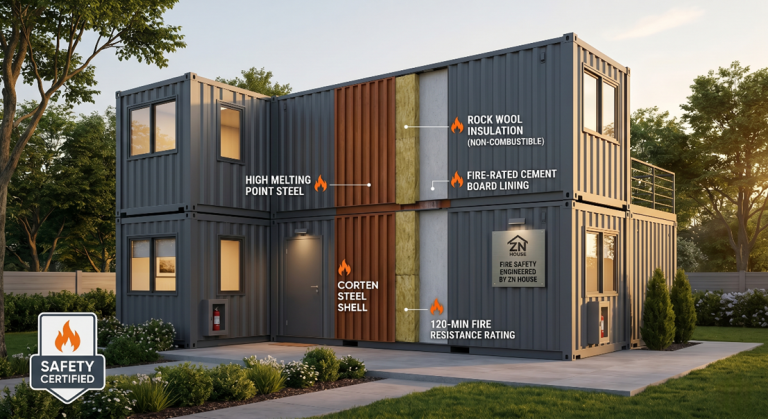
Are Container Homes Fireproof? Everything You Need to Know
Container houses have been a good alternative to buy a new house recently. These have become…

The Future of Affordable and Sustainable Housing: Shipping Container Homes
In a world where sustainability and affordability are becoming increasingly important, shipping container houses are making waves…
Creative interior design ideas for maximizing space in a shipping container house
The global shift towards sustainable, efficient, and innovative living solutions has propelled the popularity of shipping container…
The Nomad’s Dream: Portable Flat Pack House for Digital Wanderers
In a world where digital nomadism is on the rise, the need for flexible, sustainable, and…
Reliable Container Homes Manufacturer Solutions
In recent years, the demand for affordable and flexible housing has grown rapidly worldwide. A container…

Shipping Container House Foundation Types Needed
The rise of prefabricated housing has revolutionized modern construction, with shipping container house designs leading the charge in…


