



How to Build a Shipping Container Office: The Complete Guide to Structural Integrity and Insulation
With the current state of remote working and efficiency, the conventional office building type is being replaced by a more flexible alternative: the shipping container. Shipping container offices give business owners, contractors, and startups a combination of both industrial strength and modern architecture.
ZN House has been a leader in the modular steel construction industry for years. In this guide, we will take a detailed look at how container offices can serve as an innovative workspace solution and how to insulate them correctly to provide the user with comfort and long-term integrity of the container itself.
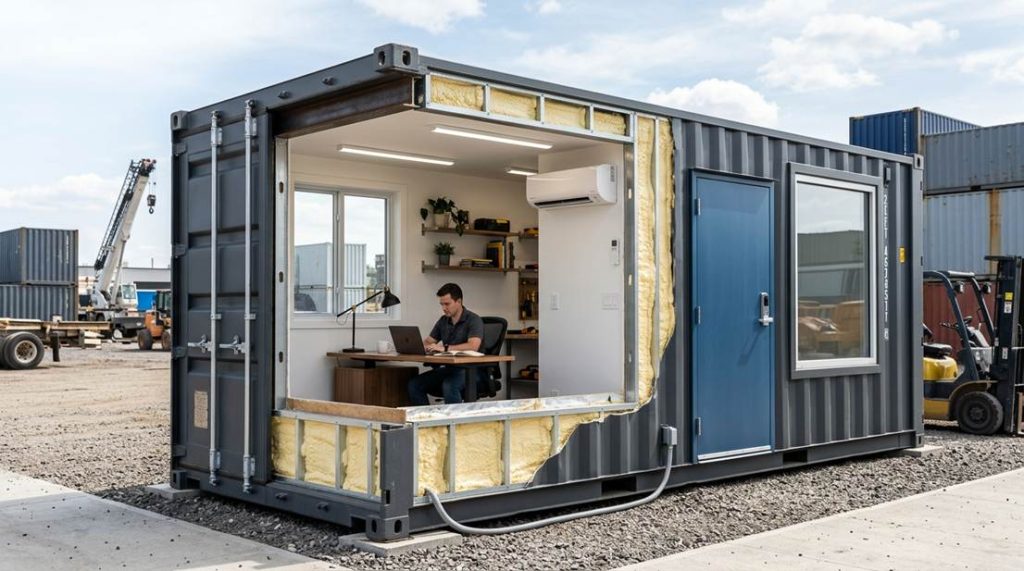
Why Build a Shipping Container Office?
The growing use of mobile container offices is no longer just a trend; it is part of a larger strategic business decision based on five key factors:
Cost-Effectiveness
Mobile container offices provide a cost-effective solution for your workspace, as the overall cost of building a container office is much less expensive than traditional construction or renting commercial space for long-term leases.
Portability and Flexibility
Mobile container offices are very portable and can be moved from one location to another, whether it’s for a construction site or temporary headquarters for a specific project.
Highly Customizable
Mobile container offices can be customized to suit your company’s needs; from the type of heating/cooling systems you use to the type of layout you desire.
Durability and Security
Mobile container offices are constructed from heavy-duty, corrugated steel, which provides unmatched protection against weather conditions and theft for your organization’s high-value equipment.
Eco-Friendly
Because mobile container offices utilize repurposed, high-quality steel structures, you can significantly reduce the amount of waste you create during the construction process and reduce your carbon footprint.
In addition, most companies can expect to move their mobile container offices from the design stage to being ready to use in as few as a few weeks.
Container Office Basics: Sizes, Types & Use Cases
You need to choose the right “bones” for your DIY container office project before you start.
Standard Container Office Sizes
10ft Container Office: Great for a small gatehouse or a workspace for one person.
20ft Container Office: This is the “Goldilocks” size that is best for small teams and site offices.
40ft Container Office: Great for departments with more than one person, meeting rooms, or executive suites with walls.
New vs. Used Units
| Feature | New Container Office | Used Container Office |
| Lifespan | 25+ Years | 10–15 Years |
| Cost | Higher upfront investment | Budget-friendly |
| Condition | Pristine, no chemical history | Requires inspection for rust/dents |
Common Container Office Applications
A shipping container office can be used in many different ways in many different fields. People often use it as an office on a construction site because it gives contractors and engineers a safe, weatherproof place to work near where they are working. A lot of businesses also use temporary container offices for short-term work, events, or seasonal work. As more people work from home, there has been an increase in the use of backyard container offices as inexpensive and private places to run a business or work from home. A mobile container office provides a consistent and functional workspace, allowing teams to move around to various locations without having to enter into a long-term lease. As such, they are a very popular choice among small businesses and start-ups because they are inexpensive and easy to set up.
How to Build a Container Office (Step-by-Step)
Design & Planning
Success begins on paper (or CAD). Set up your workflow: Where are the desks going to go? Do you need a rack for your dedicated server? Before cutting the first piece of steel, make a plan for your lighting and electrical outlets.
Choosing Your ZN House Quality Unit
When choosing a unit, make sure it is structurally sound. ZN House puts a lot of emphasis on the condition of the floor and the high-tensile steel. Check for “daylighting” (holes in the roof) and make sure the corner castings are still in good shape.
Modifying Doors & Windows
It is vital to have natural light when doing work. When you cut holes in steel to put in windows, the steel’s structural integrity is momentarily compromised. As a general rule, be sure to weld a steel frame (C-channel or box section) around any opening to support the wall’s integrity and allow it to carry more weight.
Container Office Insulation & Flooring
This is when “how to insulate a shipping container house” becomes very important for how well the office works.
Why Insulation Matters: Steel construction makes shipping containers good at moving heat quickly. Without the right insulation:
- The temperature inside changes a lot.
- Condensation causes mold and rust.
- The costs for energy go up a lot.
ZN House Insulation Approach: ZN House usually uses, based on real projects:
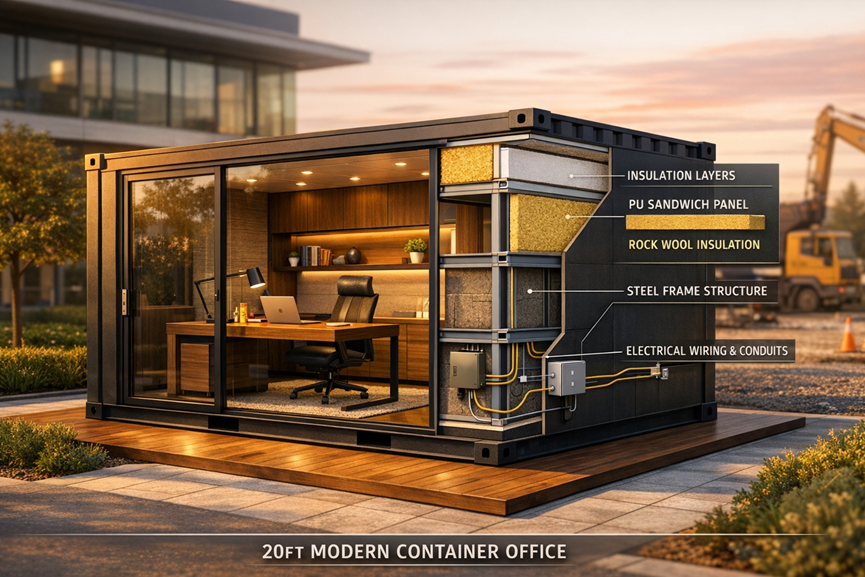
- Rock wool insulation panels are fireproof and cost-effective.
- PU sandwich panels (very good at keeping heat in)
- Vapor barriers to stop condensation
Insulation Options Comparison:
| Material | Performance | Best Use |
| Spray foam | Excellent sealing | Premium builds |
| Rock wool | Fire-resistant, affordable | Standard offices |
| PU panels | High insulation efficiency | Prefab modular offices |
Flooring Options:
- Plywood (affordable)
- OSB board (long-lasting base layer)
- Vinyl flooring (with a professional finish)
Electrical & HVAC for Your Container Office
The inside of an office should be comfortable and conducive to a productive office environment through appropriate electrical wiring & outlets; efficient LED lighting systems; & an HVAC or split A/C for temperature regulation.
Expert Tip: ZN House has built-in conduits that are installed in the factory, which lowers the risks of installation on-site.
Interior Setup for a Functional Container Office
Make the most of your space by using:
- Furniture that comes in parts
- Storage that goes on the wall
- Desks that can be folded
When moving mobile container offices, make sure all of the equipment is securely fastened so it doesn’t move.
Building a Container Office on a Budget (Real Case Study)
Real Container Office Example
- 20ft used container office
- Build time: 6–8 weeks
- Total cost: approx. $6,000–$10,000 (adjusted for inflation)
Container Office Cost Breakdown
| Item | Approach | Estimated Cost (USD) |
| Container | Used | $1,500 – $3,000 |
| Doors & Windows | Custom cut | $300 – $800 |
| Insulation | Foam / Rock wool | $200 – $600 |
| Electrical | Basic wiring | $200 – $800 |
| Flooring | OSB / Plywood | $150 – $400 |
| Furniture | DIY / Modular | $300 – $1,000 |
Tips to Reduce Container Office Costs
- Use reclaimed materials
- DIY non-technical tasks
- Plan purchases early
- Avoid over-customization
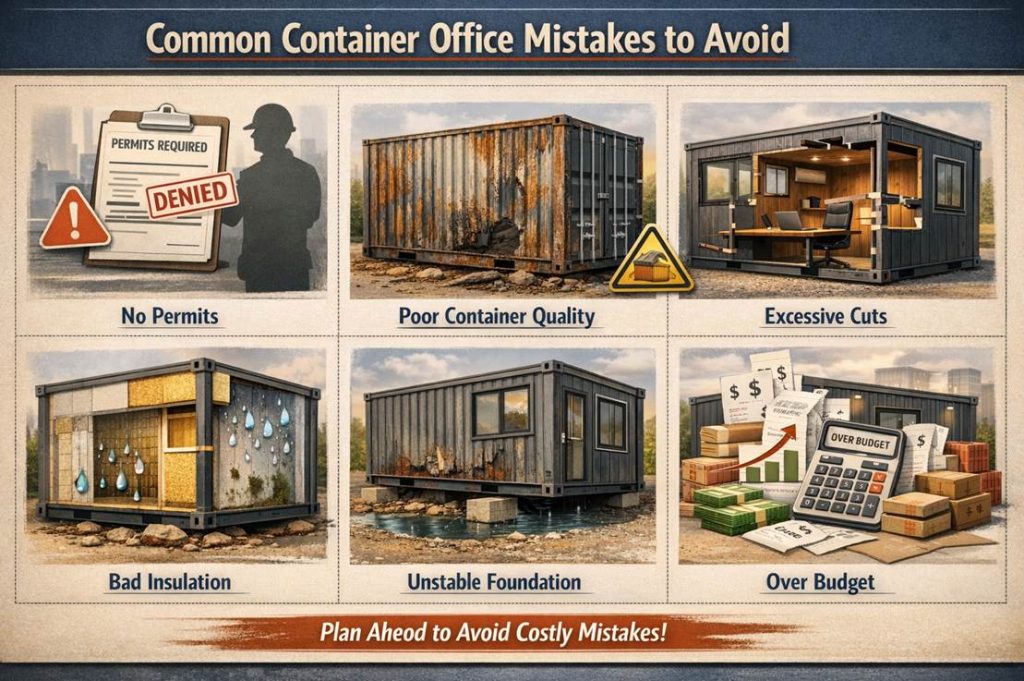
Common Container Office Mistakes to Avoid
Ignoring Local Permits
Many people who build for the first time don’t realize they need local permits. This can result in fines, delays, or the container office being taken down. Before you start working, always check that you have the right zoning, electrical approvals, and installation requirements.
Buying Low‑Quality Containers
If you pick a container that is broken or badly corroded, the whole project could be ruined. Check the unit carefully for rust, dents, damage to the floor, and chemical residues to make sure it will last a long time.
Over‑Cutting Structural Steel
If you cut too many holes for windows and doors without adding support, the frame of the container will be weaker. To keep strength and safety, every cut must be supported by welded steel framing.
Poor Insulation Leading to Condensation
Insufficient insulation is perhaps one of the biggest problems leading to mold, moisture, and subpar indoor comfort. Good insulators (spray foam and rock fiber as examples) are necessary for year-round usage.
Weak Foundation Setup
Putting a container directly on ground that isn’t level or stable can cause it to shift, water to pool, and long-term structural problems. A simple but strong base, like concrete blocks, piers, or a slab, makes sure that it will last.
Underestimating Total Container Office Costs
Many builders think that container offices are always cheap, but adding insulation, electrical work, and customization can make them more expensive. Making a realistic budget helps you avoid costs and delays that come up out of the blue.
Pros and Cons of a Shipping Container Office
| Pros | Cons |
| Lower cost than traditional buildings | Limited space |
| Portable and flexible | Requires insulation |
| Fast construction time | Some professional work is required. |
| Eco-friendly reuse | Used units may need treatment |
When you need speed, mobility, and a good return on a small footprint, a container office is the best choice. If you need a lot of open space, complicated accessibility needs, or a very customized permanent building from the start, it’s not as good. The main trade-off is that you need to plan and do the technical work correctly if you want to pay less up front.
Read this article to know the way of Maximizing Workplace Efficiency with a Modular Container Office.
Container Office FAQs
How long does it take to build a container office?
Depending on how much customization is needed, most projects take 2 to 8 weeks.
Do I need permits for a container office?
Yes, most places need permits for electrical work and installation.
How long does a shipping container office last?
A unit that is well cared for usually lasts between 15 and 25 years.
Can I build a DIY container office myself?
Yes, but professionals should do things like cutting steel and working with electricity.
Is a used container safe for a container office?
Yes, but it needs to be checked for rust, damage, and chemical residues first.
Can a container office be expanded later?
Yes, you can always add more modules or containers.
Conclusion: Is a Container Office Right for You?
If you appreciate a fast, secure, and environmentally friendly option, then shipping containers will work well for your needs. You can convert a raw metal cube into an effective, commercial facility by learning about how to insulate shipping containers. Start with ZN House Today
Are you ready to make your work area better?
Check out our selection of high-quality manufactured units at ZN House.
Similar Posts

Shipping Container House for Sale Size Options
In the booming market of alternative housing solutions, shipping container house for sale options have emerged as a…
Why is the Easy Assemble House the Best Choice for Quick Projects?
The construction sector nowadays is under growing pressure to come up with buildings that are not…
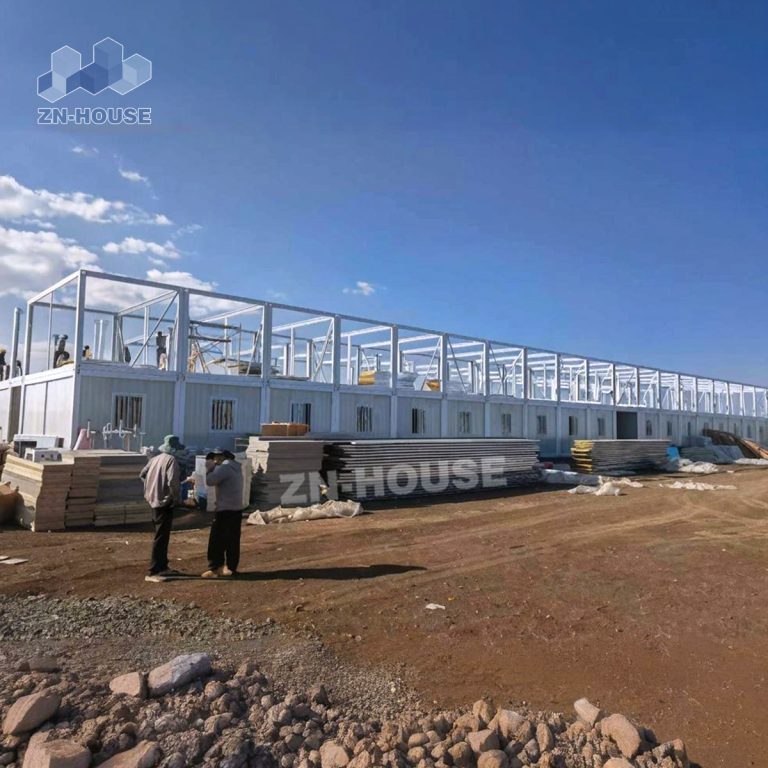
EPC Project Camp Construction — Practical Implementation of a Container-Based Approach
In outdoor Container Camps for EPC such as infrastructure, new energy, and mining, the efficiency and…
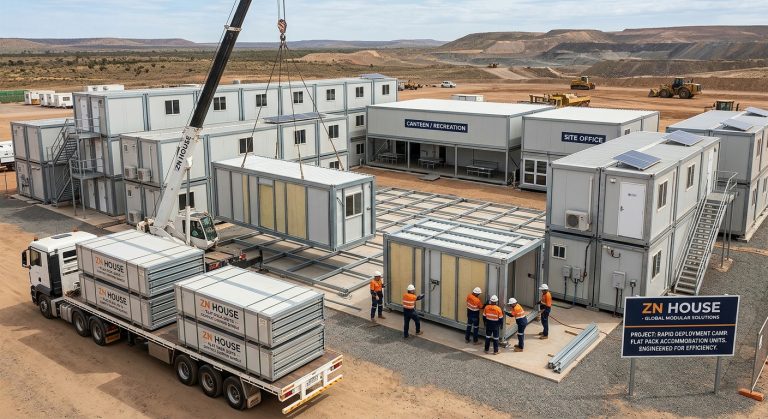
Flat Pack Accommodation Units – Modular Living Solutions for Every Project
The demand for rapid, high-quality, and scalable housing options is increasing day by day. Flat pack…
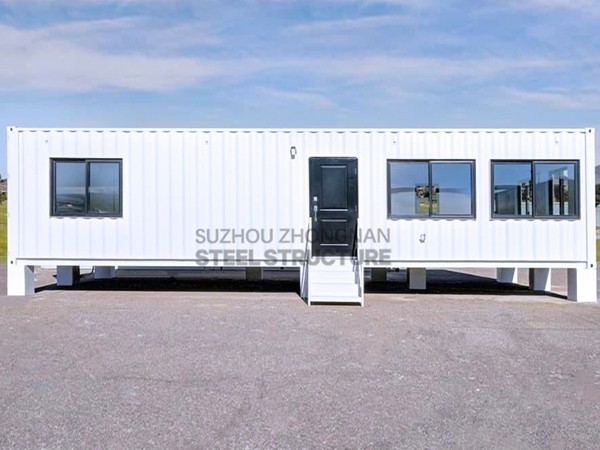
Quickly Build 20FT Container House
A 20 feet container house is a very desirable type of housing that can be constructed…

Prefab vs Modular Container Homes: Which Is Best for You?
Introduction – Why Container Homes Are Trending Container houses have rapidly gained popularity as a modern…


