



How To Convert a Shipping Container into an Office
An office created using an enclosed metal recycling system from original shipping vessels provides an environmentally safe working environment. Offices built from recycled shipping containers are generally located in factories where all of the modifications in terms of size, door and window systems, electrical systems and insulation have been completed before being shipped. Due to their flexibility, sturdy construction, ease of transportation and much lower cost in comparison with traditional brick and mortar offices for the same amount of usable square footage, shipping container office structures continue to become popular. With the increasing number of companies, site managers and telecommuters looking for quick construction, modular construction and a workspace that can be added to, repositioned or adapted to meet new requirements, many are utilizing containers as their primary means of providing their workspace.
Introduction: Why Container Offices Are Growing
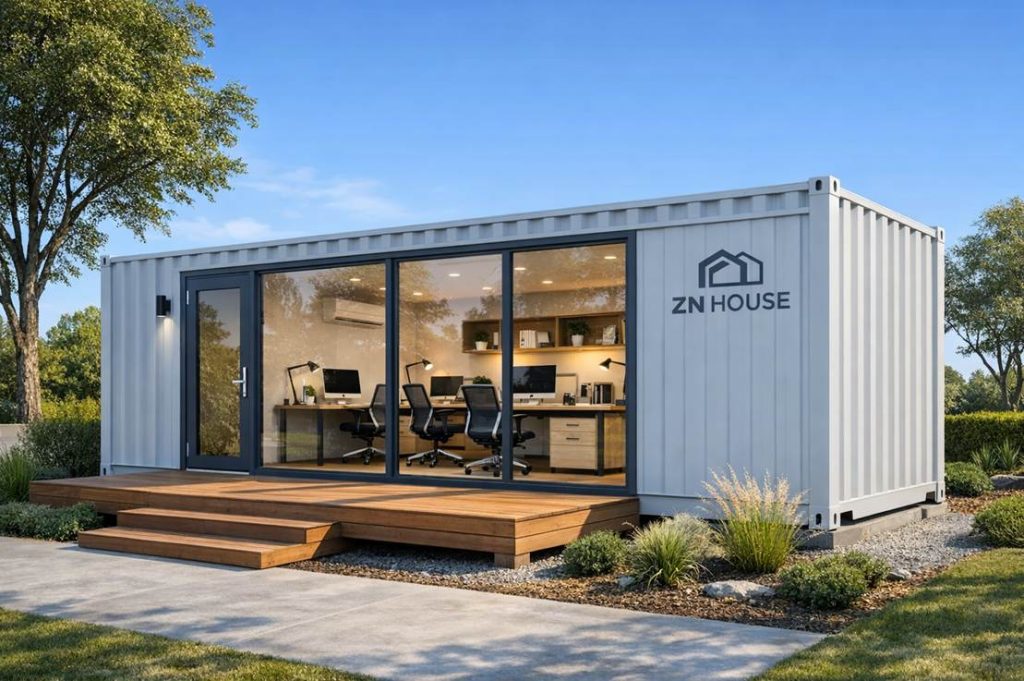
Shipping container offices are offices made from shipping containers that have been transformed into a fully fitted out, insulated, lit, air conditioned & decorated office with all the necessary features for an office. The main advantage of shipping containers is that they have been designed to withstand harsh environments (marine) and heavy weight, so they provide a very strong, durable shell that will last far longer than many temporary site buildings.
Businesses choose to convert containers into offices because:
- They are cost-effective compared to traditional building methods especially when an urgent or short-term need for space arises;
- They are very durable, secure and robust because they are made entirely of steel, they have a corrosion-resistant coating; and,
- They can be relocated so that when your project/operations move, you can relocate the office.
A shipping container office can be used as a home office, construction site office, commercial showroom, sales office or on-site management space, providing companies with the option of having a flexible modular workplace that fits with the new trend for flexible workspace solutions.
Why Choose a Shipping Container for Your Office
Decor and function aren't the only reasons for choosing a shipping container for your office; it also provides superior structural integrity. Here are some reasons why you should choose a shipping container house:
Cost‑Effective Workspace
Compared to traditional office space, purchasing and modifying a shipping container typically is less expensive and quicker, especially for smaller and/or mid-sized office spaces. Since the structure is built with metal (existing on a shipping container), the amount of building material, labor, and onsite time needed is significantly reduced. Many of the items necessary to complete the structure, such as framing, electrical, insulation, and finishing work, may be completed before delivery through factory prefabrication. Lower costs and disruption to the site result from this method of construction.
Durable and Weather‑Resistant
The design and construction of standard shipping containers are optimized for use in ocean shipping, stacking, and exposure to severe climate and physical impact forces during transit and at the destination, which gives the structure strength that is superior compared to typical modular structures made with thinner, galvanized frame material. The use of higher-strength Q235B steel (around 6mm) as the ground frame for ZN House container offices is one example of how much stronger a container will be than lightweight modular buildings. The welded shell construction of the container and the use of corrosion-resistant coatings on the exterior surfaces help protect the interior from wind, rain, snow, and UV rays for many decades, when properly maintained.
Eco‑Friendly and Resource-Efficient
Using shipping containers as a converted office maximizes the use of existing steel structures while decreasing the amount of construction waste generated from needed new building materials. In addition, once a container office reaches its end of life, steel is easily recyclable contributing to the alignment of container offices with sustainable building practices and the circular economy. When insulated well with good windows and HVAC systems, container offices can drastically reduce their operational energy usage in comparison to traditional, outdated single-use buildings (built without sufficient insulation).
Highly Customizable
Container office designs can use internal separators or walls, various layouts including a large glass frontage, staircases, or fixture add-on systems for the interior. Since ZN House manufactures both 20-foot and 40-foot units, they can be combined and stacked up to three levels high, allowing for the design of reception areas, meeting rooms, open-plan workstations, or executive offices inside modular volumes. Your source of interior finishes will include a variety of different materials, such as Rock wool sandwich wall panels, cement fiberboard floors, custom lighting fixtures, and wires integrated into all of your finishes creating a professional and comfortable workplace rather than just an industrial box.
Mobile and Flexible
Since shipping containers have a fixed international size and standard lift points, they can be moved using trucks, cranes, or forklifts, and reinstalled at different sites. ZN House emphasizes mobility; therefore, container offices can, at various stages of a project or firm, be moved from site to site; however, since container offices are modular in design, there is the ability to expand in the future so that additional containers can be added (either horizontally or vertically) and additional space created with a minimum of interruption.
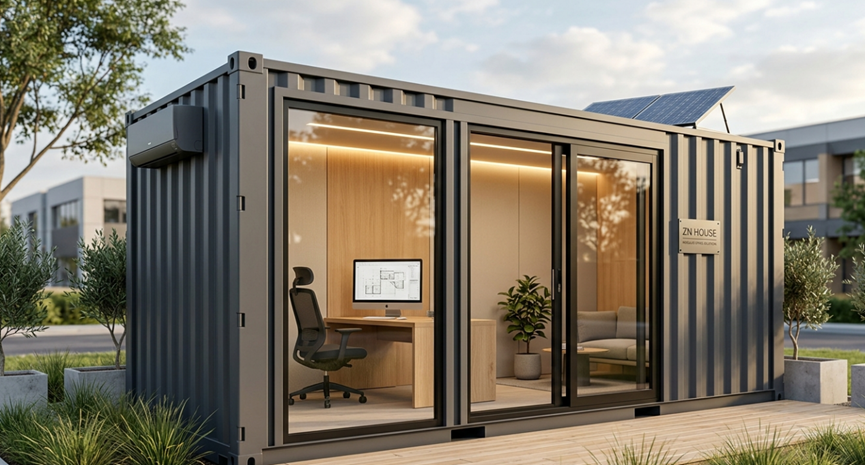
Step‑by‑Step Guide: Converting a Shipping Container into an Office
Here is a complete, expert-level breakdown of the whole conversion process.
Step 1: Define the Purpose of Your Container Office
Before starting any physical work, it is important to clearly identify how exactly you intend to use your container office. For example, many people use these types of units as a home office for one person, small commercial workspaces, construction sites, offices, design studios, or site management offices situated near industrial operations. Decide about:
- The number of persons who will utilize the office and whether you will require individual desks, hot-desking or meeting space.
- Storage, document filing, equipment, or server racks are necessities.
- Whether your office is going to be fixed at one location or if you want a design that could be relocatable in case you may move in the future.
Such an approach will guarantee that your layout, insulation electrical design, and access are based on the actual daily use and not on generic assumptions.
Step 2: Choose the Right Container Size
People usually convert 20 ft or 40 ft shipping containers into container offices. A container of 20 ft length is very suitable for a single-person office or two persons office, especially if it is a backyard office or a compact site office. A container of 40 ft length is a lot bigger and can be used to accommodate multiple workstations, a small meeting area or a reception plus workspace layout suitable for commercial uses.
If the site is somehow limited or if very complex container configurations are involved, then consulting an expert is the best way to find container size and stacking (single story versus two or three story) options that will fit your site, foundation, and access conditions.
Step 3: Understand Local Approvals and Compliance
Regulatory compliance is a must before setting up the installation. You have to:
- Make sure that local council or permitting requirements, which may be different for temporary vs permanent installations, are checked.
- Make sure local zoning regulations, such as setbacks, height limits, and whether container offices are considered accessory structures or primary buildings, are clarified.
- Make sure structural changes, electrical work, plumbing (if bathrooms or kitchenettes are added), and fire safety meet local building codes.
ZN House container offices are constructed with full-welded structural frames and standardized materials, which greatly ease the code documentation and structural calculations, however local approvals are still necessary.
Step 4: Structural Modifications and Layout Planning
After clearing the approvals and confirming the purpose, start planning for structural openings and layout. Major changes usually involve:
- Make door and window openings, including large glass walls or sliding doors to bring in natural light and improve aesthetics.
- After cutting, areas need to be reinforced with welded steel frames to maintain the container's structural integrity, especially long side walls and around large openings.
- Develop the interior layout: walking path, desk locations, storage areas, and placement of electrical panels, air conditioning units, or network cabinets.
To produce reliable container structures capable of being stacked and transported while providing new openings and internal partitions that are safely supported, ZN House utilizes integral full welding techniques on the container office frame.
Step 5: Insulation, Ventilation, and Condensation Control
Since steel is a good heat conductor, uninsulated containers can quickly become uncomfortable, too hot in summer, and too cold in winter, besides being prone to moisture formation. This is the very reason that top-notch insulation is a must. For instance, in the ZN House container office, internally lined walls and ceilings made of rock wool sandwich panels are normally utilized. These panels offer not only thermal insulation but also fire resistance and sound absorption capability. As far as floors are concerned, the use of high-strength cement fiber boards over an insulated layer not only increases user comfort but also the load-bearing capacity of the floor.
The importance of good ventilation cannot be underrated; it is as necessary as insulation. Mechanical ventilation combined with opening windows can help in the removal of excess moisture and stale air so that there is less condensation on steel surfaces and the quality of air is comfortable for the inhabitants. One can get the best long-term results with spray foam insulation, vapor barriers, and balanced mechanical ventilation, especially in regions of extreme climate.
Step 6: Electrical and Lighting Fit‑Out
A functional office must be equipped with reliable power, lighting, and data connectivity. When remodeling, it is a good idea to implement:
- Electrical wiring sufficiently sized for computers, printers, monitors, and other office equipment, with an ample supply of wall outlets to avoid the overuse of power strips.
- Energy-efficient LED lighting that has been planned very carefully so as not to produce glare and shadows on the work surfaces.
- Data cables, Wi-Fi access points, and telephone lines - made in advance and installed behind the walls and ceilings.
ZN House makes high-quality circuits and waterways in the factory, so that the wiring, switches, and outlets are pre-installed and tested, which not only reduces on-site electrical work but also guarantees consistent quality. HVAC units (split systems or packaged units) may be wall- or roof-mounted, with electrical provisions for future capacity increases if needed.
Step 7: Interior Finishes and Office Comfort
Professionalism is achievable with container offices when you mainly concentrate on interior finishes and ergonomics. The common construction typical of interiors is like:
- Wall and ceiling treatments with rock wool sandwich panels - these not only offer sleek and contemporary surfaces but also enhance the acoustic comfort of the space.
- Hard-wearing surface materials for floors like vinyl, laminate, or carpet tiles installed on the cement fiber board base to give a good mix of appearance, maintenance ease, and load capability.
- Spatially efficient furniture--built-in desks, wall-mounted storage, and acoustic panels--to reduce both clutter and echo.
With a well-thought-out design, not only will the container office be so functional and welcoming, but it will also escape the stereotype of a metal box. The setting will be made more comfortable and productive by the use of neutral color schemes, windows that let in considerable natural light, and well-planned lighting.
Step 8: Delivery, Installation, and Site Setup
Without a doubt, proper site preparation is the main factor of long-term performance. Here are the most important steps that prepping the site usually includes:
- First of all, laying the groundwork for the foundations or footings is necessary. Among the suitable fundamental types are concrete pads, strip footings, or piers, which will be chosen by the builder after a soil test and the building scale is considered.
- Making sure the ground is flat and properly supporting the container's corner posts and floor structure to prevent the container from physically deforming or warping.
- Organizing the arrival and lifting the container by trucks, cranes, or forklifts, which place the container on the foundation and then connecting to different utilities (power, water, sewer) follow as needed.
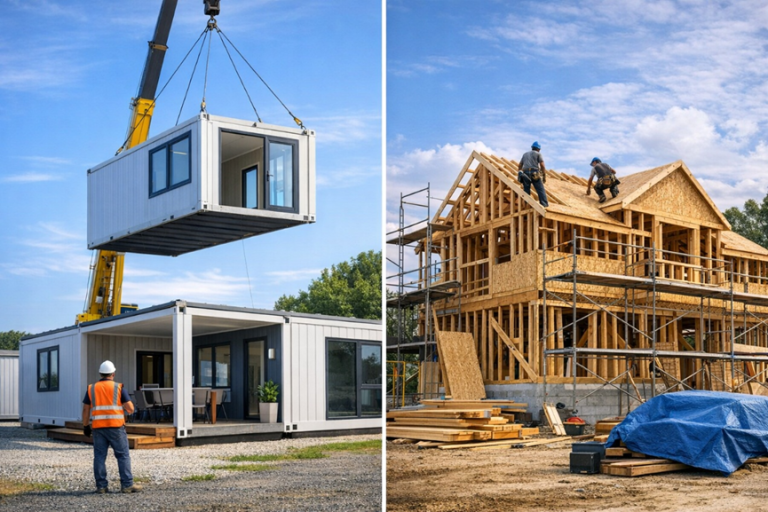
ZN House's modular container offices are designed for a very quick assembly. Most of the time, they arrive back-to-back finished, thus their construction phases on site are mainly securing the units, sealing the joints, and final utility connections. If it is the plan to move the building in the future, then the foundation and the connections can be designed in such a way as to allow housing disassembly.
Step 9: Final Checks and Ongoing Use
After the installation, thorough checks need to be made:
Electrical Systems: Check if outlets are working, how much load each circuit can handle, what kind of circuit protection is there, and if everything is properly labeled for safety?
Ventilation And HVAC: Make sure the air is moving, the temperature is controlled, and the condensate is being drained properly.
Building Envelope: Look at the doors, windows, roof, and wall joints to make sure they are properly waterproofed, free of air leaks, and secure.
If container offices are regularly maintained by checking and renewing seals, repainting exterior steel as necessary, servicing HVAC, and inspecting foundations, their service life of 30 years or more can be achieved with good quality materials and workmanship, such as that of ZN House container structures, has been indicated.
Types of Container Offices
Container offices can be arranged in numerous ways based on usage and expansion plans.
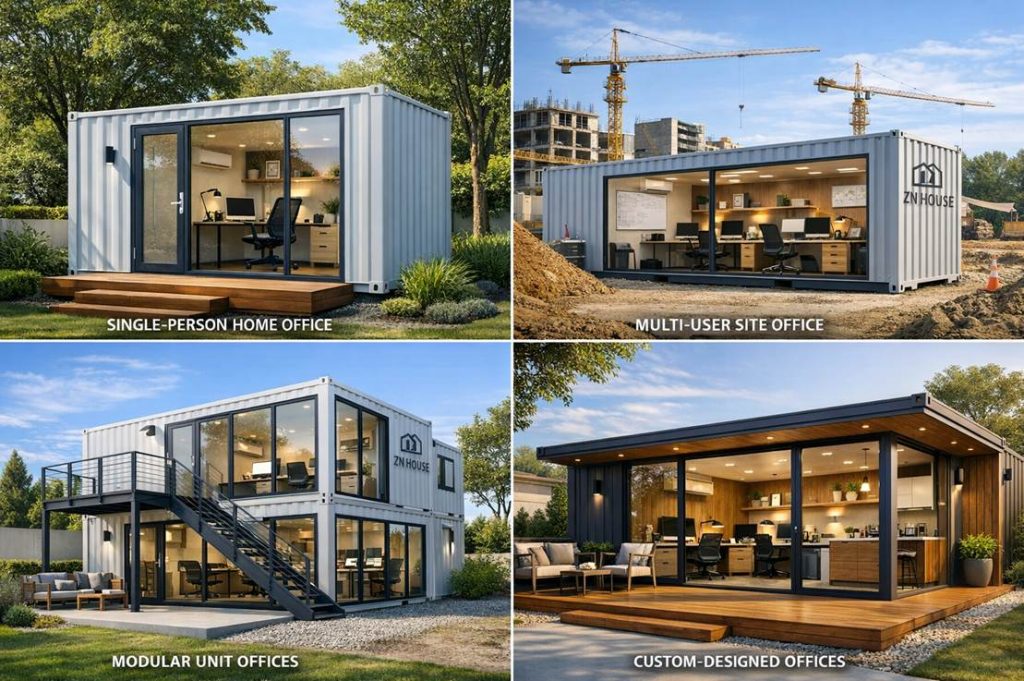
Single-person Home Office: Usually a 20 ft container redesigned to include a single desk, storage, and a small HVAC system; ideal for backyards or side yards where space is limited.
Multi-User Site Office: The 40 ft size offices or units in combination are used on the sites of construction, warehouses, or industrial plants. The layout consists of several desks, a small meeting room, and storage spaces.
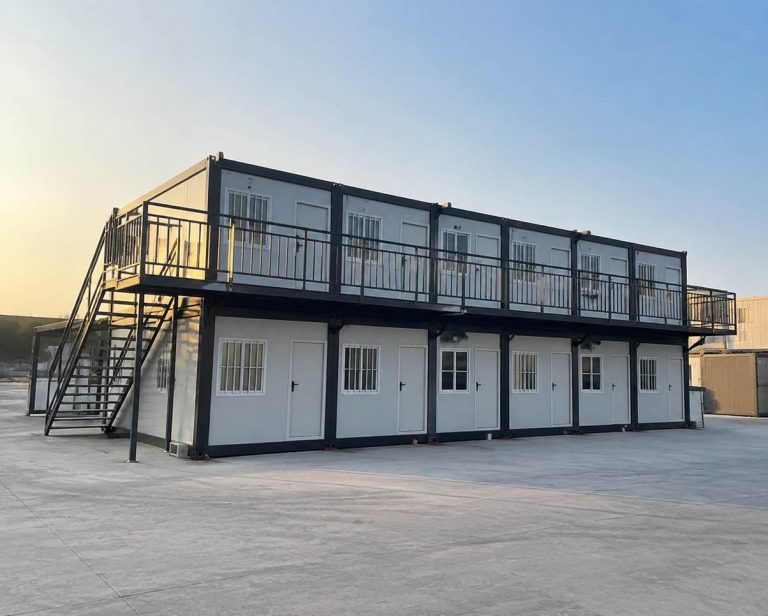
Modular Unit Offices: Numerous shipping containers placed side by side and on top of one another, resulting in multiroom, multistory offices. Corporations needing reception areas, executive offices, and open workspaces mainly go for such facilities.
Custom-Designed Offices: Layouts are extremely customized, for instance, including kitchens, bathrooms, showers, or unique furniture. These are typically portable premium offices or commercial buildings, semi-permanent.
Common Modifications and Add‑Ons
Some upgrades that really help maximize efficiency and comfort are:
Large Observation Windows and Glass Facades: offer natural lighting, beautiful surroundings, and a stylish, customer-facing look; ZN House features office containers with the entire sides made of glass and additional external decorative panels.
HVAC and Climate Control: Robust refrigeration and heating systems appropriately sized for the volume of the insulated container to keep people comfortably warm or cool, depending on the season.
Kitchenettes and Bathrooms: Plumbing, fixtures, and hot water systems are all part of the integrated package that converts a simple office into a self-contained unit perfect for remote or long-term locations.
Security Upgrades: Steel doors that are reinforced, very secure locks, window shutters, and surveillance facilities to keep equipment and documents safe even in risky locations.
FAQs About Shipping Container Offices
How much does it cost to convert a shipping container into an office?
Prices differ depending on the area, size (20 ft or 40 ft), and degree of customization, but container offices usually cost less than building a traditional building of similar space since the steel shell can be reused, and the factory prefabrication. If you do decide to add luxurious finishes, complicated plumbing, or give the building more than one story, the total amount you invest will be higher. Still, it often works out cheaper than a traditional build, especially if you consider shorter construction times.
Can a container office be moved to another site?
Yes. Mobility is one of the container office's greatest assets. Containers come with standard lifting points and dimensions, so they can be taken to another place by truck and crane and set up on new foundations again, if necessary. ZN House creates container offices that can be moved from place to place multiple times so they can be used for different projects.
Do I need council approval for a container office?
Generally, you will require a permit of some kind, particularly if the installation is long-term or permanent. The rules will vary depending on the classification of the office as temporary, semi-permanent, or permanent and on its size, location, and purpose. Therefore, it is advisable to communicate with the officials in your area or hire the ones who are familiar with container building regulations to make sure that the structure, electrical, and fire aspects are up to code.
How long does a container office last?
A container office of high-grade quality that is well designed, protected against corrosion and regularly maintained can be serviceable for approximately 30 years or even longer. The lifespan of the building is influenced by a few factors, such as climatic conditions, the number of times the container is moved, how much maintenance is done (painting, changing sealant), and the effectiveness of the foundations in managing moisture and settlement.
What insulation options are best for extreme climates?
In cases of very hot or cold weather, it is necessary to combine high-quality wall and roof insulation with proper condensation control. Extra-dense rock wool panels sandwiched between layers provide excellent thermal and fire performance and are thus widely used in ZN House container office buildings. For extremely cold weather, apart from additional layers of insulation, spray foam to achieve airtightness, and mechanical ventilation systems are used to maintain a consistent level of comfort in the room and at the same time prevent the steel building from being damaged by moisture.
Conclusion
Shipping container office conversions provide a highly cost-effective, flexible, and customizable working environment, mainly due to their steel shell, which is not only very sturdy but has also been designed for many years of service. ZN House maximizes these strengths with its fully welded Q235-B steel frames, rock wool insulation panels, prefabricated installations for electrical and plumbing, and modular layouts that can be stacked and joined to create multi-story offices.
If a home office, site office, or marketplaces designing a modular commercial workspace is what you are thinking about, then teaming up with container experts who have a lot of experience will also ensure compliance with the different codes, structural soundness, and a comfortable, high-performance interior in which the design is tailored to your needs. To get a design consultation, custom layouts, and container office solutions from start to finish, contact ZN House via their container office solution pages and project examples.
Similar Posts
Prefab Houses vs Traditional Construction: Pros, Cons, Cost, and Speed Comparison
Introduction The decision to build is one of the most important and most expensive decisions anyone...

What Are Prefabricated School Buildings? Types, Benefits, and Project Planning Guide
With increasing student enrollments, decreasing budgets, and schools that cannot be closed for construction, the whole...

How Much Does a Container Dormitory Cost in 2026?
Housing often presents the most significant logistical challenge in the rapid development of infrastructure and the...
Container Office vs Modular Office:Which Is Better for Your Project?
When comparing a container office vs modular office, the best option is determined by factors like...

The modern interior of a shipping container building
With the rising popularity of sustainable and innovative architecture, shipping container building has evolved from functional structures...
How to Choose the Right Container House for Your Project
Introduction Container house solutions are rapidly changing how we construct buildings on a global level, allowing...


