



Container Dormitory vs Traditional Building: Cost and Speed Comparison
Introduction
The need for accommodation for construction workers is increasing rapidly. In addition to construction site workers, thousands of other workers require safe, comfortable places to live on remote mine sites, infrastructure developments, and industrial sites. However, for over 40 years, the traditional way of providing workers with shelter has been temporary dormitory-style buildings constructed with concrete or steel frames that are expensive to build, take a long time to build, and are not movable after they have been constructed.
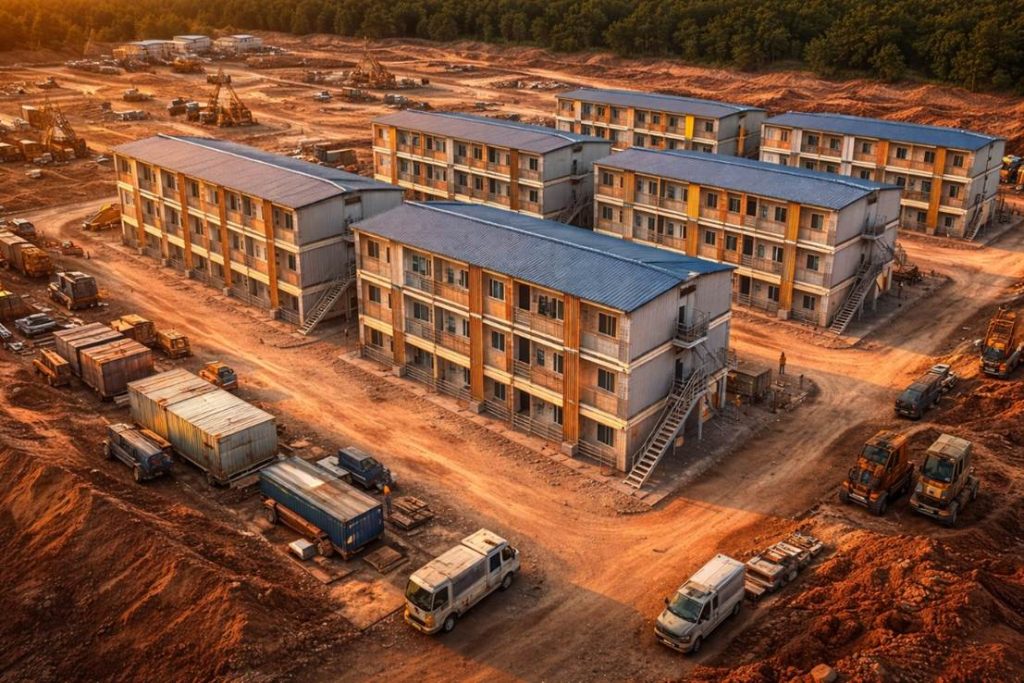
Project managers and purchasers are now actively trying to find out if there is an easier way to provide shelter to their workers. We are experiencing a shift towards container-style dormitories because of the rapid development of prefabrication technology, and this shift will have an impact on how companies think about providing housing to their workforce in the future. But how do container dormitories compare with traditional buildings in terms of total real cost and construction speed?
In this deep-dive comparison, we provide you with comprehensive information to help make an informed decision on the best type of accommodation to use for your upcoming project by analysing each type of accommodation through multiple performance criteria, including total capital cost, total labour cost, total duration of construction, flexibility of use, and total cost of ownership.
What Is a Container Dormitory?
Container dormitories are a type of modular or prefabricated building used to create housing for several people, constructed mainly from steel frame modular units manufactured in a factory and assembled on site. The difference between conventional construction and this type of construction, is that the majority of heavy lifting takes place at a very local and clean-controlled factory, not at a muddy job site.
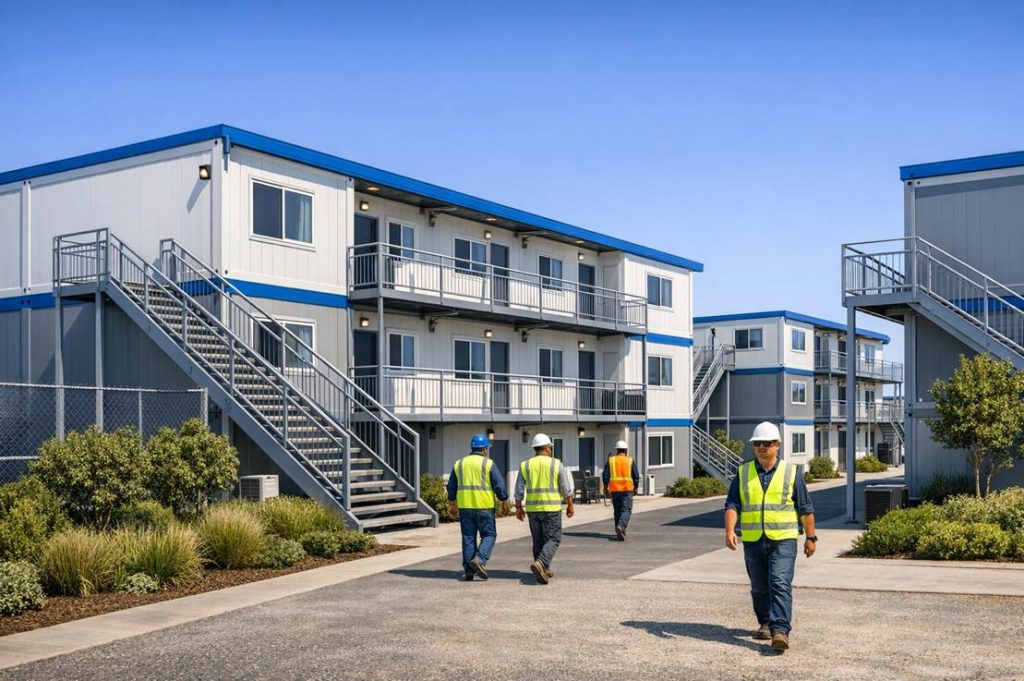
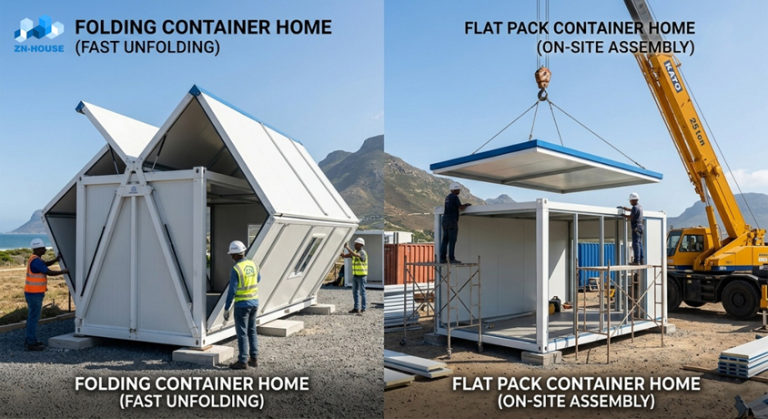
Container dormitory units containing living space, generally utilize ISO standard dimensional units (20ft fork prints or 40ft fork prints), will arrive at the site either as flat-pack components for assembly or complete, finished and hooked up to utilities modules. Due to their self-contained and structurally independent design, container dormitory units are:
- Stacked vertically (typically up to 3 stories) to maximize density on a limited footprint
- Arranged horizontally in any number of configurations — rows, L-shapes, U-shapes, or courtyard clusters
- Scaled up or down as headcount demands change
- Relocated entirely when the project ends
ZN House has completely developed container dormitories that are created with hot-dip galvanized Q235B steel frames, fire rated insulation, fully integrated HVAC, Electrical and Plumbing for worldwide safety requirements including CE, ISO 9001 and BV certifications. Standard configurations support 4 to 8 occupants per unit; however, custom layouts can range from single occupancy to multi-person bunkrooms (prefix). Container dorms are designed for living systems (not just boxes) with engineered speed, safety, and long-term operational use.
What Is a Traditional Dormitory Building?
The permanent, on-site built traditional dormitory buildings are solidly built with the use of typical building materials (i.e., reinforced concrete frame, masonry wall, and structural steel). As an example, from the time that the foundation is poured until the roof cap has been installed, everything that is needed to construct a dormitory is created and assembled at the job site.
Traditional dormitory buildings must be constructed using a predetermined and consistent construction process to provide predictable results, which include: site survey → structural design → regulatory approvals → groundworks → concrete frame → mechanical and electrical installations → interior fit-out → final inspections. This type of dormitory buildings must have each construction process completed before commencing the next one, making the overall construction timeline very linear and therefore highly susceptible to delays.
Examples of the design of typical dormitory buildings are:
- Permanent foundation — once built, the structure cannot be relocated
- On-site fabrication — materials are delivered raw and assembled by multiple trades on location
- High labor intensity — requires concurrent management of civil, structural, M&E, and finishing crews
- Long lead times — a typical 100-bed facility takes 6–12 months from groundbreak to occupation
- Fixed capacity — scaling up requires new construction phases, each with their own permits and costs
Traditional construction continues to be an appropriate choice for long-term, fixed-location applications that include university campuses, dedicated employee villages or for government-supported social housing. But for any needs that are project driven, time sensitive, and/or require temporary or semi-permanent workforce accommodation, there is a significant financial and operating risk associated with traditional construction methods.
Container Dormitory vs Traditional Building: Quick Comparison
Prior to analyzing the specifics of each option, here is a comparison of the two options according to the most important criteria that will be considered when making a final decision:
| Feature | Container Dormitory | Traditional Building |
| Construction Time | 4–8 weeks | 6–12 months |
| Cost | 30–40% lower upfront | Higher across all cost categories |
| Flexibility | High — modular, reconfigurable | Low — fixed layout |
| Mobility | Yes — 100% relocatable | No — permanent structure |
| Scalability | Easy — add or remove modules | Difficult — requires new construction |
| On-site Labor | Low (assembly only) | High (multi-trade, sequential) |
| Material Waste | Under 2% (factory precision) | 10–15% typical waste rate |
| Lifespan | 15–25 years | 30–50+ years (fixed) |
| Maintenance | Low — steel is non-porous, mold-resistant | Medium to High — dependent on materials |
| End-of-Project Value | High — asset can be relocated or repurposed | Sunk cost — structure has no mobility value |
This table alone makes an excellent argument for project-based housing. Let's look more closely at each dimension now.
Cost Comparison: Which Is More Affordable?
The most significant factor affecting workforce housing procurement is usually cost. The container dormitory advantage exists not only at the time the unit is purchased, but for the entire life of the asset.
Container Dormitory Cost
Container dormitories have their cost advantage at the factory where the units are created in a large manufacturing facility through high-volume production and standardized in nature:
Standardized production reduces material waste. Factory-grade precision manufacturing has allowed ZN House to hold waste below 2%, whereas on-site construction typically sees waste closer to 10-15%. When working with large quantities of steel, insulated panels and engineered systems, waste reduction saves the unit-price of the entire system.
Labour expenses are significantly lower. Traditional construction onsite will have various different trades providing labour onsite at the same time; civil engineering, steelwork, electricians, plumbers, plasterers and finishers are all managed, scheduled and billed separately. The assembly crew is the only trade required to perform the work for container dormitory installation (data acquired from ZN House indicate). Onsite labour requirements will be reduced up to 60% with container dormitory than with performing the same amount of construction in a traditional method of construction.
Budget predictability is integrated. Factory-priced products have a defined specification guaranteeing that there can be no "budget creep." The cost that was agreed upon at contract signing will be the final delivery cost, as there are no extended weather delays, inflationary materials price increases, and variation orders which typically inflate the original budget with traditional construction methods.
Traditional Building Cost
The cost impact of constructing a traditional dormitory occurs at multiple points through the build process:
Labor, materials and management being as expensive as they are, each phase builds on the previous one to add even greater cost to a long, multi-tiered project. The costs of skilled labour for construction on complex sites, particularly projects that are remote or infrastructure-related, will also carry an elevated cost due to either location allowances, transportation costs and accommodation for the labour force (i.e. there is an additional cost incurred to accommodate workers for jobs that are in remote locations).
These long-term build projects also build compounding costs over the construction period. An additional month of construction incurs costs that are recurring in nature — for example, the continued exposure to overhead costs; site management, equipment hire, temporary accommodation, security, and continued labour are all costs associated with incurred expenses based on an extended construction duration. These cost exposures will be exacerbated further when typical construction delays from either weather or supply chain issues cause an extended construction period that can quickly escalate.
Additionally, there are costs associated with the duration of obtaining regulatory approval prior to the start of construction. There will be several months to complete sufficient architectural drawings and engineering approvals, etc., to allow for construction materials to be ordered, but no equipment/mail will have arrived on-site until at least one cubic yard of concrete has been sampled prior to the start of construction. This upfront period not only builds an increase in pre-construction costs; project personnel will accrue payroll costs while waiting to find accommodations for the permanent occupant of the newly constructed facility.
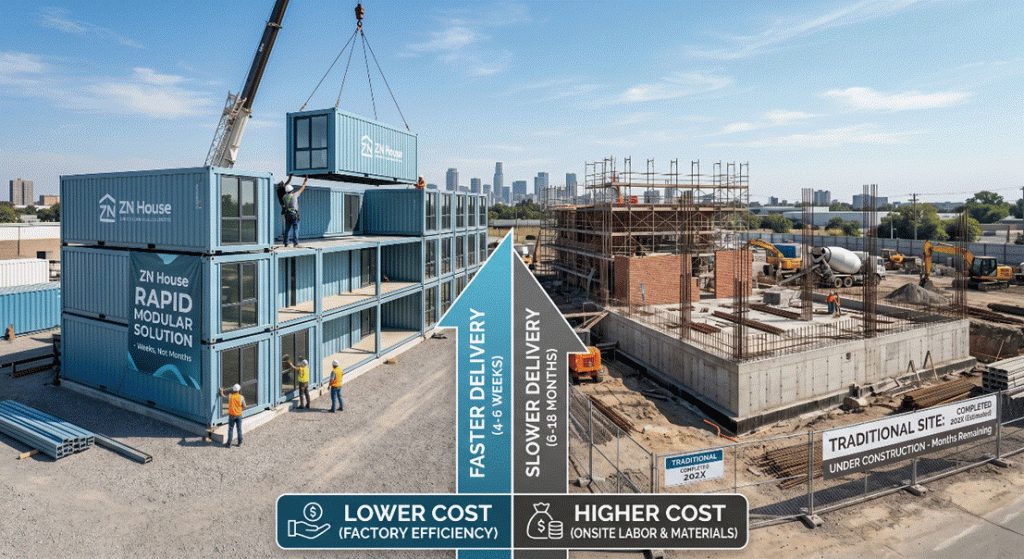
Total Cost of Ownership: The Long View
The key difference in the cost of construction is the total cost of ownership (TCO) over the life of the project, rather than just looking at the initial construction costs (referred to as capital expenditures). Container dormitories are reusable assets. They can be decommissioned and transported to the next location when a mining project ends, the construction site moves, or when temporary camps no longer need to be utilized. As a result, they will still have value and continue to provide utility. ZN House's ISO-conversion dormitories provide a useful life of 15-25 years, which means that a dormitory will typically service three or four projects during its life span before retiring.
Traditional buildings are considered "sunk cost," and when a project ends, the fixed dormitory either has to be demolished (costly expenses) or left to sit idle (stranded asset). The cost to maintain an idle structure (especially in remote locations) or the liability of leaving it vacant is a legitimate operational consideration that is typically small for initial budget comparisons.
In terms of maintenance costs, the container system comes out ahead compared to traditional construction methods, because the ZN House units are made from hot dipped galvanized steel frames and utilising non-porous sandwich panel walls gives them a natural resistance to the three main causes of maintenance costs in traditional buildings - moisture ingress, mould and structural decay. As such, over the longer term, the Operations and Maintenance (O&M) costs for the container system will be reduced by approximately 50% compared with the timber frame or lower grade masonry dormitory systems.
When looking at Total Cost of Ownership (TCO) for a 10-year horizon, the TCO advantages of a properly specified container dormitory system compared with an equivalent traditional facility are tremendous, and in many cases they will exceed the obvious upfront cost differential.
Construction Time Comparison
For any industry based on projects, time has a tangible effect on both revenues generated from contracts and the timing of contract fulfilment. In the construction industry, there is significant difference in construction time between container dormitories and conventional buildings. This illustrates one of the most significant operational advantages associated with this approach.
Container Dormitory Timeline
The rapid construction speed of container dormitories is due to one central element: concurrent building and preparation of the site.
Factory prefabrication is done at the same time as site work is performed. While the site is cleared, sanded, and prepared, ZN House units have already been created, constructed, and quality tested in the factory. By the time site preparation is finished, the dormitory has already been built!
Once on site, setup can be accomplished quickly. A camp with 50 units can have full utility connections structurally complete and weather-tight within 72–96 hours of modules arriving. A 200-person dormitory complex can usually be completely deployed and ready for occupancy within 2 weeks. ZN House’s Flat-Pack design allows up to four units to be shipped together in one 20ft ISO shipping container, decreasing shipping costs and optimizing the logistics of transportation.
The entire process from order to occupancy takes just weeks! The total length of time for a complete container dormitory project — from the first design consultation to first night of use — is typically 4 to 8 weeks, depending on how complex or customized the project may be. If necessary, the timeframe can be reduced even further to meet urgent delivery requirements.
Traditional Building Timeline
The standard dormitory construction process follows a timeline outlined below:
The construction process is a sequential, dependent process where no new phase can commence until the previous phase is completed.
The design and approval processes take weeks or months to complete before construction begins. The design process (architectural, structural, etc.), building permit application, and building inspection review collectively take an average of 4 to 12 weeks (or sometimes more) depending on where you live. Planning approvals related to worker accommodation may require additional time and consultation in some areas, especially in sensitive areas such as the environment or agriculture.
The construction cycle itself can last an average of 6 to 12 months for a 100 to 200 bed facility. You must complete groundworks, concrete frame, structural steel, mechanical and electrical rough-in, wall construction, finishes, and commissioning in a sequential manner, along with trade coordination and inspection sign-offs at each step of the process.
Delays will occur and will be costly. There are many examples of how construction projects are delayed — especially those in remote locations, extreme climate areas, and in markets where the labour market is constrained. For example, an average of 3 months may elapse when pouring concrete in naïve tropical or arctic locations due to inclement weather. In addition to the lengthened periods of time workers are on-site without permanent housing, construction delays will often require temporary (and expensive) alternative to the permanent facility.
Flexibility and Scalability Comparison
The project-based work structure is evolving. Personnel counts rebound and fall as phases of works progress and regress. Scope changes, contractor rotations, and operational pivots are common place vs rare place on projects. Therefore, the accommodations infrastructure must evolve to meet the changing needs.
Container Dormitory Flexibility
Container dorms have a built-in capacity for modularity, making them adaptable:
Every module is capable of scaling independently. For example, you can start building a camp with 20 units in order to get started with mobilization, and when you are at your peak construction phase you can increase use of the camp to 100 units by simply adding on modules. You will not have to re-design the structural framework of the building, you will not need to add a new foundation (in most cases) and there will be no disruption to the existing operational buildings and encampment at that location. Conversely, if workforce numbers decline at project end, you can demobilize or remove modules to be moved somewhere else.
Entire camps are portable. When a project is relocated - like with many linear infrastructure projects (pipelines, roads, and rail) - a container dormitory encampment can be removed and transported to the new location. The asset is following the project.
Layouts can be modified/interchanged. As part of ZN House’s “Building Block” modular philosophy, a unit that began as a bunkhouse, can be reconfigured to function as an office, canteen, medical facility or command centre through all phases of the project without any structural modification.
Phased projects are suitable. Container dormitories can adapt to the changing configuration and capacity needs in relation to all phases of the project for multi-year projects where phase 1 infrastructure is followed by construction and operations versus being built to meet peak phase requirements from day 1 (and overbuilt).
Traditional Building Inflexibility
Traditional dormitory structures must remain at their original on-site location, barring any unanticipated need for relocation. Any changes to operational capacity must be carried out through either the development of a new structure or renovation of an existing facility. Changing capacity at a traditional dormitory building is a complex process requiring structural redesign, approval through the planning process, civil works and construction, all of which have separate costs and timelines. There are no modular expansions ("plug-in additional wings") available to accommodate increased capacity.
Traditional dormitory buildings do not accommodate dynamic operational requirements. Companies with fluctuating headcounts, multi-site operations, and projects with life spans of less than five to seven years will find the inability to modify facilities will create significant liabilities to their operations. If a company overbuilds for peak headcount, they have wasted capital; if a company underbuilds during key phases of a project, they create shortages in the accommodations required during the critical project phases.
Best Use Cases for Each Option
Knowing when each type of solution will serve as an appropriate tool to accomplish a particular task is just as critical as understanding how they compare generally. Both container dormitories and traditional buildings are viable options; it is simply a matter of finding the right solution based on your specific project requirements.
Container Dormitory
Container dormitories are the optimal solution for accommodation needs characterized by any of the following:
- Construction sites
- Mining camps
- Remote workforce housing
- Emergency or temporary housing
- Infrastructure projects
Traditional Buildings
Traditional dormitory buildings remain the preferred option in specific, well-defined scenarios:
- Permanent campuses
- Residential complexes
- Institutional housing
- Long-term infrastructure projects
Why More Projects Are Choosing Container Dormitories
The use of container dormitories to house workers is no longer just a small trend; rather, it demonstrates a major change in how the project-based sector provides workforce housing. The global acceleration of this trend can be attributed to multiple intersecting forces.
Cost Advantages: Lower capital expenditure (CAPEX) makes it easier to manage cash flow.
Delay Advantages: Getting your workers on-site and housed weeks earlier will directly affect the project's bottom line.
Sustainability: Container dorms leave less waste on the site and have a smaller impact on the environment than buildings that use a lot of concrete.
Which Option Should You Choose?
After looking at the evidence for cost, construction time, flexibility, scalability, and use case alignment, the decision framework is simple:
Choose a traditional building if:
- You have an ongoing requirement for permanent accommodation and the sites are expected not to change in the next 30 years.
- You will be required to build a permanent structure according to regulations.
- Your project consists of a long-term fixed asset (campus, hospital, government) investment.
- The capital costs of the building will be amortized over 30 years which makes the upfront costs reasonable.
Choose a container dormitory if:
- Your project has a defined or semi-defined timeframe for operational deployment (1-10 years).
- Speed of deployment is a key constraint to your critical path.
- Your project's headcount will vary significantly through phases of your project.
- Your operational footprint may change location during the project lifecycle.
- Budget control and capital efficiency are primary procurement criteria.
- You are working in a remote (i.e. hardly inaccessible), extremely harsh or difficult logistical operating environment.
- You want to acquire housing assets that retain value after your project is completed as opposed to being written off as uncollectible.
Frequently Asked Questions
Is a container dormitory cheaper than traditional buildings?
Yes. Container dormitories can save between 30% and 50% on total project costs, including labor, time, and material efficiency.
How long does it take to build a dormitory?
It takes only four weeks to make a container dormitory ready for people to move in, while it would take six months or more to make a traditional building of the same size.
Are container dormitories durable?
Absolutely. The use of galvanized steel frames and high-density sandwich panels in container dormitories make them strong enough to stand up to high winds, earthquakes, and bad weather.
Can container dorms be used permanently?
Yes. They are "movable," but they are built to high engineering standards and can last for more than 20 years as permanent housing.
What is the lifespan of container housing?
A high-quality container dormitory can last for 20 to 30 years with regular maintenance.
Conclusion
For the vast majority of project accommodation situations, container dormitories are incomparable to traditional buildings. Container dormitories offer quicker deployment (a matter of weeks rather than a few months), reduced costs (30-40% lower initial investment and 50% reduced ongoing maintenance costs), more flexibility (modular, scalable, and completely relocatable), and an inherently superior total cost of ownership for any project with a defined operational life cycle.
Traditional construction remains valuable for true permanent, fixed-location structures. However, in the ever-changing, project-driven construction, mining, oil and gas, infrastructure development and emergency response industries, container dormitories have become the obvious and logical choice.
Ready to Deploy a Container Dormitory?
→ Request a Dormitory Solution→ Get a Custom Layout Design→ Contact ZN House for a Quote
Similar Posts
What Is a Detachable Container House? Complete Guide for Buyers
Introduction As construction companies, developers, and project contractors seek out faster, more adaptable, and cost-effective options...
Shipping Container Homes for Sale Off Grid Setup Options
At Suzhou Zhongnan Steel Structure Co., Ltd., our decades of expertise in container housing are rooted...
Community of Shipping Container Buildings
The concept of building communities with shipping container house and converted shipping containers has emerged as a revolutionary...
How to Choose the Best Container Camp for Your Outdoor Adventure
Container camps have changed outdoor experiences in many ways, allowing people to shift from tent camping...
What Are Emergency Temporary Buildings? Types, Uses, and Planning Guide
People living in a community that has suffered from natural disasters or emergencies like public health...
Flat Pack vs. Folding Container Homes: Which One Is Better for Your Project?
Introduction Modular building is globally revolutionizing the construction industry through speed of construction time, eco-sustainability, and...


