



How Many Flat Pack Container Houses Fit in a 40HQ?
Usually, a 40HQ container can fit around 6-10 sets of standard 20ft flat pack container houses. In most overseas projects, buyers can safely estimate the use of 6-8 sets per 40HQ, while the optimized standard models may reach 8-10 sets considering the packed height, thickness of the wall panel, accessories, and the packing method.
Flat pack container houses are mainly aimed at reducing the shipping volume against fully assembled container buildings. Manufacturers, through the compression of the structure into small stackable components, can load a lot more units in a single container. For this reason, flat pack designs are highly suitable for overseas projects that require delivery in bulk and also lower the transportation cost per unit, e.g., worker accommodation camps or multi-room residential developments.
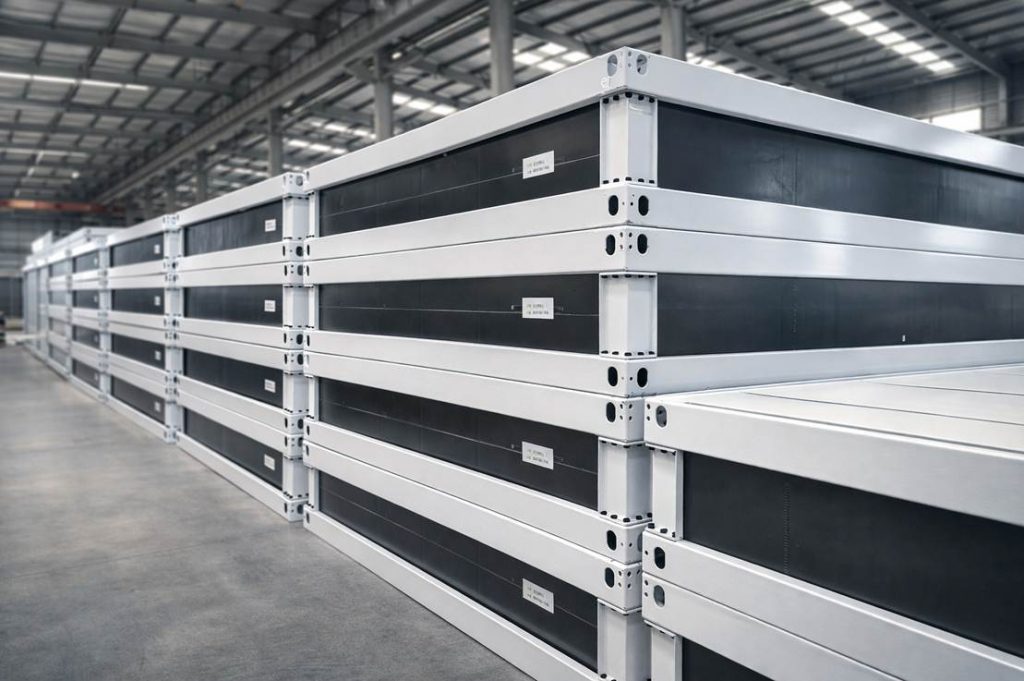
Quick Answer: 40HQ Loading Quantity for Flat Pack Container Houses
Below is a quick reference to how many flat pack container houses typically fit in a 40HQ shipping container, depending on model and configuration.
| Flat Pack Container House Type | Estimated 40HQ Loading Quantity | Notes |
| Standard 20ft flat pack container house | 6–10 sets | Common range for overseas shipments |
| Practical project estimate | 6–8 sets | Safer estimate for most buyers |
| Optimized standard model | 8–10 sets | Depends on lower packed height and fewer accessories |
| Units with bathroom or kitchen | Usually fewer | Accessories and plumbing parts increase packing volume |
| Mixed project configuration | Depends on packing plan | Offices, dormitories, toilets, and kitchens may load differently |
Important: 6–10 sets is a reference range, not a fixed number. The exact figure depends on the specific model, wall panel type, and accessories included in each unit.
Why 40HQ Loading Quantity Matters for Buyers
When it comes to foreign purchasers, the quantity of unpacked container houses that fit in a 40HQ container is a key thing in determining the final price of each unit. A better loading arrangement can lower the transport cost of each house, make scheduling the delivery easier, and also give the buyers of the construction funds better control over the overall budget.
Understanding the loading quantity matters for several reasons:
- It affects shipping cost per unit — more units per container means a lower per-unit freight cost.
- It affects total project budget, since freight is often one of the largest line items for overseas projects.
- It helps buyers plan order quantity in multiples that fill containers efficiently.
- It affects delivery schedule, since the number of containers required determines shipping lead times.
- It helps plan phased project shipments, especially for large camps or multi-building developments.
- It helps compare flat pack container houses with fully assembled container buildings on a true cost-per-unit basis.
Typical Flat Pack Container House Size and 40HQ Space
When opened up to their finished living size, a regular 20ft flat pack container house approximately measures length 5800-6055mm, width 2438-3000mm, and height 2896mm.
To get an idea of how this is accommodated within a shipping container, it is useful to examine the normal internal sizes of a 40HQ container:
| 40HQ Internal Size | Approx. Dimension |
| Internal length | About 12,000mm |
| Internal width | About 2,350mm |
| Internal height | About 2,690mm |
The basic loading logic works like this:
- A 20ft flat pack house is around 5,800–6,055mm long when assembled.
- A 40HQ can usually place two packed modules end-to-end along its length.
- Final quantity depends mainly on packed height and packing method, not just floor footprint.
- If the packed height is lower, more sets can be stacked on top of each other.
- If the packed height is higher, or accessories are included, fewer sets can be loaded.
How Packed Height Affects 40HQ Loading Quantity
One of the main reasons why packed height has a huge impact on the total quantity of units that can fit in a single 40HQ is that the internal height of the container is fixed at approximately 2,690mm. So, the height of each flattened module is what ultimately decides the number of layers that can be stacked, respectively.
| Packed Height per Set | Estimated 40HQ Loading Quantity |
| Around 450–500mm | 8–10 sets |
| Around 550–650mm | 6–8 sets |
| Around 700–800mm | Around 6 sets |
| With bathroom, kitchen, or many accessories | May be lower than standard range |
Lower packed height of one flat pack container house means that more units can be stacked inside a 40HQ container. Then again, if the unit features thicker wall panels, reinforced roof and floor structures, bathroom parts, kitchen systems, or additional accessories, the packed height and total volume may increase, resulting in a smaller final loading quantity.
What Affects the Number of Flat Pack Container Houses in a 40HQ?
Many design and project aspects influence the number of items that can be loaded into one 40HQ container. Having an insight into these aspects enables buyers to create more feasible order quantity and shipping budget plans.
House Size and Module Dimensions
- 20ft models are the most common choice for efficient 40HQ loading.
- Custom sizes, such as 10ft or 40ft modules, may change the loading quantity significantly.
- Wider or higher units may require a different packing plan and reduce the number of sets per container.
Wall Panel Thickness and Insulation
- EPS, rock wool, PU, and PIR panels each have different thicknesses, which affect the packed dimensions.
- Better insulation generally means thicker panels, which may increase packed volume per unit.
- Dormitory, office, and residential units may use different wall systems depending on the climate and project specification.
Roof and Floor Structure
- Stronger roof and floor systems built for heavier loads or harsher climates may take up more space when packed.
- Reinforced structural components can directly affect packing height.
- Different project standards, such as wind load or seismic requirements, may change the overall loading plan.
Doors, Windows, and Accessories
- The number and type of doors and windows affect how compactly a unit can be packed.
- Bathrooms, kitchens, plumbing, and electrical systems take up additional space and weight.
- Stairs, corridors, canopies, and furniture can reduce the overall loading quantity for a given container.
Packing Method
- Standardized models with consistent dimensions are easier to load efficiently.
- Mixed models within the same shipment may reduce overall loading efficiency.
- Protective packing materials add a small amount of space but help reduce transport damage.
Project Configuration
Different project types may require a mix of unit types, such as:
- Dormitory units
- Office units
- Toilet units
- Kitchen units
- Shower units
- Corridor units
- Stair units
Mixed projects cannot use a single standard number, but need a custom loading plan, as each unit type can have a different packed footprint and height.
40HQ vs 20GP vs 40GP: Which Container Is Better?
Picking the right type of shipping container is important before you finalize your loading plan.
| Shipping Container Type | Suitable For | Notes |
| 20GP | Samples or small orders | Limited loading space |
| 40GP | Medium shipments | Lower internal height than 40HQ |
| 40HQ | Bulk flat pack container house shipments | More loading space and commonly used for overseas projects |
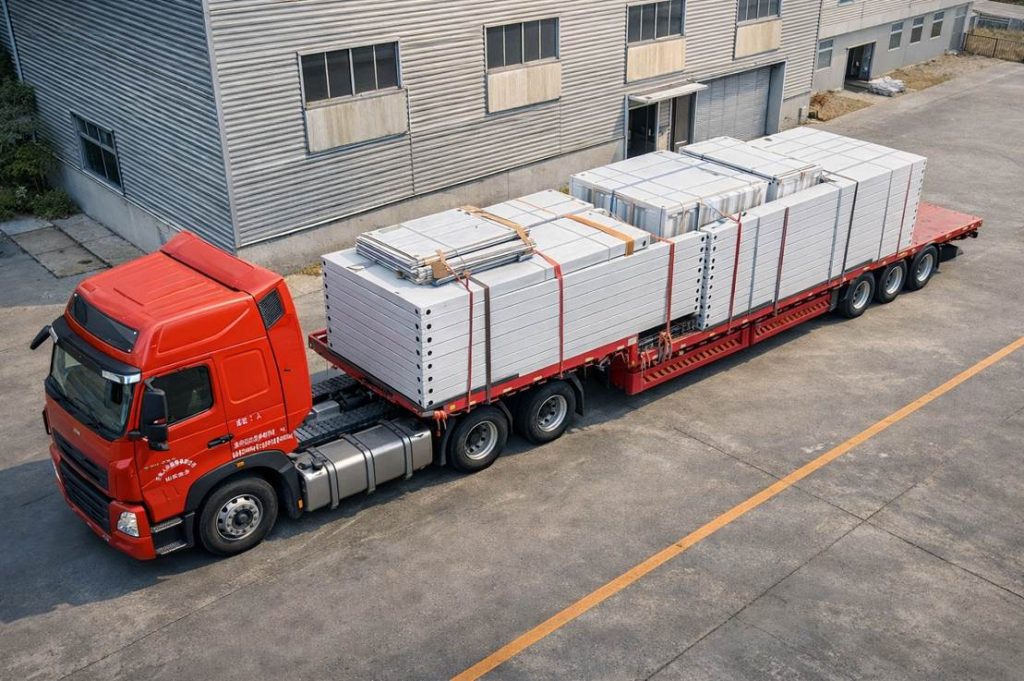
For most overseas flat pack container house projects, 40HQ is usually preferred for more loading space and helping to reduce shipping cost per unit.
Flat Pack Container House vs Fully Assembled Container House Loading
Flat pack design is mainly there to solve the shipping efficiency problem that fully assembled container houses encounter on long international routes.
| Item | Flat Pack Container House | Fully Assembled Container House |
| Shipping Volume | Lower | Higher |
| Loading Quantity | Higher | Lower |
| Shipping Cost per Unit | Lower | Higher |
| Installation | Requires on-site assembly | Less assembly after delivery |
| Best For | Overseas bulk projects | Local short-distance delivery |
Compared to the fully assembled container buildings, flat pack container houses usually take up less space when it comes to shipping, as the structure is packed in components. So, it is possible to accommodate more units in a single 40HQ which is of great help to the buyers abroad as they get to lower the transportation cost for each house.
Example Loading Scenarios for Overseas Projects
Often the best load quantity is very dependent on the type of project. Here are a few common buyer situations.
Construction Site Dormitory Project
- Usually requires multiple identical rooms, which simplifies the packing plan.
- May include toilet and shower units alongside standard sleeping units.
- Loading quantity depends largely on whether bathroom modules are included in the same shipment.
Flat Pack Office Cabin Project
- Office units may include partitions, doors, windows, and electrical systems that add to packed volume.
- Meeting rooms and reception units often use different configurations than standard offices.
Worker Accommodation Camp
- Usually includes dormitories, offices, toilets, kitchens, and dining units in one project.
- Needs a full packing list and loading plan that accounts for each unit type separately.
Distributor or Reseller Order
- Standard models are easier to load efficiently and predictably.
- Optimized packing can help improve the overall loading quantity per container.
How to Calculate Loading Quantity Before Ordering
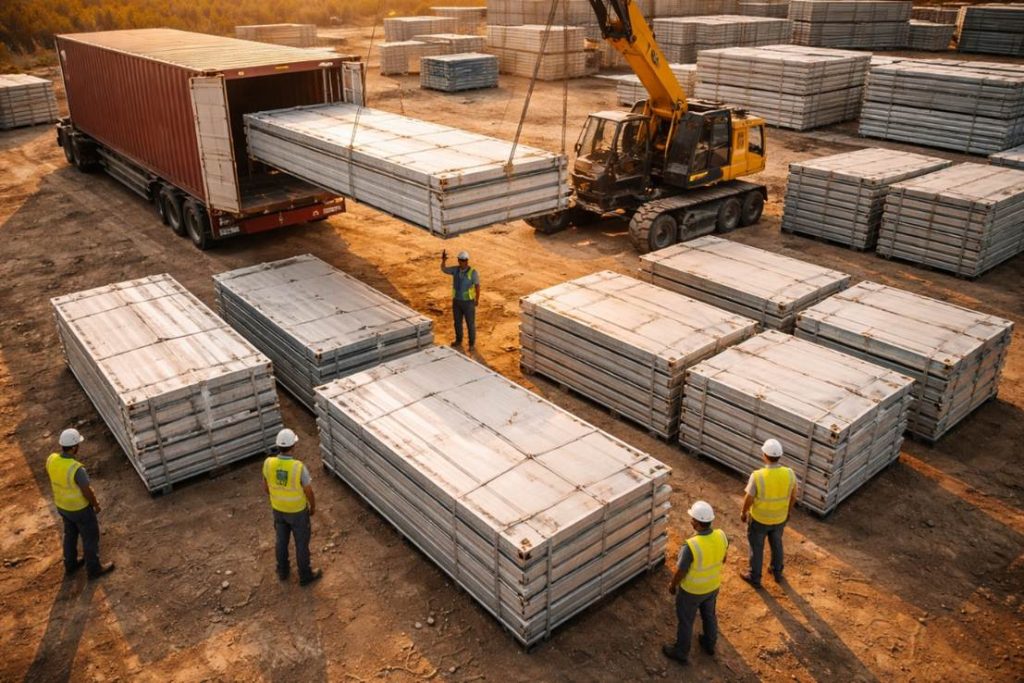
Calculating the number of flat pack container houses that can be accommodated in a 40HQ needs the buyer to verify the unit size, dimensions of the packing, types of wall panel layout accessories and overall quantity. A supplier can then get a better and more precise loading plan by getting these details.
| Information Needed | Example |
| Unit Size | 20ft, 40ft, or custom size |
| Structure Type | Flat pack, folding, or detachable |
| Wall Panel | EPS, rock wool, PU, or PIR |
| Layout | Office, dormitory, toilet, kitchen, or accommodation |
| Accessories | Doors, windows, bathroom, kitchen, stairs, canopy |
| Quantity | Number of units |
| Destination | Country, port, or project site |
| Installation Plan | Self-installation, local team, or project support |
Why Choose ZN House for Flat Pack Container House Shipping?
ZN House offers flat pack container house solutions that are specially developed for convenient international shipping and rapid assembly at the site. Based on ZN House’s product details, the flat pack units are constructed with a galvanized steel structure and insulated sandwich panels (EPS, rock wool, or PU). Also, they are 80% pre-assembled in the factory, and their shipping volume can be reduced by up to 70% compared to complete container homes.
ZN House can support buyers in several ways:
- Customize loading plans based on the selected model, configuration, and total quantity.
- Prepare a detailed packing list and shipping plan tailored to your project.
- Help overseas buyers optimize container loading to reduce cost per unit.
- Support dormitory, office, accommodation, and camp projects with mixed unit types.
ZN House is able to offer you a tailor-made loading plan taking into account your model of a flat pack container house, the number, and your project layout type. Our group is available to aid customers in planning the most effective usage of packing, container loading, and project delivery for overseas container house projects.
FAQs
How many flat pack container houses fit in a 40HQ?
Generally, a 40HQ container is capable of holding 6 to 10 sets of standard 20ft flat pack container houses. However, for the majority of overseas projects, it is safer to estimate 6 to 8 sets per 40HQ. With optimized standard models, the figure could be 8 to 10 sets, subject to packed height, accessories, and packing method.
Why is 40HQ commonly used for flat pack container houses?
40HQ container brings more loading space than 20GP or 40GP, and it can hold more bulk overseas shipments and reduce the shipping cost per unit.
Can bathroom or kitchen units affect loading quantity?
Yeah. Bathroom, kitchen, plumbing and electrical fixtures and other accessories may increase the packing volume and reduce the total number of units per container.
Is flat pack cheaper to ship than fully assembled container houses?
Usually, in most of the overseas projects, the answer is yes. It is because flat pack container houses are, most of the time, more shipping-efficient. The biggest reason is that the structure components are packed separately rather than the whole unit being assembled and then shipped.
Can ZN House provide a loading plan before ordering?
Yes. ZN House is capable of creating a personalized loading plan based on the model of your product, the number of items, the configuration, and the destination.
What information is needed to calculate loading quantity?
Buyers need to mention the unit size, the structure type, the wall panel, the layout, the accessories, the quantity, and the destination. All these data points are used to determine a 40HQ loading quantity with greater precision.
Get a Custom 40HQ Loading Plan
Are you considering ordering flat pack container houses for a project abroad? Send us your size, quantity, layout, and destination requirements. We at ZN House are able to help you figure out the 40HQ loading quantity and offer you a proper packing and shipping plan for your project.
Similar Posts

Container Construction How to Plan and Execute Modular Buildings
Container construction streamlines modular building projects with fast planning, cost savings, permit guidance, and flexible customization options.

Modular Healthcare Buildings: Types, Benefits, Applications, and Planning Guide
Hospitals, clinics, governments, NGOs, and emergency response organizations often need medical space faster than traditional construction…
Modular Container House Solutions for Smarter Living
As urban density increases and housing costs continue to rise, a growing number of individuals and…
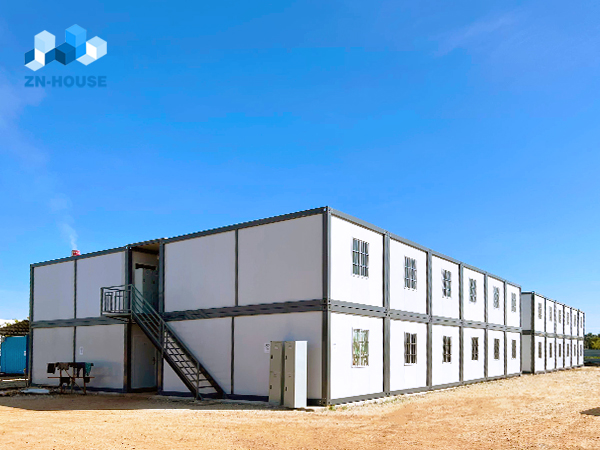
Discover the Versatility of Modular Container Homes
Transform your living experience with our innovative Modular Container House solutions. Designed for flexibility, efficiency, and ease of…
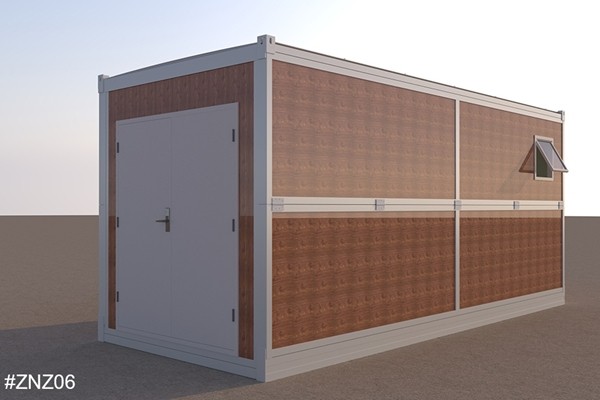
The Innovative World of Folding Container Houses
As the demand for flexible and efficient living spaces grows, folding container houses are emerging as…
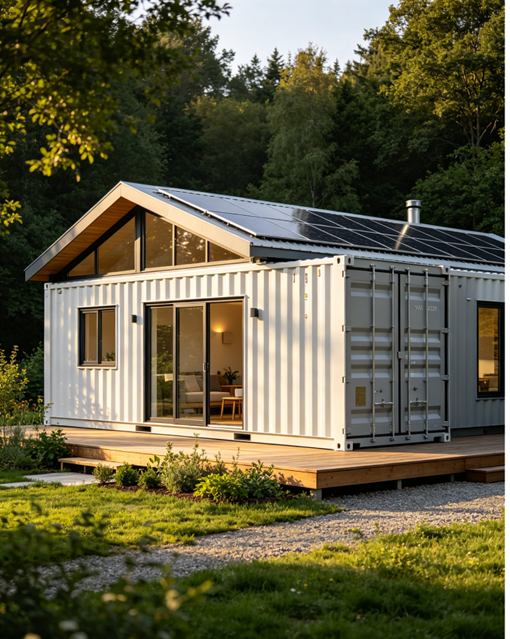
Is a Container House Safe?
Often, when people are introduced to the concept of a container house, they are flooded with…


