



Expandable Container House vs Folding Container House: Which One Is Better for Your Project?
Introduction
Modular building has grown very rapidly as a choice for new buildings in the majority of the world in terms of housing solutions, commercial expansion, and emergency deployment. The demand for reasonably priced and quick-to-construct buildings on a global scale is increasing, with modular construction being the way to go for both temporary and permanent structures. The ‘Expandable Container House’ and the ‘Folding Container House’ represent two of the most interesting options in modular construction.
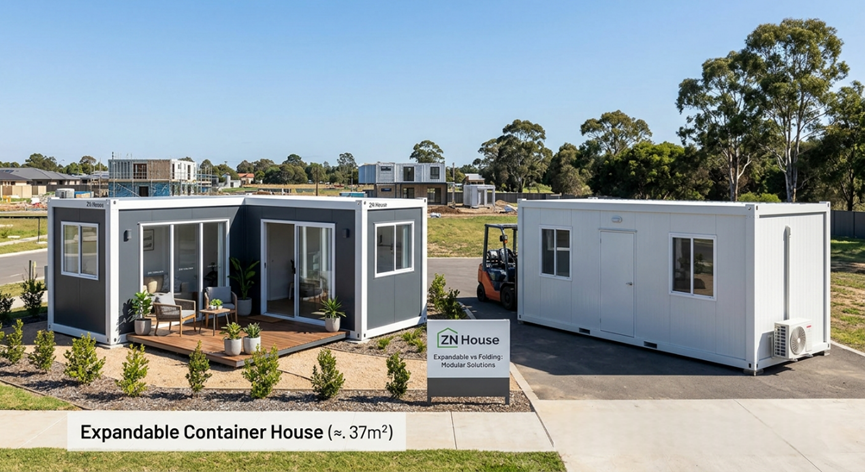
So, what is the best solution for your next project? That depends on how you value living space and long-term comfort vs. speed of assembly, density of your building, and transportation efficiency. In this article, we will go over the differences between (a) the structures of each type of modular container construction; (b) their respective function; (c) what is considered the optimal use for each type; and how you can determine which type of modular container construction would be best for your specific application.
What Is an Expandable Container House?
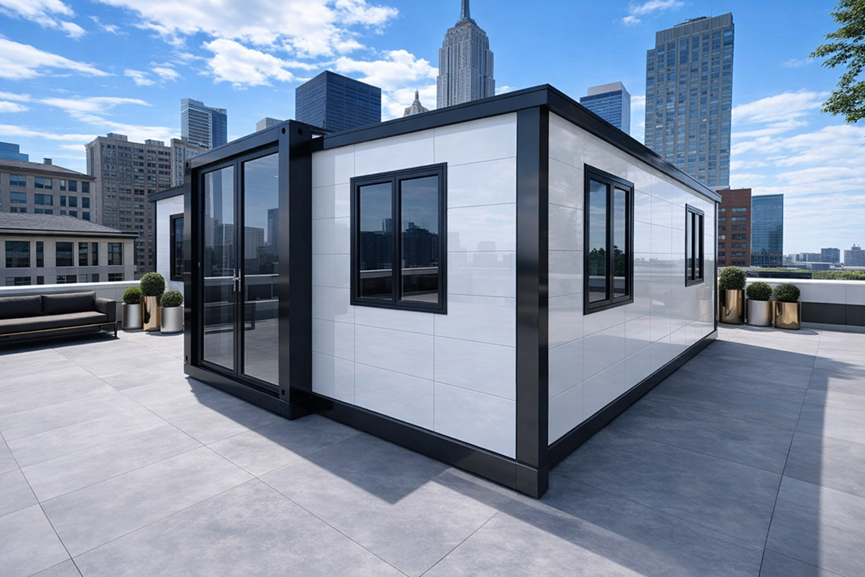
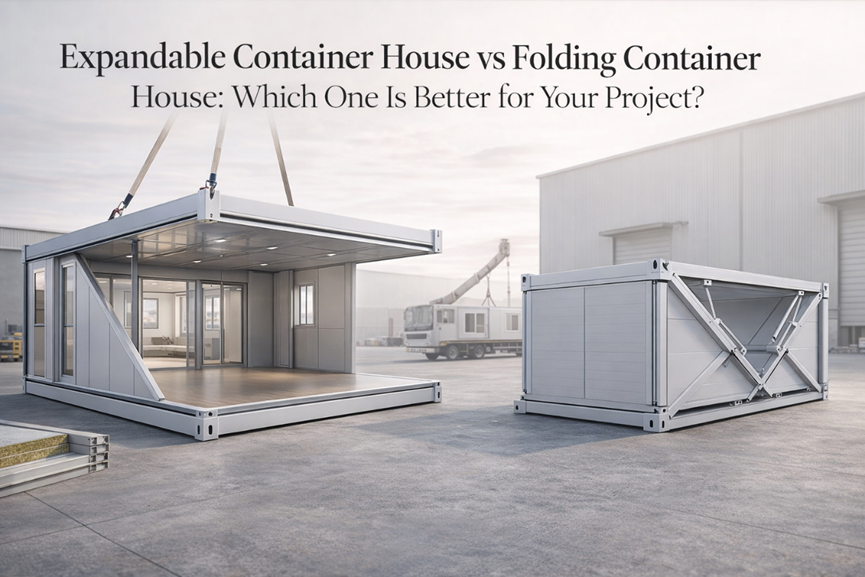
An expandable container house is a modular building type that expands to increase its usable floor area after it has been delivered. It will arrive in a compact shape that can fit onto a delivery truck, but the trailer will expand to create a much larger living area once at the final site of occupancy, using either hydraulic/mechanical systems or slide-out systems that make room for many times more usable living area than contained within the original closed form.
An expandable container home has many features that allow users to create two, three or even larger living spaces based on modular volume with a strong steel frame, insulation, wall and floor panels that are prefabricated and positioned so they lock together once deployed at the final site.
All of the above adaptations provide space for multiple bedrooms, larger living spaces, kitchens, and working spaces without changing the original modular nature of the project design concept. The larger living area can allow for improved zoning and the ability to integrate stronger insulation – this will always depend upon the user’s plans for long-term living vs. year-round living.
What Is a Folding Container House?
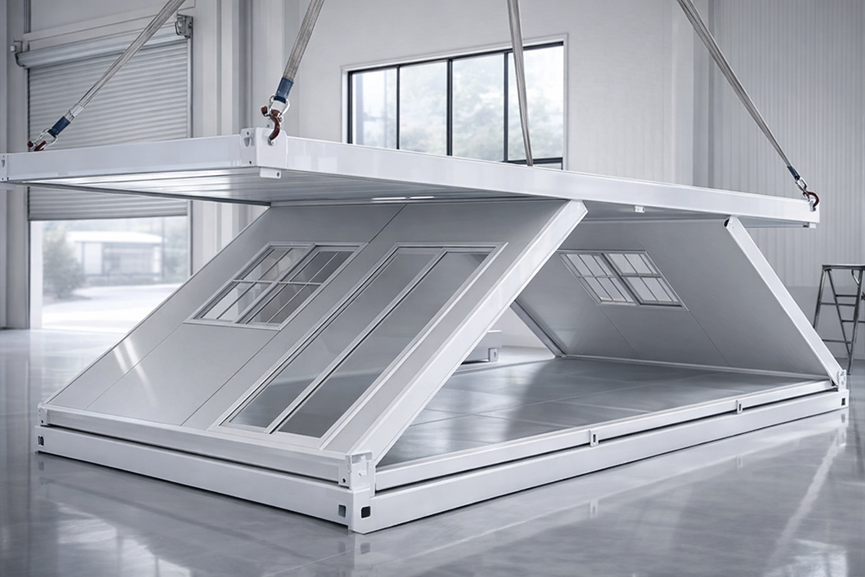
The Folding Container House provides an excellent answer for fast deployment and efficient use of logistics. The folding home has a unique “X-Fold” design with special roller hinges or sliding systems that allow the entire home to be folded down to 360mm to 440mm in height when shipped to your project site.
At your project site, a crane will lift the roof and the installed walls will then “unfold” to assume their pre-connected position. This process typically happens in 10-15 minutes. The model has unique features like an extremely compact design that allows up to 10-12 homes to be shipped in one 40 ft HQ container, as well as the lowest building costs per square meter or per unit. This is a plug-and-play model based on speed and volume which has been used primarily for high-density type buildings such as worker dormitories or emergency housing.
What Is the Difference Between Expandable and Folding Container Houses?
Both containers have the advantage of portability but they both put their own spin on the experience of a modular unit by having different priorities.
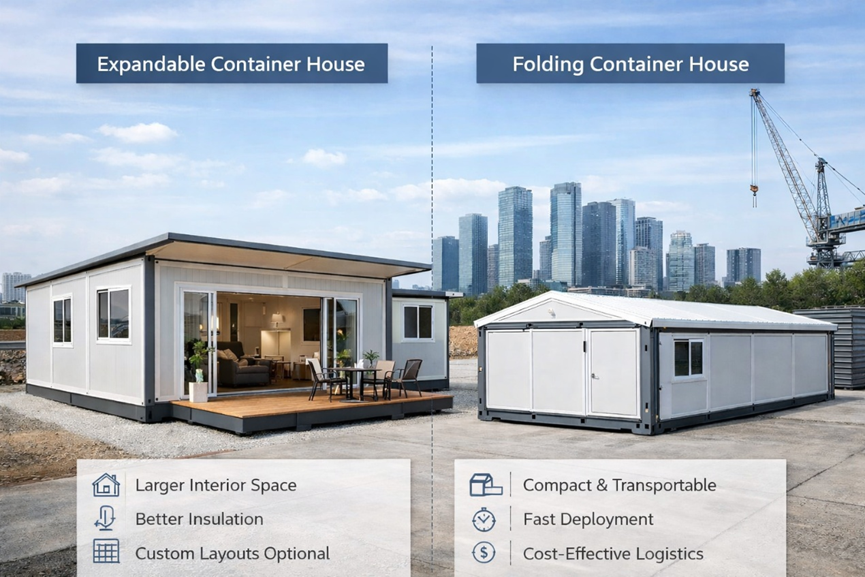
The Expandable Container House creates an emphasis on space quality. It provides large multi-room living spaces (usually 37 square meters in size) that are furnished to a high standard, making them suitable for long-term residential use. The Folding Container House, on the other hand, emphasizes logistical speed. The typical folding container unit is usually between 14 square meters and 15 square meters in size and the units can be delivered and set up in bulk for a fraction of the price of the expandable model. In other words, if you are interested in the quality of the space in a flexible modular unit then you would go with an expandable container house. If you are more interested in the efficiency of delivery, then you would go with a folding container house.
Expandable vs. Folding Container House – Key Comparison
| Feature | Expandable Container House | Folding Container House |
| Space | Large (approx. 37m² / 398 sq. ft) | Standard (approx. 14m² – 15m²) |
| Transport | 1-2 units per 40ft HQ | 10-12 units per 40ft HQ |
| Installation | 2-3 hours (Small crew) | 10-15 minutes (2 people + crane) |
| Customization | High (Multi-room, high-spec MEP) | Moderate (Standardized layout) |
| Durability | 20+ years (Permanent feel) | 15-20 years (Mobile focus) |
| Cost | Higher initial investment | Highly cost-effective |
| Use Case | Granny flats, villas, luxury offices | Site offices, dorms, relief camps |
According to the table above, the Expandable unit has the best space and durability for staying permanently in one place, while the Folding unit is the best choice for large-scale logistics. When making this decision, you must consider whether you will live with one family or an entire workforce.
Which Container House Is Better for Long-Term Living?
The Expandable Container House wins for long-term living and has the necessary structural integrity as construction of the ZN House expandable model includes a reinforced galvanized steel frame of Q235B that has been tested for up to 8 seismic grades and has been tested for wind resistance up to 0.60kN/m2.
Not only is it safe to live in, but it is also much more liveable. Because the unit expands, there will be three distinct rooms: a separate bedroom, a living room and a pre-fitted bathroom. The 18mm Magnesium Oxide (MGO) flooring and 75mm insulated sandwich panels will give an outstanding thermal and acoustic performance. It will feel less like a container and more like a modern, permanent house that was designed for a standard lifestyle.
Which Option Is More Cost-Effective for Your Project?
Cost-effectiveness is different for everyone and depends on the size of your project.
Folding Container Houses
The lowest cost for large projects. 10-12 Units can fit into 1 shipping container, reducing your shipping cost by over 80%. If you have a need to give 100 people housing quickly, you will find the cost per bed to be the lowest with a folding unit.
Expandable Container Houses
Higher initial cost and shipping per unit, but much more value in the long-term. Greater on-site finishing required, but greater resale or rental value, because of size and amenities.
If you need frequent relocation or large temporary housing – use Folding. If you are building an additional residence or a permanent office – use Expandable.
Advantages of Expandable Container Houses
Huge Inside Room: Grows to almost three times its shipping size.
Complete Inside Integration: Fully equipped with all internal plumbing/electrical/cabinetry systems included upon receipt of building.
Excellent Insulation: Provides thicker wall panels which will lower the total costs of energy used to heat and cool down the building.
Aesthetic Appeal: Designed to provide both glass wall systems and high-quality finishes.
Structural Rigidity: Includes the use of heavy-duty (210 mm x 150 mm) lumber columns as an ongoing support method against column loads.
Advantages of Folding Container Houses
Logistical King: This item fits in small spaces and reduces shipping costs.
Extreme Setup Speed: Ready for use in 15-30 minutes.
Reusable & Portable: Built to be moved/installed multiple times without losing structural integrity.
Fire and Weather Resistant: All items use Class A/B flame-retardant materials and galvanized steel, preventing rust.
Stackable: Contemporary designs allow for stacking up to three high on top of each other, to create a more efficient camp area
Limitations You Should Consider
Expandable Limitations
Higher Shipping Costs: You can only ship two units in a 40-foot container.
Weight: Heavier units need more work to prepare the foundation.
Site Access: Needs more room to “unfold” the wings on the site.
Folding Limitations
Smaller Footprint: The inside space is only as wide as a standard container.
Hinge Maintenance: Hinges made of 304 stainless steel and other moving parts need to be checked on a regular basis.
Fixed Layout: Once made, it is harder to change the internal partitions.
Which One Should You Choose?
Choose Expandable if:
- You need a place to live that is permanent or semi-permanent, like a villa or granny flat.
- You need to have a fully equipped kitchen and bathroom ready to go.
- The most important things are thermal comfort and sound privacy.
- You only need to move a few units to one place.
Choose Folding if:
- You are managing a large-scale construction or mining camp.
- You need to deploy housing within 24 hours of arrival.
- You need to store units in a small warehouse when not in use.
- Minimizing international or domestic freight costs is a priority.
Real-World Applications
Construction Sites: Folding houses offer an ideal solution for the placement of site offices or supervisors’ cabins that can relocate along with the construction project’s location.
Emergency Relief: Folding units can be rapidly deployed during disaster recovery for temporary hospitals and shelters.
Residential Housing: Expandable units can function as wonderful primary homes, guest houses, or “tiny homes”.
Commercial Use: Expandable units with glass walls make fantastic pop-up showrooms or stylish cafés.
Remote Mining Camps: Folding units are regularly used as high-capacity workers’ dormitories in remote areas such as Western Australia or Africa.
Frequently Asked Questions (FAQs)
How long does a container house last?
A ZN container unit made of MGO Flooring and Galvanized steel typically lasts from 15-20 years for folding versions and can live more than 20-25 years for expandable styles if regular maintenance on hinge seals is performed.
Which one is cheaper?
The price of the Folding Container House is low (both the unit and shipping price), but the Expandable Container House has more amenities and a larger total square footage for each square meter than the basic unit.
Can it be used for living?
Yes, you can live in both. The Expandable Container House, on the other hand, is designed for comfort in the home, with separate rooms and better insulation. The folding house, on the other hand, is more often used for dorm-style living.
Is it waterproof?
Yes. ZN House employs D-shaped adhesive strips, waterproof tape at joints, design in different horizontal layers, plus a dedicated drainage system to keep every unit free from water damage even when the rain is torrential.
What is the shipping capacity?
A standard HQ 40ft container can accommodate roughly 10 to 12 pieces of the Folding Container House when folded down to 440mm, but only 1 to 2 pieces of the Expanding Container House due to their much larger and heavier central core.
Conclusion
While choosing between a folding container house and an expandable container house, it’s essential to note that neither choice is going to be better than the other, but rather that one of them will fit your goals more appropriately.
The folding container house is a marvel of speed and logistics, ideally suited for temporary, high-volume uses. The expandable container house provides generous accommodation for those who demand an uncompromising level of excellence in their modular construction.
By gaining a thorough understanding of the design qualities and performance benefits of both types of container homes, you can make certain that your next modular project will have a reliable foundation on which to build.
Ready to Start Your Project?
Contact ZN House for a complimentary design consultation or ask us for price information on our modular homes. Our professionals will assist you with selecting the right modular home for your location.
Similar Posts
Sustainable Living with Modular Container Homes
Sustainable living has become a global priority—and modular container house solutions are leading the way in eco-friendly…
Detachable Container House Advantages for Rapid Deployment Projects
The modern world economy requires construction to be completed extremely quickly. Infrastructure, disaster relief, and commercial…
Explore the Benefits of Modular Container Houses
In today’s fast-paced world, the demand for versatile and cost-effective living solutions is on the rise….
What is a Container Office? A Deep-Dive into Benefits and Structural Integrity
With today’s business environment being so competitive and multifaceted, agility has become the ultimate way to…

Modular Container Homes for Sale Custom Layouts
In the dynamic world of modern housing solutions, modular container homes for sale have emerged as a revolutionary…

Assemble Container House Crane Rental Tips
Assemble Container House Crane Rental Tips are essential for ensuring safe, efficient, and cost-effective installation of…


