



How to Insulate a Container House: Complete Guide (2026)
The architectural trend of container houses has turned into an international movement that promotes the idea of sustainable, affordable, and modular living. The biggest problem builders encounter when working with containers is the inherent properties of the containers themselves — they are large metal boxes that, without the correct heat control, will behave like a large oven in summer and a large freezer in winter.
If you want to know how to properly insulate a container house, this is the right place for you. We will leverage our technical expertise from ZN House—the preeminent manufacturer of modular containers—to provide a detailed breakdown of how to insulate your container home, how much to spend on insulation, and the best way to professionally insulate it for years to come.

Why Insulation Is Essential for Container Homes
Shipping containers are made of steel, which behaves very differently from traditional building materials.
Problem: Extreme Temperature Swings
- Containers quickly absorb heat in the summer, making their interiors unbearably hot.
- They quickly lose heat in the winter, making the interiors freezing.
Consequence: Without sufficient container insulation, your HVAC system will struggle, leading to expensive energy bills and uncomfortable living conditions.
Problem: Condensation (Most Critical Issue)
Steel surfaces cool rapidly. Moisture is created when cold steel walls come into contact with warm indoor air.
Consequence:
- Water droplets inside the walls
- Mold growth
- Rust and corrosion of the container structure
Vapor barrier container solutions are therefore necessary rather than optional.
Problem: Mold & Structural Damage
Moisture is trapped by poor insulation.
Consequence:
- Health risks from mold
- Long-term deterioration of the structural integrity of the container
Problem: Energy Inefficiency
Without Insulation:
- The cost of heating and cooling rises dramatically.
- Comfort levels drop
Proper Insulation Improves:
- Thermal stability
- Energy savings
- Overall livability
Key Factors to Consider Before Insulating
You must assess the conditions of your project before selecting materials or techniques. Elaborately, you must evaluate the requirements of your particular project before purchasing foam boards or a spray gun.
Climate and Location
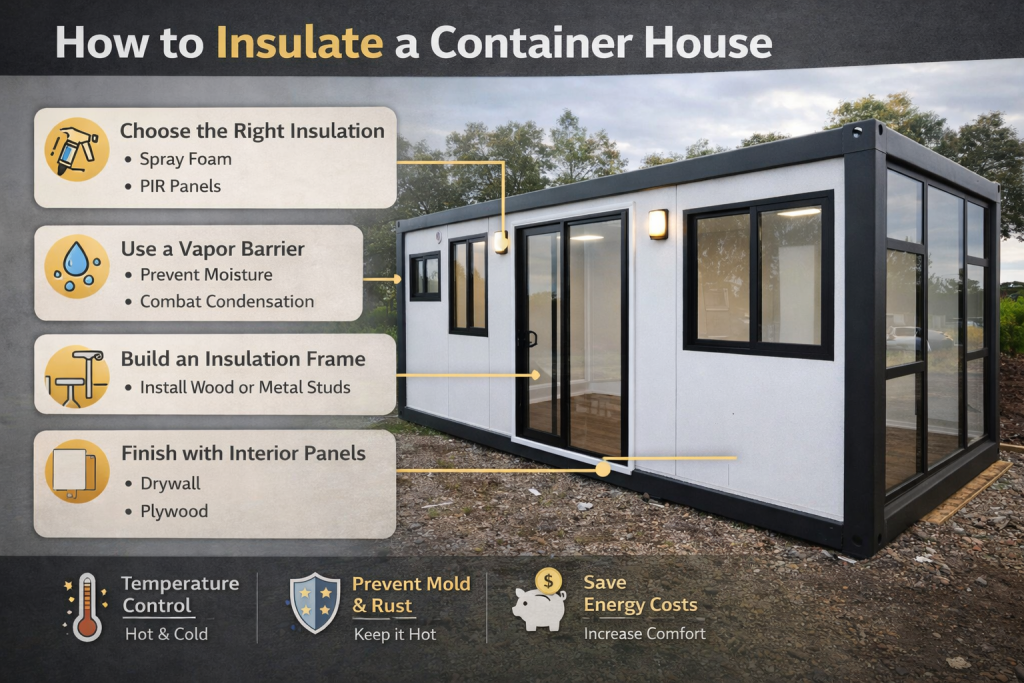
The R-value needed for the walls, roof, and floor of a container home will depend on your zone. Generally, colder and mixed-type zones require a higher R-value than milder or moderate-type zones, meaning that insulating materials like closed-cell spray foam or PIR panels will be beneficial in cold or mixed-type zones, while rockwool and/or EPS panels would be sufficient in a moderate-type zone.
If you live in a hot, humid coastal environment, it is advised that you utilize either continuous exterior or spray foam insulation to manage the heat absorbed into the metal skin while allowing for moisture to be released. If you live in a cold climate or a high-altitude environment, you should use thicker wall and roof assemblies with appropriate vapor control on the warm side to prevent condensation from developing inside the wall assembly.
Intended Use (Home vs. Storage vs. Office)
When selecting insulation for your container home design, keep in mind that what is suitable for a storage or office container might not be suitable for a primary residence. Containers that are used as full-time residences require a higher R-Value, greater soundproofing capability, and superior condensation management compared to those containers that are simply looking to provide a dry place to store products.
If you are creating a custom-built permanent home out of a shipping container, we would suggest a solid wall construction utilizing performance-based insulation (i.e., spray foam or PIR) along with interior finishes that would typically be found in a standard home. If you are installing a container as either a temporary worksite design or as a site office, then the use of insulated sandwich panels or a hybrid solution that combines quick installation with performance, like the modular envelope being utilized by ZN House camps, would be recommended due to their cost-effectiveness.
If your container project will be primarily used for basic storage, we would suggest lower-end solutions, such as rigid foam or EPS flat panels, with adequate ventilation and select vapor control, rather than investing heavily into high-end solutions that would provide a level of comfort typically found in a residence.
Space Limitations
The internal measurements of a 20-ft or 40-ft ISO shipping container are very limited. Therefore, every centimeter of insulation you place on the inside of a container will reduce the usable floor area. Insulation placed on the outside of the container will maintain an internal width, but you will also have to provide cladding, flashing, and extensive detailing on the exterior of the shipping container.
If you are building a small home out of a 20-ft container, we recommend you consider the exterior insulation, or use thin high-performance insulation such as PIR or closed-cell spray foam to limit loss of internal space. However, if you combine multiple containers (like we do with ZN House in our camp projects), we recommend building standard framed interior walls, as a fractional loss of space is not as much of an issue, and the detailing of the walls is easier to achieve.
Main Methods to Insulate a Container
Choosing the correct application method for insulating a container house is essential for creating a comfortable environment inside it. Below are the three major applications that are used in modern engineering:
Internal Insulation (Most Common Method)
The interior insulating process essentially creates an insulated “box” within the outer steel container; this means constructing an all-framed interior wall and ceiling structure (framing comes after adding a vapor barrier), insulating the inside of those frames with a suitable insulation material, and finally covering those insulated frames with finished interior wall materials (panels or drywall, etc.). As such, this is a common method of converting cargo containers by both DIY homeowners and commercial businesses. Many of today’s modular camps and housing systems utilize this process for their design and structural integrity.
Pros:
- Very simple for do-it-yourself (DIY), utilizing light steel or common wood framing.
- HVAC, plumbing, and electrical services are simple to operate in wall cavities.
Cons:
- Decreases the height and width of the interior.
- Inadequate detailing may cause moisture to be trapped between steel and insulation.
External Insulation
An external insulation system shields the production container with insulation and a weather-proof cladding material, maintaining the metal shell at a temperature closer to the indoor space than if it were to be simply exposed. By using this approach, thermal bridging has also been minimized. It is also commonly used in architect-designed groupings of shipping containers so that the outside exposed to the weather appears to have a single uninterrupted finish.
Pros:
- Keeps nearly all of the interior space intact.
- Reduces the risk of condensation inside the shell by keeping the steel skin warm.
Cons:
- More intricate details around windows, doors, corners, and connections between several containers.
- Cladding and support systems usually result in higher labour and material costs.
Spray Foam Insulation
Closed-cell polyurethane (commonly referred to as spray foam insulation) is a highly effective way to insulate containers. With its ability to adhere to the metal directly, filling all empty spaces, and creating high R-value insulation plus a vapor retarder, this material offers the best spray foam insulation option. It can be installed inside, outside, or both through the use of combination systems.
Pros:
- High R-value per inch, perfect for small spaces.
- Reduces the risk of condensation by acting as a vapor barrier and air seal.
Cons:
- More expensive initially than polystyrene or rockwool.
- Requires specialized tools and safety measures; it’s challenging to do it yourself at a professional level.
Best Insulation Materials Compared
Rockwool, PIR, spray foam, and polystyrene (EPS/XPS) are the most commonly used materials in insulating a shipping container home. Each material has different costs, performance levels, and ideal uses, particularly when used in conjunction with ZN House-style metal framework and sandwich wall systems.
Insulation Material Comparison
| Material | Cost | Performance | Best Use |
| Spray Foam (Closed-Cell) | High | Excellent (R-6.5 per inch) | Extreme climates & condensation prevention |
| Rockwool (Mineral Wool) | Medium | Good (Fire-resistant) | High-end eco-friendly homes & soundproofing |
| PIR | Medium | High (Great for thin walls) | Projects with tight space constraints |
| Polystyrene (EPS/XPS) | Low | Moderate | Budget-conscious builds or mild climates |
Table 1: Comparison Table: Container Insulation Materials
Recommendations
- Rockwool: Eco-friendly materials and fire safety should be your top priorities.
- PIR: Great for do-it-yourselfers who want high R-values without spray foam mess.
- Spray Foam: The best option for guaranteeing a lifetime seal and preventing rust.
- Polystyrene: Ideal for B2B storage solutions or temporary structures.
Do You Need a Vapor Barrier?
Yes, absolutely. A vapor barrier is a substance (usually a sheet of foil or plastic) that prevents moisture from reaching the cold steel wall.
Why is it Mandatory for Containers?
Steel does not allow moisture to transfer through it. If warm air touches the steel, the moisture will turn to liquid water and will now be trapped between the steel surface and the insulation, which may result in corrosion.
Materials That Need a Different Vapor Barrier:
- Rockwool
- Fiberglass Batts
- EPS Panels
Materials That Don’t Need One:
- Closed-cell spray foam (it has its own vapor barrier)
- High-quality PU Sandwich Panels
Step‑by‑Step Guide to Insulating a Container
To guarantee that your container insulation is installed expertly, follow these instructions:
Cleaning & Rust Prevention
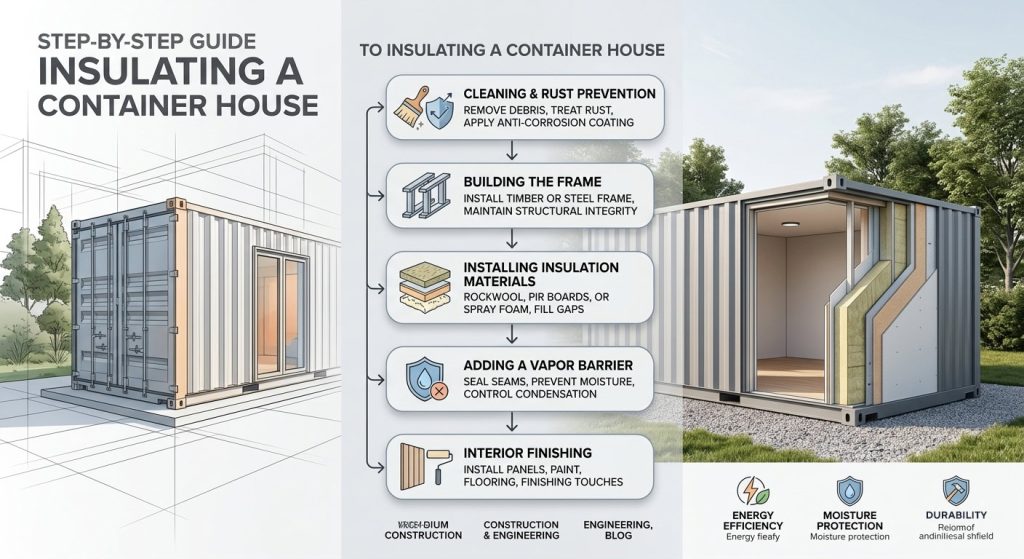
First, clear the container of any loose materials, including paint, oils, and contamination. To get rid of any surface rust on the steel shell, use mechanical methods. Apply a premium corrosion-resistant primer or coating to protect the exposed steel and extend the container’s lifespan after removing these items from the interior. Then, insulate the container’s exterior.
Building the Frame
Using either timber studs or light gauge steel, construct your frame system from your point of reference spacings and install insulation thicknesses to new centre lines to accept all new service lines. When fastening each bracing member, it is important not to cut any structural members that may weaken or compromise the strength of the container shell, and you must maintain the overall stability of the interior frame when installing.
Installing Insulation Materials
Install your selected form of insulation, whether it’s Rockwool batts in between the studs, PIR/poly boards on top of the framing, or a can of spray foam in contact with the metal, and fill remaining void spaces as well. Ensure that you also cover all corners, joints, windows, and doors with your chosen type of insulation so that you can reduce the number of thermal bridges.
Adding a Vapor Barrier
Where applicable, apply an uninterrupted vapor barrier (on the warm side of the wall) when installing your chosen type of insulation by ensuring that seams are properly taped and that penetrations into walls are sealed (outlets/pipe). Prior to adding additional barriers to closed-cell spray foam systems, check to see if the thickness of the current application has met the required amount of vapor control.
Interior Finishing
After you have attached your interior panels (OSB, cement board, and drywall) to the framework, you now finish your joint, paint, lay your flooring, and add your trim. At this point, your container home will be similar in appearance and performance to a typical small home, with the steel shell hidden behind a high-performance envelope.
How Much Does It Cost to Insulate a Container House?
Based on the project requirements and the local market conditions, one can logically expect that the insulation of the whole living area inside a 20-foot shipping container shall cost around $4,000.00 to $7,000.00, including labor and material expenses. Besides that, sophisticated designs and systems utilizing high-end features such as closed-cell spray foam, premium finishes, and integrated MEP routing may go close to or way above $7,000.00 for a high-end insulated shipping container.
A clear cost breakdown approach helps:
Size: A 40 ft. container actually has about 2x the surface area of a 20 ft. container, so insulation costs will increase accordingly, often doubling or potentially exceeding that. However, to some extent, economies of scale may help reduce the overall cost per square foot, offering improved cost efficiency on larger projects.
Materials: The prices of rockwool and polystyrene in comparison to PIR and spray foam are usually lower, but to be efficient, they may have to be thicker and have additional vapor control layers.
DIY vs. Professional: While professional sprayed or panel systems are more expensive but perform better and require less rework, do-it-yourself framing and batts can save labor but increase time and error risk.
With an investment in better insulating material up front, such as high R-value and very airtight container insulation, energy efficiency improvements (HVAC sizing) can result in long-term energy savings on a monthly basis compared with most buildings’ lifetime utility costs across many climates. For longer-term (i.e., residential homes, camps, etc.) building projects, the energy efficiency improvements from these materials will likely more than offset the cost of the building’s initial thermal insulation costs.
Common Mistakes to Avoid
When planning how to insulate a container house, use this quick ×/ √checklist:
×Omitting vapor barriers where necessary, especially when using rockwool or EPS products. This is a common issue in climates that are at lower temperatures or have mild-to-cold temperatures.
√ Verify if your system requires a vapor barrier and place it on the correct side of the assembly with properly sealed joints.
×Using stick-built construction techniques and ignoring the unique characteristics of thin metal-clad walls regarding energy transfer.
√Modify design parameters to accommodate rapid temperature fluctuations, prevent thermal bridging through metal components, and account for condensation risks on the exterior of the metal cladding.
×Not best practice to assume “that a little insulation is better than none”, and therefore ignore the risks of condensation.
√Design the entire wall as one complete assembly and consider how the insulation, air barrier, and vapor barrier will work together to move the dew point.
×Installing too many holes or cutting too many holes without first evaluating their structural impact on corrugated metal walls, or whether the holes affect their load-bearing ability.
√Compliance with construction codes/ANSI requirements regarding how to create new openings/conditions in your existing building or hire an engineer (as is done at ZN House) to ensure that you are properly modifying the structure without compromising its integrity.
Best Insulation Solutions by Use Case
Container Homes
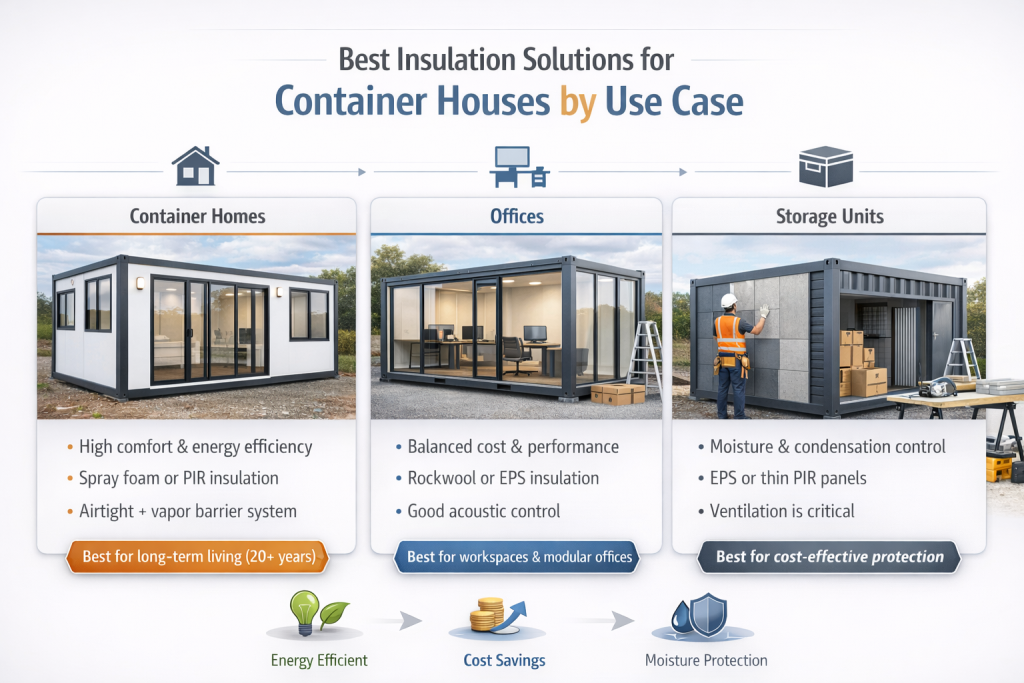
The primary importance of a full-time container home design is comfort, durability, and energy performance. For example, a typical quality solution would have closed-cell spray foam applied directly to the steel or PIR boards installed in a framed system with a carefully detailed vapor barrier, along with an interior framework for installing services.
We Recommend:
We build super energy-efficient compounds using either foam or PIR spray insulation and using an airtight liner on the interior. This product is well-suited for customers who are looking for 20+ years of residential use. This is similar to our high-spec insulated container building, which we offer ZN House for extreme weather and long-lasting residential projects.
Offices
Thermal comfort must be considered when planning container offices; however, as occupancy hours might simply be during workdays. Insulated sandwich panels or framed walls with rockwool or EPS and a suitable vapor barrier might be enough while also keeping the budget under control.
We Recommend:
Going for a balanced approach by using factory-made insulated panels or rockwool in framed assemblies, producing excellent acoustic control and decent R-values, while not resulting in the total expense of spray foam. This fits well with modular office and camp units typically provided for construction and mining clients.
Storage Units
In the case of dry storage, the primary concern is actually to avoid the problem of extreme condensation and to keep temperature extremities within a limited range, rather than achieving full residential comfort. Usually, basic EPS or PIR panels, when used together with ventilation and effective vapor control, provide sufficient protection for the goods.
We Recommend:
Go for cheap polystyrene or thin PIR panels that have good air-sealing and ventilation features (either passive or mechanical), rather than heavy and costly interior fit-outs. This strategy will help to minimize capital cost while, at the same time, drastically lowering the instances of sweating and corrosion within the storage container.
Read this article from our blog to know how rock wool insulation impacts the temperature of a container house.
Conclusion
Insulating a container house is more than just filling the wall openings with materials; it is essentially creating a total system that controls the movement of heat, air, and moisture in such a way that the steel frame stays in good condition. The interior becomes a warm and comfortable home. The ideal insulation for container home projects varies with the climate, the purpose of the space, and the amount of available space, but a well-selected blend of materials, along with a properly installed vapor barrier, will definitely yield better results than the most cost-friendly improvised solution.
If you are working out how to insulate your container house – whether it is a one-off DIY build, or a multi-unit camp – it pays to get a recommendation for your specific climate, layout, and budget, rather than simply copy a generic detail.
To match your insulation design to engineered container structures such as the ones from ZN House, you can get in touch with our technical team, request a custom design, or request a project-specific quote that packages structure, insulation, and finishes together as one integrated offering.
Similar Posts
How to Choose the Right Site Office Container for Your Construction Project
The construction industry, which operates in dynamic settings and under time pressure, demands the highest levels of…

How a Collapsible Container House Can Save You Time and Money
In today’s fast-moving world, innovative housing solutions are revolutionizing the construction industry. Folding container house and collapsible container house options…
Fold Out Container Homes for Emergency Shelter
Fold out container homes—alongside folding container house and foldable container house variants—have become a lifeline in emergency scenarios,…
Flat Pack Container Houses vs. Traditional Housing: What’s the Real Difference?
Introduction Increasingly, modern construction projects require building systems that can respond to the changes based on…
Container House Construction: Expert Advice on for Urban Spaces
Container house construction offers fast, affordable, and eco-friendly urban housing with flexible layouts and strong steel frames.

Assemble Container House vs Traditional Construction: Key Differences
The housing industry is evolving rapidly, with assemble container house solutions emerging as a revolutionary alternative to conventional…


