



What is an Assemble House? A Complete Guide to Detachable Steel Structure Housing
Currently, most infrastructure projects require buildings that can be efficiently and economically set up, moved, and reused between project cycles, as is the case with many modern-day projects. This has become more difficult for engineering contractors, mining businesses, government infrastructure programs, and international developers, who are all finding it hard to provide for their needs due to the limitations of traditional construction methods.
The Assembly House concept has taken a different approach; it provides an entirely new framework for infrastructure projects and is designed for fast installation and disassembly, reinstallation, and reuse over and over again. Instead of using traditional construction techniques, the Assembly House uses modular components, with modular construction methods, conventional construction methods, and other construction innovation techniques, to create and deliver an entirely modular building system at once.
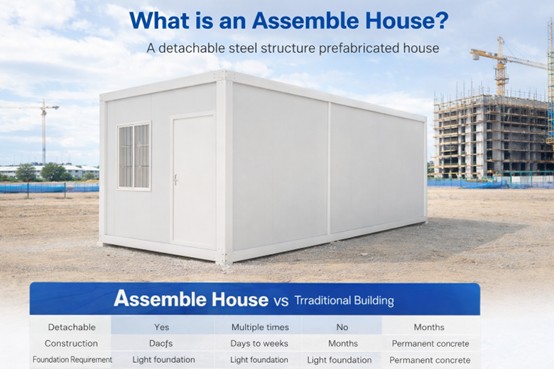
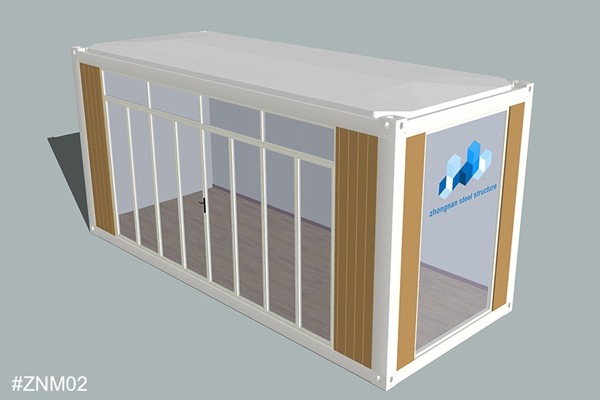
Fig.1: Assemble House: Detachable Steel Structure Prefabricated Housing System
Assemble Houses can typically be erected and ready for use within days after a project has finished, just as easy are they can be deconstructed, relocated, and used again. For these reasons, the Assemble House is a highly efficient housing choice for the construction of dormitories in construction camps, or for housing related to mining, disaster relief, and temporary project offices.
In addition to their efficiency as a housing solution, Assemble Houses are engineered using steel structure prefab building technology in conjunction with modular panel systems and industrial manufacturing quality control, ensuring structural safety and long-term durability.
What is an Assemble House?
An Assemble House is a detachable steel structure building system designed for quick installation, disassembly, relocation, and repeated reuse. Assembly houses are typically referred to as: detachable houses, prefabricated houses, knock-down houses, or dismounted houses.
Assembled houses are designed to be transported and assembled quickly and efficiently in order to provide housing for people. An Assemble House’s structural system consists of:
- Bolt connected galvanized steel frames.
- Panelized wall/roof systems.
- Modular standardized components.
- Flat Pack Transportation Design.
As opposed to traditional houses that are fixed to the ground or foundations, an Assemble House is a demountable housing system. All of the components are manufactured off-site, shipped flat pack, and assembled on-site.
A typical unit structure includes:
| Component | Typical Specification | Engineering Purpose |
| Steel Frame | Q235 structural steel | Structural strength and load resistance |
| Main Beam & Column | 2.2 mm thickness | Structural stability |
| Wall Panels | Sandwich panel (rock wool / EPS) | Thermal insulation |
| Roof Panels | Insulated steel panel | Waterproofing and thermal protection |
Table 1: Core Structural Materials and Specifications of an Assemble House
Assemble Houses are well-suited for temporary housing projects because all components are designed to come apart and reassemble multiple times with minimal to no deterioration.
What Makes an Assemble House Different from Traditional Buildings?
The design philosophy of an Assemble House differs from that of more traditional forms of construction, as the traditional building will stay in place (sometimes forever). In contrast, the Assemble house has been designed for both mobility and reuse.
Key Comparison
| Feature | Assemble House | Traditional Building |
| Detachable | Yes | No |
| Reusable | Multiple times | No |
| Construction Time | Days to weeks | Several months |
| Foundation Requirement | Light foundation | Permanent concrete foundation |
| Lifecycle Cost | Lower over multiple projects | Higher |
Table 2: Comparison Between Assemble Houses and Traditional Buildings
Engineering Implications
Construction Speed
Classic construction methods involve excavation, needing time for pouring concrete to cure, and lots of work performed by multiple subcontractors working on different stages. The reason that assemble houses will reduce most of these activities is that each of the homes’ structural components is pre-made in factories.
Project Flexibility
After the completion of a project, like a construction site or mining site, most old constructed buildings will then become abandoned assets. The adaptability of Assemble Houses allows them to be dismantled and moved to a new job site, which significantly improves asset utilization.
Cost Efficiency
At first glance, the initial unit price of a conventional style building will generally be the same as the initial unit price of a unit that has been designed to be reused; however, when taking into consideration that this reusability factor greatly helps to lower the overall lifecycle costs.
How Does an Assemble House Work?
An Assemble house is constructed using an industrialized process that consists of a combination of engineering design and manufacturing through factories and modular assembly.
Engineering & Structural Design
Every project starts with a structural design and load analysis. These engineers will perform a structural performance calculation using the following items:
- Wind loads
- Seismic requirements
- Vertical loads
- Environmental conditions
An inspection of the structural integrity of a standard modular unit will provide the following data:
| Structural Parameter | Result | Standard Limit |
| Beam Vertical Deflection | 14 mm | < 23 mm (L/250) |
| Column Horizontal Drift | 16 mm | < 18 mm (H/300) |
| Steel Stress Range | 118–171 MPa | Within allowable limits |
Table 3: Structural Performance Analysis of an Assemble House
The calculations confirm that the building will be structurally sound according to code, regardless of whether it is a two-storey configuration or not.
Factory Fabrication of Components
Upon finalising designs and before any assembly, all structural elements/components are manufactured at a factory under controlled conditions from the most common types of material:
- Q235 steel structural frames
- Galvanised steel panel
- Insulated sandwich panels
Factory production yields:
- Consistent material quality
- Accurate measuring and cutting of component dimensions
- Following the code requirements for quality control.
Independent testing of material has shown that structural steel used within the system achieve relied upon tensile strength from 428 MPa to 450 MPa, which is in accordance with engineering demands.
Fig. 2: The Lifecycle of an Assemble House: From Engineering to Relocation
Flat-Pack Transportation
After the fabrication process has been completed, your components will be packaged in a flat pack for ease of shipping.
Benefits of flat pack packaging include:
- Improved loading efficiency of the containers.
- Reduced international freight costs.
- Easier access for delivery to remote locations.
For overseas infrastructure projects, the transportation costs can be a significant percentage of the overall project budget, making flat packing an attractive option.
On-Site Bolt Assembly
As opposed to welding, installation is done with a bolt connection.
There are many advantages to this type of installation:
- There is no special equipment for welding
- Installation is faster
- Quality control is easier
- Training is simplified for laborers
Normally, a relatively small crew can assemble a modular unit in about 1-2 days, depending on the size of the project.
Future Disassembly & Relocation
An Assemble House’s capability to be fully disassembled is one of its most important qualities.
When the project is finished:
- Remove the panels
- Unbolt the steel frames
- Pack the components
- Transport the structure to a new job site
This process turns the Assemble House from a one-time use structure to an engineering system that can be reused.
Core Structural Features of an Assemble House
Bolt-Connected Steel Frame System
Using bolted connections instead of welded connections in the structural framework removes the requirement for permanent welding.
The benefits of using bolted connections include:
- Trustworthy structural durability,
- Faster installation,
- Simpler replacement of components.
Most steel frames are constructed using Q235 steel, which balances strength, ductility, and cost efficiency.
Panelized Wall & Roof System
The system for enclosing an area is made using insulated sandwich panels.
The standard options available are:
| Panel Type | Insulation Core | Advantages |
| Rock Wool Panel | Mineral wool | Fire resistance |
| EPS Panel | Expanded polystyrene | Lightweight & cost-efficient |
| PU Panel | Polyurethane | High insulation performance |
Table 4: Common Insulation Panel Types Used in Assemble Houses
These panels function as thermal insulators, sound reduction materials, and weatherproofing.
Based on test results showing that these panels were able to reduce noise by around 14.9 dB, they resulted in improved indoor comfort levels for workers living in accommodations.
Modularized Standard Components
Having standardized designs for components such as wall panels, doors, windows & flooring systems will ease their replacement and/or upgrading.
By having standardized designs for components such as wall panels, doors, windows & flooring systems, you will greatly reduce the cost of maintenance through long term lifecycle of the project.
Flat-Pack Shipping Design
Engineering that is flat-packed maximises logistical efficiency.
The advantages of flat-pack engineering include:
- Decreased volume of shipped goods
- Improved use of shipping containers
- Lower transportation costs
In the case of international projects, flat-pack engineering has the potential to cut the total expense of shipping by 20% to 30% compared to pre-manufactured modular buildings.
Key Advantages of an Assemble House
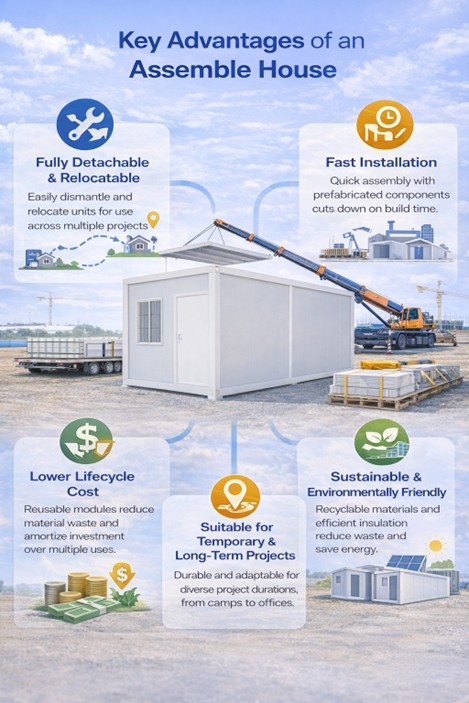
Fully Detachable and Relocatable
Dismantling and relocating the house itself is a key benefit of using Assemble Houses.
Contractors managing numerous projects (e.g., construction or mining) can utilize the same system of housing across several projects of either type.
Fast Installation
Construction fabrication moved to a manufacturing environment, reducing on-site construction to assembly only, using standardized modular frames equipped with interlocking panels; therefore, eliminates the need for cure time of concrete and/or special welding. This factory process emphasizes the efficiency of individual components by enabling them to be delivered within days, and helps achieve quicker mobilization to project use as required by time constraints.
Lower Lifecycle Cost
The difference in material specifications will result in different initial capital costs, but the long-term lifecycle costs are much lower than with traditional construction methods. Reusable modular components reduce both the waste of materials and the associated demolition costs. The initial investment can be amortized over multiple project cycles to result in a significantly lower cost per use than the traditional “build, use, demolish” method of construction.
Sustainable and Environmentally Friendly
The Assemble Houses align with the principles of green building through substantially reducing the amount of waste produced on a job site. The majority of the materials used to build the houses can either be recycled or reused, which greatly reduces the environmental impact of each project. Also, the use of high-performance insulated sandwich panels allows for improved thermal efficiency that will result in reducing energy consumption in the long term due to climate control.
Suitable for Temporary & Long-Term Projects
They are made to last, even though they have a modular design. With attention to maintenance and materials used in the building construction, their lifespan is from 10 to 20 years, which means that they can be used as either temporary camps or semi-permanent offices/worker accommodation. They strike an excellent balance between mobility and structural strength, making them an ideal flexible solution for any project scheduling.
Typical Applications of Assemble Houses
Assemble Houses are frequently employed in project-based environments where quick deployment and flexibility are important.
Construction Site Accommodation
When large-scale infrastructure projects are underway, there is often a need for temporary worker housing, engineer housing, and management team housing.
Temporary worker accommodation solutions offered by Assemble House offer workers, engineers, and management teams a warm, pleasant, and scalable product to accommodate their needs while working on infrastructure project(s).
Labor & Worker Camps
Many industrial developments require big work camps; it may not be on the same construction site as the work is either going to be re-used or transferred to different sites.
Because Assemble Houses use modular and portable logistics, they are quickly and financially feasible in these types of development situations.
Mining & Oil Field Camps
The mining industry often finds itself in areas where there is very little to no existing infrastructure, which can present unique challenges for new operating sites. Flat-pack modular homes can provide a solution to the challenges of building in these relatively inaccessible locations by simplifying transportation and installation processes.
Disaster Relief Housing
Temporary housing can be deployed quickly after a natural disaster, as long as the housing meets the required safety and comfort criteria. Prefabricated, removable homes provide rapid deployment in an emergency situation.
Temporary Office Buildings
Do you need a place to work while you construct? Since Assemble Houses are often used as site offices, they’re a good option for constructing anything from large commercial buildings to small residential projects.
Remote Area Housing
Transportable housing options are needed for infrastructure projects taking place in deserts, mountains, or offshore locations. The use of modular buildings that can be flat-packed makes them perfect structures to be used in these locations.
Are Assemble Houses Durable and Safe?
The engineering safety aspect in engineered buildings is just one of many important parts of modular construction.
Assemble Houses have undergone extensive testing throughout their construction process; structural design testing & analysis have proven they can satisfy the performance requirements established by the assembly method chosen for its application.
Structural Performance Indicators
| Performance Category | Typical Result |
| Vertical Floor Load | 120 kg/m² |
| Roof Load | 100 kg/m² |
| Wind Resistance | Up to 65 kg/m² (depending on panel type) |
| Structural Stress | Within allowable limits |
Table 5: Structural Performance Indicators of Assemble Houses
Waterproof Performance
Roof and wall spray testing has shown that the system is capable of withstanding high-pressure water exposure without leaking and is therefore resistant to most weather conditions.
Fire Resistance
Assemble Houses that use insulated panels composed of rock wool, which provide high-calibre fire resistance capabilities thanks to their use of a mineral fibre core material.
Anti-Corrosion Treatment
Steel structures usually have a protective finish applied to avoid rusting, thus prolonging their lifespan by minimizing corrosion. The service life ranges from 10 to over 20 years, depending on the specification.
Compliance with Standards
Manufacturers create these types of structures to meet international quality systems, such as:
- ISO Quality Management System – Standard
- CE certification requirements
- National code and building code
Having these certifications guarantees both consistent safety in engineering and dependable manufacturing.
How Much Does an Assemble House Cost?
The cost of an assembly house, often also referred to as a detachable house or knockdown house, is highly variable due to the characteristics of modular, transportable, and configurable buildings. Rather than being priced according to fixed values, pricing is determined by various factors that depend on the configuration of the assembly house. Reusability of the system has a significant impact on the long-term value and will also lower overall lifecycle costs over the course of each assembly house’s use.
| Factor | Impact on Price |
| Building Size | Larger units require more materials |
| Steel Specification | Higher steel grade increases strength and cost |
| Panel Thickness | Thicker insulation improves performance |
| Project Quantity | Bulk orders reduce unit cost |
| Transportation Distance | Shipping cost varies by region |
Table 6: Cost Drivers for Assemble Container House
Price will vary, but being able to reuse the building as part of multiple projects greatly reduces the long-term cost per use.
Why Reusability Reduces Long-Term Costs
The original investment on assemble houses was shared over numerous projects or in different years, allowing each subsequent time they are installed to place the effective knock-down cost per square area lower than before due to waste reduction and downtime reductions from single-use versus fixed structures. Over the course of their entire life, the potential to be reused will produce some of the largest contributing factors for savings over the long run.
Frequently Asked Questions (FAQs)
How many times can an Assemble House be reused?
A well-maintained Assemble House can be assembled and dismantled quite a few times. However, the exact number of times depends on the condition of the components and the thoroughness of the maintenance procedures.
Does easy assemble house requires a concrete foundation?
Most of the time, Assemble Houses will be adequate with light foundations like concrete pad or strip footings instead of full structural foundations.
Can house assemble withstand extreme weather?
Yes. Assemble houses, if properly engineered, are capable of resisting the forces of wind, preventing the penetration of rain, and handling the structural stresses that occur within the allowable safety limits
Are factory assembled homes suitable for long-term use?
Used primarily for temporary projects, these houses can actually stay functional for 10 to 20 years or even longer, the determining factors being the quality of the material and the conditions of the environment.
How long does installation take?
Normally, a standard modular unit can be installed in a day or two; however, big project camps might require anywhere from a few days to a couple of weeks, depending on the size.
Why Assemble Houses Are Ideal for Modern Project-Based Construction
Infrastructure development across the world keeps growing, especially in the areas of:
- Transportation networks
- Energy projects
- Mining operations
- Industrial construction
However, at the same time, companies are under great pressure to reduce their capital expenditures and enhance the efficiency of their assets.
Assemble Houses are capable of meeting these difficulties in the following ways:
- Reusable construction assets
- Rapid deployment capability
- Lower lifecycle costs
- Sustainable construction practices
Rather than considering temporary housing as a structure to be thrown away, what is happening more and more is that engineers are viewing assembled houses as building systems that can be reused.
Conclusion: Is an Assemble House Right for Your Project?
An Assemble House offers a very pragmatic approach to modern project-based construction where quick installation, movable ability, and cost control are the main factors. Being a detachable steel structure, reusable components, and flat-pack transportation, this building system enables a company to set up housing in no time and to reuse it on several projects, which leads to less long-term investment as compared to conventional construction.
If your project leads you to dependable, relocatable, and efficient housing solutions, ZN House proposes a professional Assemble House system for the construction camps, workers’ accommodation, and isolated project sites.
Ready to optimize your next project site? Contact us now!
Watch the following video on ‘Slope Roof Assemble Container – Aesthetically & Rapidly Installable Living Solution’:
Similar Posts

Assemble House Solutions for Global Wholesale Partners
In an era demanding rapid, efficient, and adaptable construction, the paradigm is shifting towards innovative modular…
How to Install a Flat Pack Container House: Step-by-Step Guide (With Tools, Timeline & Tips)
Introduction Flat pack container houses fall into the category of modular homes and have come a…
Container house price facts every homeowner should knowFolding Container House
Container house price depends on size, design, and location. Learn key cost factors and how container homes compare to traditional housing.
Structural Superiority of Quick Assembly Homes for Education
In regions where traditional construction methods are slow, costly, or impractical, quick assembly homes like ZN House’s…
Innovative Design Possibilities Using Assemble House Tech
The global demand for efficient, adaptable, and high-quality construction solutions has never been greater. Traditional building…
Maintenance Guide for Quick Assembly Homes
In the market of modern construction, easy assemble house, prefab container modern luxury prefab house easy…


