



Prefab vs Modular vs Container Dormitory: What's the Difference?
When a construction business, mining operation, university, or project developer needs to house quickly for dozens or hundreds of people, selecting the type of facility to build is one of their first decisions. One of the most common questions for these organizations is, "What type of dormitory should we build?"
Prefabricated (or "prefab"), Modular, and Container are often terms used interchangeably by manufacturers in their marketing publications and on their websites, but they all refer to different housing types. Choosing the wrong type of housing will result in delays to the construction timeline, budget overruns for a project and depending on which type was used it may be unable to relocate after completion of a project.
This guide will help clear up uncertainty regarding the fundamental distinctions between prefab, modular and container dormitories based on speed, cost, flexibility and suitable examples for each type. Therefore, you will be able to assess the variety of options available for making an informed decision.
What Is a Prefab Dormitory?
Plan7architect states that, "A prefab (for prefabricated) house is a type of house that is built off-site and assembled at the location of the house, which is made with prefabricated parts and standardised materials and is produced using continuous runs of products."
Definition and Key Features
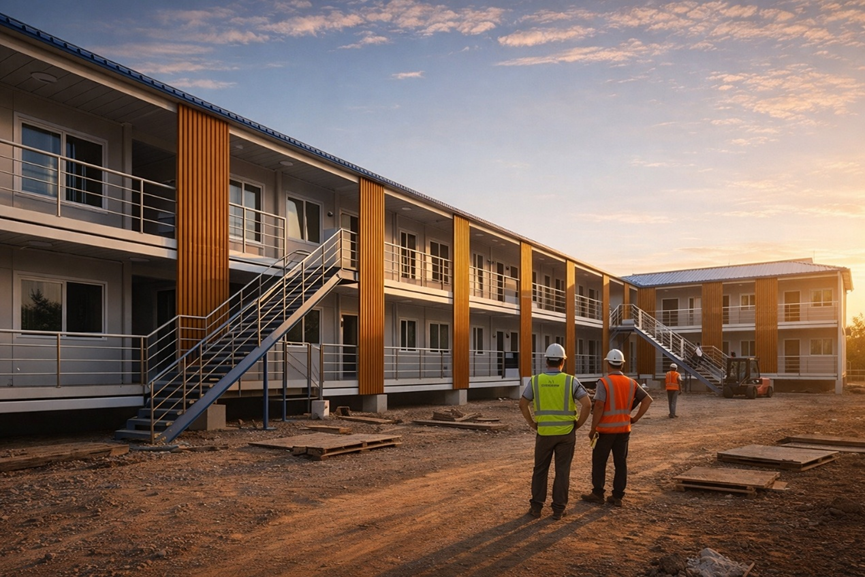
A prefab dormitory is a residential unit consisting of many components: walls, roofs, structural frames and building components that are produced in a factory and shipped to the jobsite for eventual assembly on site.
Unlike complete modular or container solutions, prefab buildings do not have uniform or standardized dimensions. They are built to custom specifications and on-site assembly will often closely resemble traditional construction rather than modular or container assembly methods. When these buildings are complete, they will more closely resemble conventional brick and mortar-type buildings than either modular or container housing products.
Advantages of a Prefab Dormitory
Flexible Design: With an unrestricted design, architects have greater freedom to create larger open floor plans, custom ceiling heights, and non-uniform footprint shapes.
Appearance: Prefab dormitory structures are capable of being developed to appear like a conventional constructed building. They could therefore be used in many instances where the aesthetics of a building are important, such as on campuses, at educational institutions, and in permanent residential neighbourhoods.
Structural Permanence: A completed prefab dormitory structure is intended for long-term use as a permanent structure (fixed asset).
Limitations of a Prefab Dormitory
Longer Construction Period: Compared to modular and container options, the construction period for prefabricated modular units at the site is much longer as it is generally more labour-intensive than both modular and container options; taking many months to over one year to complete, depending on the size of the individual modules.
Higher Cost: Cost is generally higher due to unique engineering requirements, the need for skilled labour on site and the non-reusable foundation of a prefab modular building.
What Is a Modular Dormitory?
According to Wikipedia, "A modular building is a prefabricated building comprising multiple identical sections called modules. Modularity is defined by manufacturing the building sections off-site, then transporting the finished units to the location. The assembly of the prefabricated parts on-site is the last step."
Definition and Key Features
A modular dormitory represents an advance in factory prefabrication because a modular system not only manufactures building components, but also creates complete room-sized modules. As these complete, fully enclosed volumetric units arrive at the job site, they will already have plumbing, electrical circuitry, insulation and interior finish materials installed.
Each module can be viewed as a finished room that is stacked and connected to other modules to form a finished building. Factory-built modules carry out the bulk of the work at the factory, while the only work that is required on-site is to position the modules, to connect utilities and to finish the joints between modules.
Advantages of a Modular Dormitory
Shorter Construction Time: Since most of the work gets done off-site and runs parallel to site preparation, the overall project duration can be shortened to a few weeks instead of months.
Scalable: You can add more modules to enlarge the building as your staff increases, without tearing down or constructing new ones.
High Degree of Standardization: Making the building in a factory under closely monitored conditions guarantees quality, consistency, and simpler fulfillment of the building code requirements.
Limitations of a Modular Dormitory
Transportation Constraints: Transport of large volumetric modules may be difficult in some areas due to narrow roads, weight-restricted bridges, or limited access to ports. Moderate Design Flexibility: A modular-based building is less design-free than a fully custom prefab building.
What Is a Container Dormitory?
Glamni states, "A container house is a residential structure made of steel shipping containers. It is a code-compliant house that is insulated, equipped with windows doors, plumbing, and wiring, and then finished indoors and outdoors to give a safe and cozy living space. Keeping the container's main structural shell, the builders reduce both the cost and time of the construction without compromising the strength."
Definition and Key Features
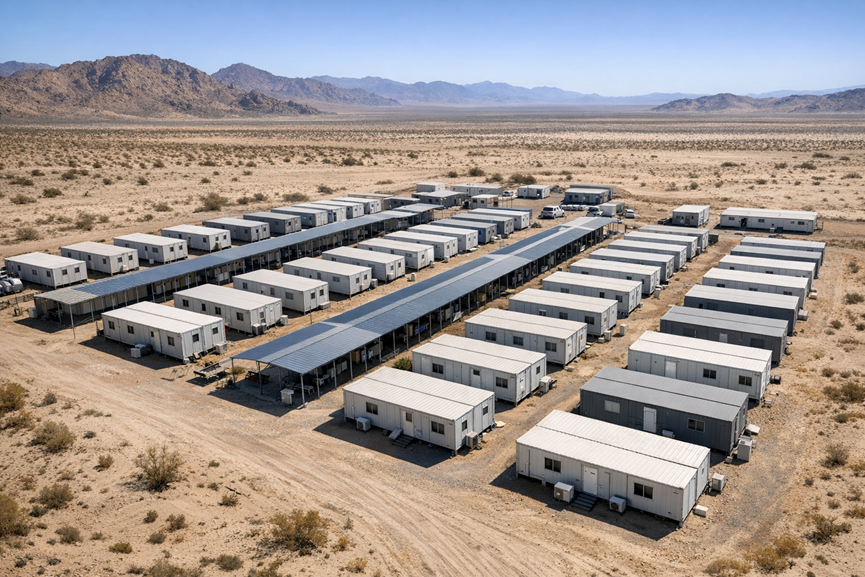
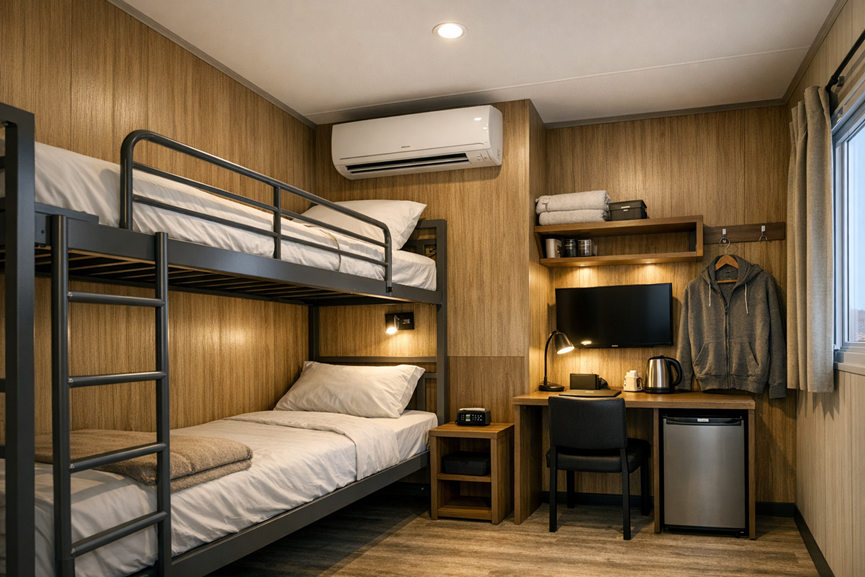
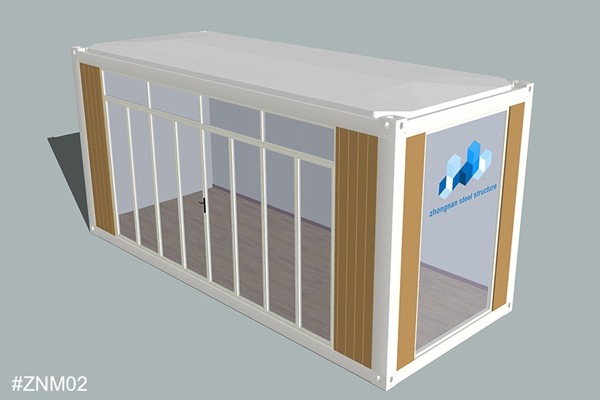
Container dormitory is primarily constructed by using steel container frames that meet ISO standards, either repurposed used shipping containers or newly purpose-built container-style modules. They are highly standardized and factory-insulated. Besides insulation, these units also include MEP (mechanical, electrical, plumbing) systems, and interior fittings which are made in the factory before the units are shipped to the site for deployment. Their design conforms to ISO specifications, thus naturally render them portable, stackable, and sea freight-ready for international delivery.
The ZN House's container dormitory systems are modular, constructed using ISO compliant galvanized steel frame, multi-level stacking up to three stories high, fire rated insulation using Rockwool or PIR, complete heating, ventilation and air conditioning systems, and pre-wired electrical and plumbing built at the factory. The standard container size is either 20 ft. (or 6,058 mm. by 2,438 mm) or 40 ft. long (or 12,192 mm by 2,438 mm). All units are certified CE, AS/NZS, and OSHA compliant.
Advantages of a Container Dormitory
Fastest Deployment: With proper use of all resources, a 50-unit camp has been completely assembled and made weathertight in 7296 total hrs. from the time it arrived on site. A fully functional 200-man camp can be completed within 2 weeks. The Modular Building Institute has provided benchmarks for the 'Commercial Building Industry' that indicate how much faster modular construction is than conventional, as there is a significant overlap between the work that takes place in the factory and in the field. In fact, according to MBI, a modular building can be constructed in a time frame of 30% to 50% quicker than a traditionally constructed building.
Lowest Cost: Saving costs, container dormitories become the most cost-effective option due to standardized production, factory-controlled quality, and the ability to flat-pack units, thereby reducing freight volume by up to 70% (Source: Future Market Insights).
High Mobility: Offering high mobility, the units feature integrated crane-lift points for easy relocation 100% intact to new project sites when a deployment ends.
Durability: Reliable performance construction in Corten-A weathering steel with C5 anti-corrosion coatings; seismic rating of Zone 8; ability to resist wind loads up to Level 11 (about 120 mph) are among the features that provide for dependable performance even in the harshest environments.
Reusability and Residual Value: Contrary to a permanent prefab structure, container dormitory units retain value across multiple project lifecycles and can be repurposed as offices, storage, or medical facilities.
Limitations of a Container Dormitory
Space Size Limitations: Standard ISO container dimensions do limit the interior width to some extent. But modular configurations and custom engineering (like joining two containers side-by-side) can drastically increase the usable space.
Aesthetic Perception: Container dormitories may look more industrial than conventional buildings; however, interior fit-outs and exterior cladding options can greatly enhance the architectural finish of the container building.
Prefab vs Modular vs Container Dormitory: Key Differences
The table below summarizes the critical decision-making criteria across all three solutions:
| Feature | Prefab Dormitory | Modular Dormitory | Container Dormitory |
| Construction Time | Medium–Long (months to 1+ year) | Short (weeks to months) | Very Fast (days to weeks) |
| Cost | High | Medium | Low |
| Design Flexibility | High | Medium | Medium |
| Mobility | No | Limited | Yes — fully relocatable |
| Scalability | Medium | High | Very High |
| Best Use | Permanent housing | Semi-permanent | Temporary/remote sites |
| Structural Lifespan | 30+ years | 20–30 years | 15–25+ years |
[Note: Prefab vs modular dormitory, modular vs container housing — the comparison above reflects real performance data, not marketing estimates.]
Cost Comparison: Which Is More Affordable?
The cost hierarchy is usually the same for all three choices:
Prefab Dormitories: These unit are the most expensive; these are caused by designing, custom engineer, skilled trades, and a permanent foundation of the structures.
Modular Dormitories: Modular dorms are less expensive than prefabs due to factory efficiency; but the cost is increasing because of shipping costs (volumetric) as well as additional skill needed for connection on site.
Container Dormitory: The least expensive to build are containerized dormitories because they are manufactured using a standardized sea container design, they have the option of flat packing for shipping, and require the least amount of work (assembly only) at the site plus have no trades other than assembly.
According to Naples Daily News (FL, USA), container houses can be built and assembled in 2-4 weeks. The price per square meter would also be low, with potential savings of as much as 60%.
It is essential to remember that final costs can differ due to configuration (number of units, stories, and types of interiors) geographic location, site conditions and local regulatory requirements. For example, a basic bunkhouse designed for use at a construction site will cost considerably more than an executive-style two-bedroom layout designed for use by a camp manager at a mining operation.
Construction Time Comparison
Project managers’ number one goal is to deploy their resources as fast as possible — especially when dealing with construction projects, mining operations, and disaster relief efforts, where employees are on-site.
| Solution | Typical Timeline |
| Prefab Dormitory | Several months to over one year |
| Modular Dormitory | Several weeks to several months |
| Container Dormitory | Several days to a few weeks |
By assembling ZN House’s 100-unit container camp in 3 to 5 days after units are delivered on site, we have shown that we are capable of getting operational capacity for a comparable 200-person container dormitory complex in 14 days or less (structurally complete and with all utilities connected). Conversely, a traditional masonry constructed dormitory of comparable size typically takes 6 to 9 months to complete.
The ability to deploy quickly means that an organization will enjoy potential operational savings by having instant accommodation on site. If an organization cannot provide on-site accommodation for one week, it will incur multiple costs including lost productivity (potential working hours), added logistics costs, and added risk(s) to workers trying to commute to remote work locations.
Best Use Cases for Each Dormitory Type
Prefab Dormitory
Prefab dormitories are ideal in circumstances where the building will remain and aesthetics or design are critical.
Permanent University or School Dormitories: University or school dormitory buildings expected to be in use for 30 + years and have a conventional appearance.
Long-term Residential Communities: Community residences located in urban or peri-urban development’s where Planning Authorities will require the structure to fit in with traditional designs.
Government or Institutional Housing: Government or institutional housing projects with design guidelines mandated by regulations.
Modular Dormitory
Modular dormitories are great for semi-permanent uses where the site is stable but construction time is important:
Campus Expansion Projects: Modular type dorms are required for additional student accommodation must be ready for the start of an academic term.
Semi-permanent Workforce Housing: Workers in the construction and large-scale industrial facilities (like dams, highways, and other infrastructure) need semi-permanent accommodations that will not be removed for many years after completion.
Urban Transitional Housing: Many urban development projects that are being built as transitional housing may also need to be relocated in the future.
Container Dormitory
Container dormitories are the best way to house workers who are only there for a short time, are far away, or need to be set up quickly:
Construction Site Camps: Camps on construction sites range from temporary housing blocks for 50 people to villages for 1,000 or more workers for big infrastructure projects.
Mining, Oil and Gas Remote Operations: ZN House has set up dormitory systems for mining and oil and gas remote operations that can handle desert conditions of 50°C or higher (Iraq oil fields) and have R-30 insulation for cold climates.
Disaster and Humanitarian Relief: You can load 6 to 10 collapsible flat-pack container shelters onto a truck and send them to areas affected by floods, earthquakes, or conflict within 48 hours. These shelters meet Sphere Handbook standards for emergency housing.
Event Infrastructure: Event infrastructure is temporary housing for event staff, performers, or security teams that can be quickly taken down and used again after the event.
Which Dormitory Type Is Best for You?
Use this selection logic to help you make your choice:
Choosing prefab as a lasting solution for a permanent institution is ideal if you're looking for a building that will stand for decades or long period of time (school, university or extended stay community). The initial price tag of a prefab building will more than make up for itself in the terms of life span alone, as well as providing the ability to easily change your design.
Choose a modular structure for a multi-year construction project where your new facility will eventually be expanded or repurposed; if you need an interim location to house people or do work; if speed, cost and quality matter to you; and if you want a better-quality living environment than a container but at an additional expense. A movable, modular building will give you significantly more value than a pre-fabricated building when considering speed, cost and quality.
Lastly, if you need something very quickly (and at a low cost), and need the ability to move your facility after you finish your project (construction site, mining camp, remote infrastructure project or emergency response), then choose a container dormitory. A container dormitory is factory built, designed to ISO standards for strength/durability for portability, and has the most flexibility of any building option available today.
Why Container Dormitories Are Gaining Popularity
Over the past ten years, container dormitory usage has increased steadily within the construction, mining, energy, and humanitarian industries worldwide. This increase in usage is a result of structural reasons as opposed to cyclical.
Cost Advantage
With global labour rates remaining high across countries around the globe and budgets remaining consistently challenged, the fact that factory-built container dormitory units can save up to 30 to 40 percent on capital construction costs compared to traditional buildings offers a compelling financial argument.
Rapid Setup
The ability to set up onsite accommodation camps quickly in remote areas (offshore islands, desert locations or areas that have been affected by a natural or man-made disaster) is more than just beneficial from an expeditious delivery perspective; it is also essential from an operational effectiveness standpoint.
Full Portability
A permanent structure is a sunk cost once the project is finished, while a container dormitory is an investment that will depreciate over time like other capital assets and can be moved to a subsequent project site and has significant residual value. For companies involved in multiple large construction projects over consecutive years, the financial benefit of moving container dormitories represents a significant benefit.
Scalability
Container dormitory housing (building on periphery of existing building) is capable of expanding from a total capacity of 50 people to 500 people simply by adding additional units; no need for existing occupants to relocate, nor is there any requirement for extensive/new construction. There is no other method of scalability available using traditional/prefabricated housing.
Environmental Performance
Container dormitory housing has a 95% recyclability rate and generates less than 2% of construction waste (conventional construction creates 10-15%). Container dormitory housing is designed for compatibility with solar panel rooftop systems and with low water/energy usage fixtures which make ZN House Container Dormitory Housing an ideal solution for housing to meet environmental, social, or governance (ESG) requirements or for obtaining green building certification.
ZN House has constructed a total of over 3,000 units of container housing worldwide. They have successfully built container housing in Ireland (3-storey urban worker development), China (tropical design sustainability), and Iraq (high number of man-camp oil workers).
Frequently Asked Questions
What is the difference between prefab and modular buildings?
Any pre-packaged or manufactured structure which is assembled by workers in the construction industry is referred to as a prefabricated (prefab) structure. Modular construction, which is an extremely large category of prefabricated structures, consists of entire rooms that have been manufactured in a factory. These rooms include electrical, plumbing and finished components ready for installation in the building site. Therefore, all modular buildings are prefabricated buildings, however, not all prefabricated buildings are modular.
Are container dormitories cheaper than modular or prefab?
In general, container dormitories are typically the least expensive to use when compared to the other options listed above. The majority of these savings come from the use of standard manufacturing processes; flat-pack shipping configurations that help to reduce transportation costs; and minimal onsite construction labour for assembling the dormitory units. According to ZN House’s data, container dormitories can offer cost savings ranging from 30% to 40% when compared to more traditional construction methods.
How long do modular dormitories last?
The lifespan of high-quality modular dormitories is typically between 20-30 years depending on the type of material used, environmental factors and how well they are maintained. ZN House container dormitory units are constructed using hot dipped galvanized Q235B steel frames and C5 anti-corrosion coatings which have a lifespan of 15-25+ years of minimal structural maintenance required.
Can container dormitories be used as permanent housing?
Yes, with the reinforced foundational treatment, guaranteed utility connections, and double-layer insulated walls, container dormitories can be long-term or even permanent living spaces. Multi-story permanent residences have been built from container dormitory units that were used as urban transitional housing. The key is to use appropriate engineering and foundation design for the specific site.
Which dormitory type is best for construction sites?
Container dormitories are widely accepted as the best solutions for construction projects. Container dormitories have the benefit of being able to quickly deploy (within 72–96 hours a camp for 50 people is operational), can be moved from one site to another once the project is completed, are in compliance with OSHA regulations, and have the lowest cost option when compared to tented or trailer-style accommodations. For these reasons, container style dormitories are viewed as practical and fiscally responsible by the site management team members.
Conclusion: There Is No Universal Answer — Only the Right Fit for Your Project
Prefab, modular, and container dorms are not competing products in the sense that one is "better" than the others. They are optimized for priorities that are very different from each other.
- For those requiring a custom-designed structure that will last and will have an architecturally integrated design, prefab is a good solution.
- If you need to balance between quality and scalability while having an extremely fast production timeline, modular is a good answer.
- If you are looking for speed, cost-effectiveness, or portability, container construction is a good solution as this meets the vast majority of real-life workforce housing challenges.
The trend in the industry is unmistakably towards greater demand for modular and container-based accommodation solutions for the workers coming to work in remote locations where global investment in infrastructure is on the rise, where ESG (Environmental, Social and Governance) compliance is becoming stricter and where the economics of projects require faster and leaner delivery. The issue is not if you should consider these options — it's if you have a trustworthy partner to support you in deploying them correctly.
Ready to Find the Right Dormitory Solution for Your Project?
ZN House has been providing quality container dormitory systems for construction sites, mining camps, universities, and humanitarian operations in Asia, Africa Europe and the Americas for more than ten years as a certified manufacturer.
Request a Dormitory Solution → Get a Custom Layout Design → Contact Us for a Quote →
Similar Posts
What Are the Main Types of Container Camps
When a large infrastructure project takes place in a remote desert or a mining company begins...
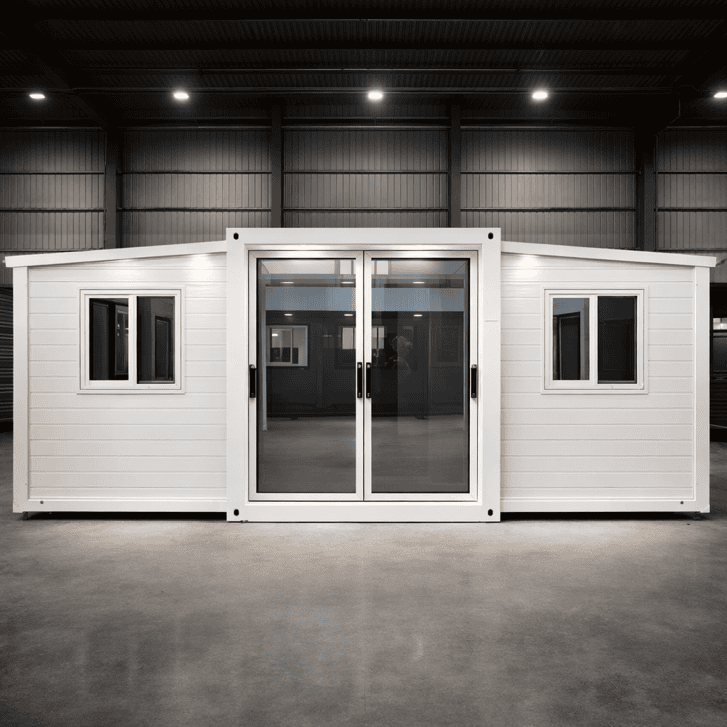
What Is a Prefabricated Building? Types, Benefits, and Applications
A prefabricated building (or prefab building) is a structure whose major elements are built in a...
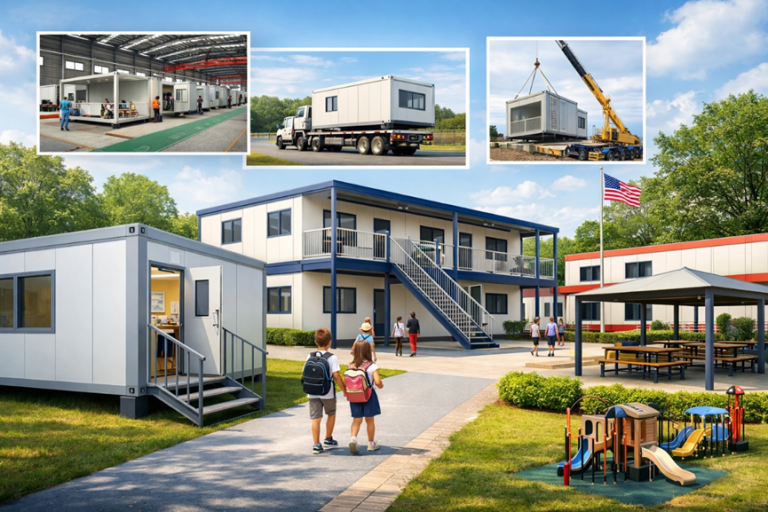
What Is a Modular Classroom? Benefits, Costs & Modern School Building Solutions
Today, more pressure is placed on the schools than at any other time. Crowded classrooms, overcrowded...
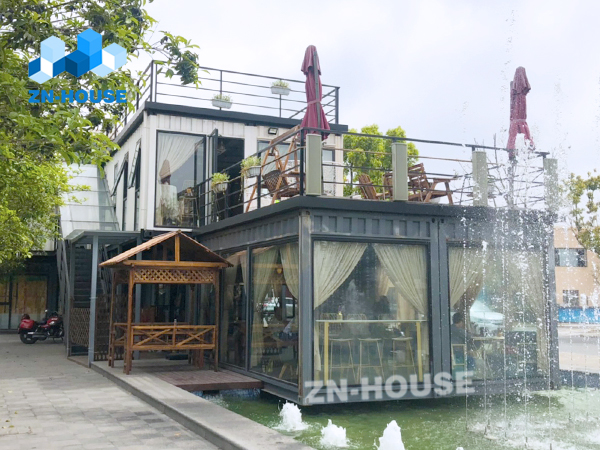
Container Hotels: A Cost-Effective & Sustainable Solution for Modern Hospitality
What is a Container Hotel? A container hotel is an innovative accommodation built using prefab containers. These...
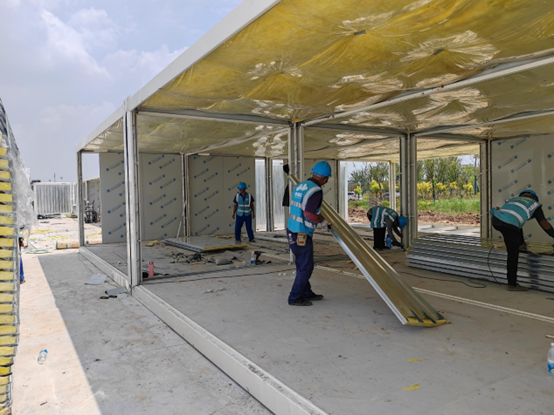
Is a Hurricane-Proof Modular Home the Safest Investment for Coastal Living?
Coastal homeowners have to deal with a distinct challenge every year. To keep their homes safe,...
Smart Building with an Assemble House: Cost, Convenience, and Customization
In the fast-evolving world of construction, the demand for flexible, efficient, and cost-effective housing is reshaping...


