



How to Install a Flat Pack Container House: Step-by-Step Guide (With Tools, Timeline & Tips)
Introduction
Flat pack container houses fall into the category of modular homes and have come a long way in just a few years. This method is an efficient building solution due to the factory-ready components that allow builders to ship the building with compact packages for rapid assembly at the project site. But with simplicity comes a need for planning an installation method that will give you the expected structural integrity, stability, and longevity.
When it comes to installing flat pack container homes, a lot of project owners struggle with common dilemmas:
This installation guide of the flat pack container home will answer all those questions in a clear, concise, and thorough manner, from initial preparation of your site to completion and inspection of your home. The information provided in this article is based on practical engineering techniques used in ZN House’s modular systems, and it includes detailed descriptions of the entire flat-pack container setup process, the different materials used, and the exact steps that should be taken in order to create a safe and stable building.
Once you have completed this guide, you will be familiar with the steps necessary to assemble a flat pack container home, the tools necessary to do so, the timeframe in which you can expect to complete your installation, and numerous professional installation tips that will help save you money and avoid issues caused by poor installation.
What Is a Flat Pack Container House?
An innovative modular building design that is designed for shipping flat panels is a new concept to ship homes in a flat pack container. A flat pack container home differs from a traditional shipping container home in that the structure uses a specially created, pre-engineered steel framework, modularly constructed, as opposed to converting an existing cargo shipping container into the home.
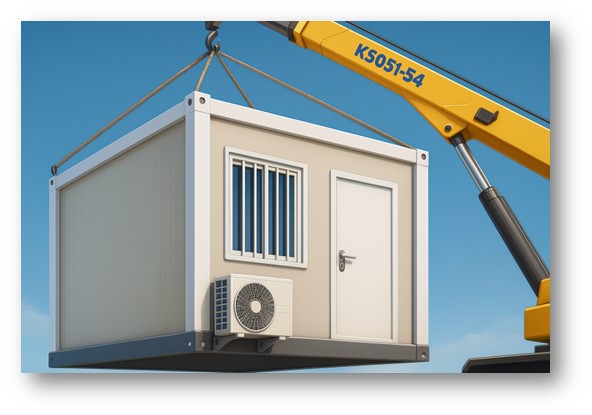
Fig. 1: Rapid Modular Installation of Flat Pack House Using Hydraulic Crane
A flat pack container home will typically consist of the following structural building components:
- Galvanized steel frame
- Insulated sandwich wall panels
- Pre-engineered roof systems
- Pre-manufactured door and window packages
The flat packing of all these components occurs during shipping. When the components arrive at the site, they are connected to one another using mechanical bolted connections to create a building that is ready to occupy.
| Feature | Flat Pack Container House | Traditional Shipping Container House |
| Transportation | Shipped as panels and frames | Transported as full container units |
| Installation | Rapid on-site assembly | Requires cutting and modification |
| Structural Design | Engineered for modular housing | Designed originally for cargo transport |
| Cost Efficiency | Lower shipping costs | Higher logistics cost |
Table 1: Difference Between Flat Pack and Traditional Container Homes
A flat pack prefab home constructed with containers provides superior thermal insulation, greater customisability, and faster assembly at the construction site than using traditional construction methods to convert a shipping container into a living space. The shipping container components have been pre-manufactured and engineered to high tolerances, so only basic tools are needed to complete the installation. Work crews will average two to three experienced workers per container.
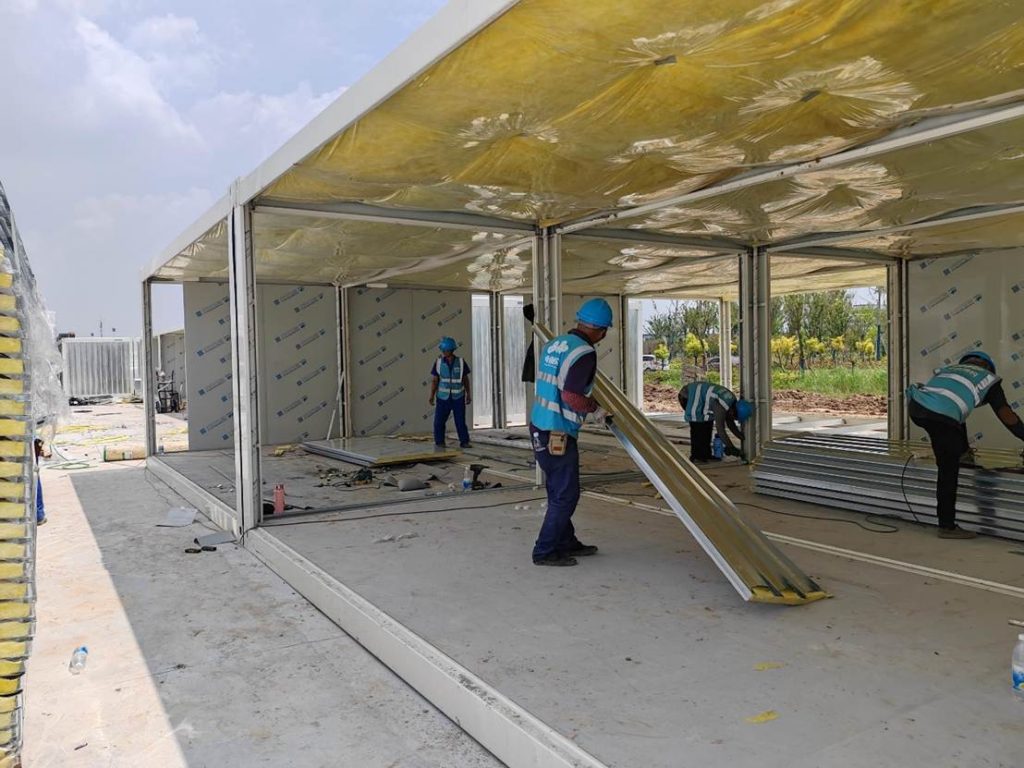
Fig. 2: The installation of a flat-pack house is going on
Before You Begin: Site Preparation
Pre-installation necessitates proper site preparation for a flat pack container house site; while modular construction requires less groundwork than traditional construction (which requires significant amounts of ground breaking), the installation site still needs to be a stable and level base to achieve structural alignment.
Assess the Installation Site
Evaluate the terrain and/or land where the container home will be built. If the ground is flat, there would be a good chance of positioning the home properly. If there are any variations in the level or slope of the ground beneath a house, this may lead to excessive load on the house’s structure or make it more difficult during construction. Proper drainage systems are also essential to prevent standing water around a home’s foundation.
Is there suitable vehicular access to your build site? Delivery of these homes typically requires heavy lifting equipment (crane, forklift) to position the pre-manufactured building components during installation. If the build site cannot be easily reached by vehicle, it may prove difficult to deliver and unload materials as well.
Regulatory Requirements and Permits
Though flat-pack houses are regarded as modular buildings, they must also comply with local codes in many locations. If there is a need for a permit for your project, the owner should verify what kind of permits would be required for any type of construction/permits before proceeding with installation. In addition, some government bodies may have additional electrical safety standards and/or plumbing codes that will apply as well.
By completing the regulatory process before installation begins, it minimises delays in the progress of the project and guarantees that the structure is built to local safety codes.
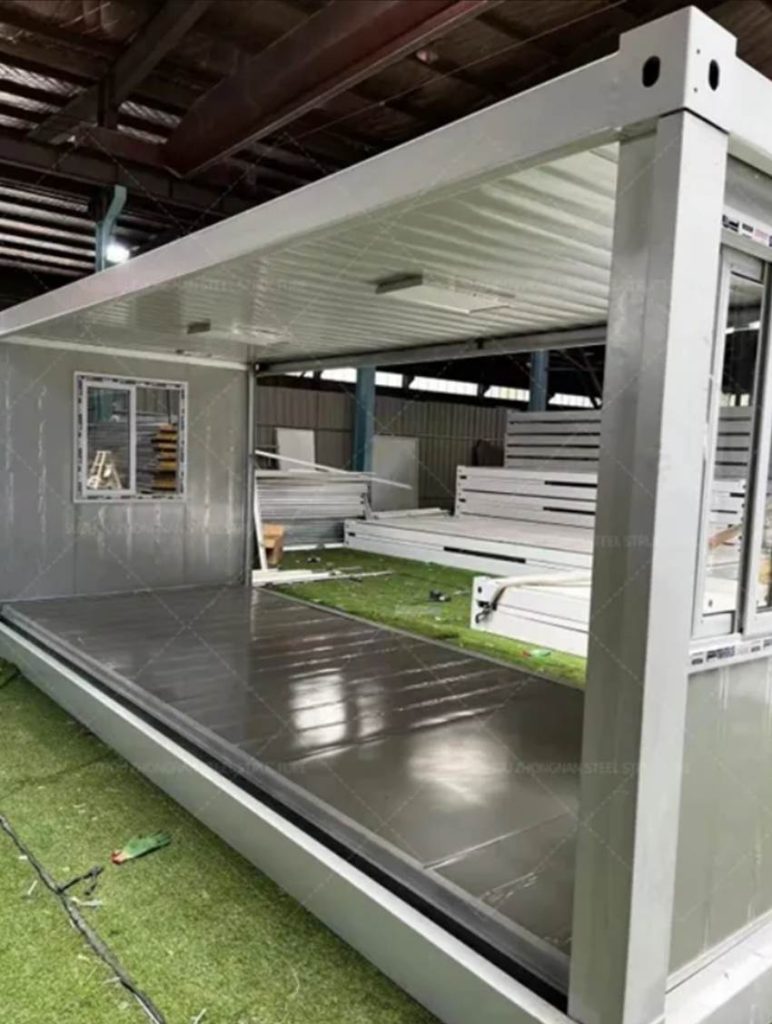
Fig. 3: A single-unit flat pack container is under construction
Foundation and Utility Preparation
Flat-pack homes typically have foundations that are fairly straightforward; however, they also need to have sufficient capacity for supporting whatever structure is being put on top of them. The type of foundation most commonly found for flat-pack homes is a concrete slab since these offer a stable base and are easy to align during the construction process. You may choose to use either pier foundations or steel pile foundations as opposed to concrete slabs if your site is sloped or has poor soil type.
Utilities need to be hooked up prior to the assembly of the container home. Water supply lines, drainage outlets, and electrical conduit should be installed so that when the final assembly of the container home takes place, they can be hooked up to the rest of the building systems easily.
Tools & Materials You’ll Need
Installation of flat-pack container homes requires fewer tools than traditional construction projects. However, having the proper tools is critical to completing the assembly of your flat-pack home safely and efficiently.
In order to put together flat-pack homes you’ll need certain essential tools: electric wrenches for tightening structural fasteners; leveling instruments for ensuring that everything is aligned properly; and lifting devices such as a crane or gantry cranes for positioning the structural frame accurately. Measurement devices will also be required to ensure that panels are placed in the correct location when being installed.
The installation of flat-pack container homes will require various installation materials to fasten together and seal the structure. Typical installation materials include anchor bolts, which connect the floor frame to the foundation; waterproof sealant, which prevents rainwater from entering the home; and mortar or grout used to stabilize the floor frame and to stabilize the frame. Insulation materials may also be used at the joints of each exterior wall and between panels.
A properly prepared materials list for your flat-pack container home will ensure that installers can complete the assembly of your flat-pack container home without delays or missing components.
Step-by-Step Installation Guide
The assembly of a modular flat pack home is carried out in accordance with a logical series of structural stability and efficient installation criteria. Since there are standard connections between all the panelised, flat-pack components that are produced, the assembly process will have a quick completion if each step is completed accurately.
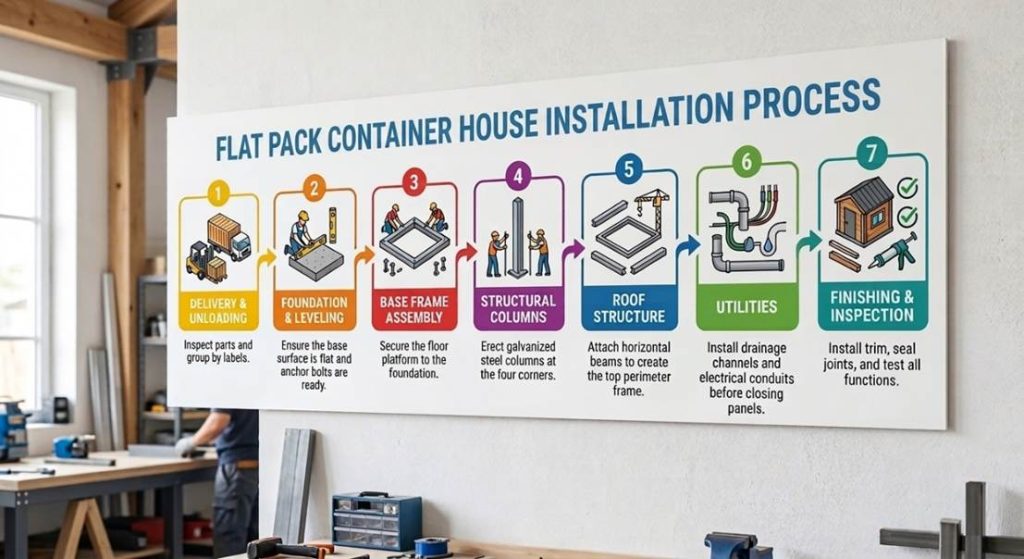
Step 1 – Delivery and Unloading
The first step of installing a flat pack container is receiving it at the building site. After delivery of packaged parts, you will need to lift them off the truck with the help of lifting equipment and place them into an area designated for assembly purposes.
When unpacking a container, inspect each part thoroughly for any transportation damage. The team installing the container should then group all parts by their respective labels to allow quick access during assembly for structural members, wall panels, and hardware.
Step 2 – Install the Foundation and Leveling
Next, a flat pack container home’s foundation shall begin being created. That means that the base frame must be securely placed on a foundation surface that has adequate support and is level from front to back, left to right, in order for correct structural alignment.
The installer must ensure that the anchor bolts have been positioned properly and that the foundation dimensions are consistent with those listed in the construction plans. Prior to the installer performing any work to secure the base-frame to the foundation surface, he/she will check the entire surface of the foundation using a level instrument to ensure it is absolutely flat before securing the base-frame.
Step 3 – Assemble the Base Frame
After the foundation has been prepared, the base frame of the unit will be assembled. The base frame provides the structural platform for the whole building.
The base frame will be placed on top of the foundation and secured to the foundation using the anchor bolts with high-strength fasteners. At this point, installers should carefully check to see if the frame is aligned properly, as any misalignment could affect future installation of the column and wall panel.
Step 4 – Install Structural Columns
Once the base frame has been securely fastened down to the ground, the structural columns are erected in each of the four corners of the frame. These columns will typically be made of galvanized steel and will serve as the principal weight-bearing members of the container structure.
The columns will be installed vertically and will be mechanically bolted down to the base frame, thus forming a vertical support system that transfers all roof and wall panel loads to the foundation when the structure has been constructed with all of its columns installed.
Step 5 – Install the Roof Structure
The installation of the roof framework occurs after the columns have been secured. At the top of the columns, horizontal beams are attached to make up the top frame (or ‘perimeter frame’) of the building. After the beams have been installed, this completes all parts of the structural skeleton.
This frame helps ensure that the building maintains its shape and structural stability during the installation of the other components of the building.
Step 6 – Connect Utilities (Water, Electricity)
The drains inside the floor drain system will need too to be included in the ceilings of the structure before they can be closed with wall panels. Water is drained off by means of roof drainage channels and downpipes.
Properly designed roof drainage systems protect buildings from moisture damage by preventing water from accumulating on roofs.
Step 7 – Finishing & Inspection
The last step to set a flat pack house in place is to finish the finishing work and complete a full inspection of the building. Some examples of interior trim are corner line trim and ceiling edge trim; these trims create seals and provide a finished appearance inside the house.
Once all finishing work has been completed, the installation crew will ensure that all wood bolts are fully tightened, that wall panels are properly aligned, and that all doors and windows work correctly. Next, a waterproof seal should be applied to provide drainage to all sink and tub areas, and all utilities should have been installed and tested.
When these inspections are completed, the flat pack container house is constructed as a finished product and is ready to be occupied.
How Long Does Installation Take?
One of the key benefits of modular housing is its short time to install a modular home. The following factors can influence the timeline to build and install your new modular home:
- Building Unit Quantity
- Site Preparation Quality
- Employment Record of Local Workforce
- Availability of Lifting Equipment
Typical timelines:
| Project Size | Installation Time |
| Single container unit | 2–4 hours |
| Small modular house | 1 day |
| Multi-unit complex | 2–3 days |
Table 2: Installation Timeline of Flat Pack Container House
With a flat pack container home, it can take significantly less time to install than with the ‘Build Out’ construction method, which typically has many stages that last a few months for each stage of Dimension Construction’s process, as per standard construction methods.
Manufactured modular construction has been indicated to offer expedited timelines for the completion of projects. This is partly due to the simultaneous construction of foundations with the manufacturing of modular components. According to published studies, modular projects can be completed in approximately 30-50% less time than what is typically required with conventional construction methods; this makes modular construction a viable option for meeting urgent and/or short-term housing needs (Source: ICSECM.ORG).
Common Installation Challenges & Solutions
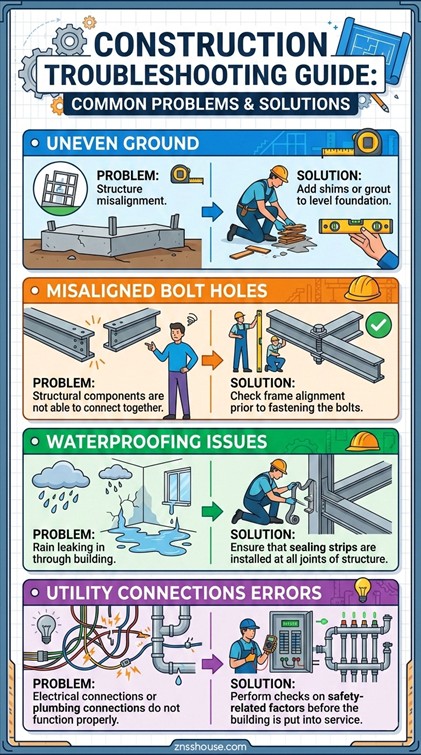
The installation of modular systems can lead to challenges in some cases when assembling flat-pack containers.
1.Uneven Ground
Problem: Structure misalignment.
Solution: Add shims or grout to level the foundation.
2.Misaligned Bolt Holes
Problem: Structural components are not able to connect together.
Solution: Check frame alignment before fastening the bolts.
3.Waterproofing Issues
Problem: Rain is leaking in through the building.
Solution: Ensure that sealing strips are installed at all joints of the structure.
4.Utility Connections Errors
Problem: Electrical connections or plumbing connections do not function properly.
Solution: Perform checks on safety-related factors before the building is put into service.
By following the best practices for installing flat-pack homes, you will avoid spending unnecessary money repairing issues later on.
Cost Considerations
When it comes to planning a housing project that includes modular homes, knowing how much it will cost to do an assembly will help you budget for the project. Flat pack container homes tend to be less expensive than building a traditional home, but there are many variables that determine the total cost of installation. These variables include labour costs, rental equipment costs, transportation costs, and the difficulty of preparing the job site. Proper site preparation, use of qualified installers, and a well-thought-out installation plan will all contribute to lower installation costs. Installing a flat-pack container home is generally less expensive than making modifications to build a traditional container home because the parts of a flat-pack container home are pre-manufactured and designed to be easy to put together in little time and with low labour costs compared to building a traditional container home.
| Cost Category | Description |
| Labor | Wages for the installation team responsible for assembling the structure. |
| Equipment | Rental or operation of cranes, forklifts, or lifting equipment used during installation. |
| Materials | Additional installation materials such as sealants, anchor bolts, mortar, and utility connectors. |
| Site Preparation | Ground leveling, foundation construction, and preparation of utility connections. |
| Transportation | Delivery of flat-pack components from the factory to the installation site. |
Table 3: Key Cost Components of Flat Pack Container House Installation
Each of these planning pieces can put a cap on the total installation cost of the flat pack container house and help keep the project efficient and within the estimated constraining budget.
Benefits of Correct Installation
Having an accurate set of plans is critical for producing a quality flat pack container house that will last for many years with optimal operation within the built environment.
When the base is level and the frame is added correctly, it increases the stability of a container home while providing an even distribution of weight throughout the container. This reduces the likelihood of misalignment of the structure and, therefore, increases the safety of the structure.
Correctly installing equipment will help improve insulating properties and the ability of the structure to resist outdoor conditions. For example, if the wall panels are installed in alignment, and the materials have been installed so as not to allow water to penetrate through the wall cavity or cause moisture damage. Because all external components (doors, windows, etc.) have been installed correctly, an occupant will experience fewer operational issues once they occupy the building, as a result of poor installation. In general, good installation practices lead to increased reliability of the structure, savings in energy consumption, and less need for maintenance in the future.
Studies of modular building have indicated that prefabricated building systems can reduce the time required to complete a project by as much as 50 percent compared to more conventional methods, as well as cut down on costs and material waste, thereby creating an effective and sustainable form of construction for modular home projects (Source: MDPI).
See our blog post titled “Why Western Sites Choose Flat Pack Containers – China’s Supply Chain Edge” for a thorough explanation of our flat pack container houses and the strategic benefits of China’s supply chain.
Frequently Asked Questions (FAQs)
Is professional installation required for a flat pack container house?
Professional installation is advisable for many projects, and even more so for multi-unit buildings. Experienced installers know about structural alignment, sealing requirements, and utility integration, even though modular construction does make the assembly quite easy. Because of this, it’s important to hire an installer with the proper experience in order to ensure that your modular home is installed safely and meets local building codes.
Can I install a flat pack container house myself?
For a small single-unit installation, you may be able to install it yourself if you are experienced with construction and lifting equipment. If you are using one of the professional installation teams, the team will finish the project more quickly than you can as an installer, and also minimize potential mistakes in the structure of the unit.
What happens if the site isn’t level?
Because uneven ground surfaces can cause some degree of misalignment during foundation installation, any adjustments to the foundation’s level or straightness should be made first (e.g., by using shims, grout, or adjustable supports) before setting the base framing.
How do you seal gaps during installation?
The use of waterproof seals or sealant is utilized to fill in the roof gutter or ceiling joints, seams around the edge of the roof, and the joints of the wood framing to create a barrier against water.
What tools are most important for assembly?
The primary tools for the task include an electric wrench used to tighten the bolts, a leveling device for leveling, and cranes to lift and position structural parts correctly and safely.
To know more about Flat Pack Container House, visit our product page here.
Conclusion
Preparing the site for installation, aligning the foundation, assembling the frame, installing the walls and roof, connecting utilities, and performing the final inspection of the flat pack container house are all steps in the installation process. These homes offer weather resistance, insulation, and structural stability when installed properly.
This makes them suitable for use in construction, residential, temporary offices, and emergency housing. One of the primary benefits of flat-pack container homes is their speed of installation. Since these homes are prefabricated off-site, installation takes a lot less time than with traditional methods. To avoid issues (such as misalignments, leaks, and malfunctioning utilities), the installer must adhere to all instructions exactly. Assemblies that are performed by skilled teams, utilize accurate planning processes, and utilize the correct tools will provide a consistent and reliable experience.
To ensure that developers and contractors understand the complete workflow for the installation of a flat pack container home. They can better understand how the installation process impacts the long-term performance of the building.
For professional support or project consultation, contact ZN House to learn more about our flat pack container house solutions.
Your Next Steps:
- Download the Flat Pack Installation Checklist
- Request a Quote for Professional Installation
- Contact our technical team for installation consultation and project planning
Watch the following video on ‘How to Install a Flat Pack Container House: Step-by-Step Guide by ZN House’:
Similar Posts

Detachable Container for Sale: Off-the-Shelf Solutions
What is a Detachable Container House? Demand of fast assemble housing solutions grow across industries. Detachable…
Building Your Flat Pack Dream House
In the ever – evolving world of housing, flat pack homes have emerged as a revolutionary way to…
Shipping Container Tiny House Minimalist Lifestyle: Redefining Modern Living
The siren call of simplicity grows louder in our chaotic world. As urban sprawl accelerates and…
The Future of Sustainable Living: A Deep Dive into Modular Integrated House Solutions
Introduction of Modular Integrated House Solutions Modular construction has experienced a boom due to increased worldwide…

Shipping Container House for Sale: Modern Farmhouse Style
In the realm of contemporary housing, where innovation meets timeless aesthetics, the shipping container house has emerged…

Flat Pack Container Living Made Easy
The flat pack container house is becoming a practical and popular choice for people who want fast,…


