



What Are the Main Types of Container Camps
When a large infrastructure project takes place in a remote desert or a mining company begins extracting resources many kilometers away from civilization, the first question that comes to mind is where will all the people working on these projects sleep? Traditional construction methods take forever to build and are extremely expensive. Living in a tent isn’t necessarily safe or secure, and they certainly don’t provide dignity. It is for these reasons that container camps have become the top choice among all project developers, relief agencies, and military contractors around the globe.
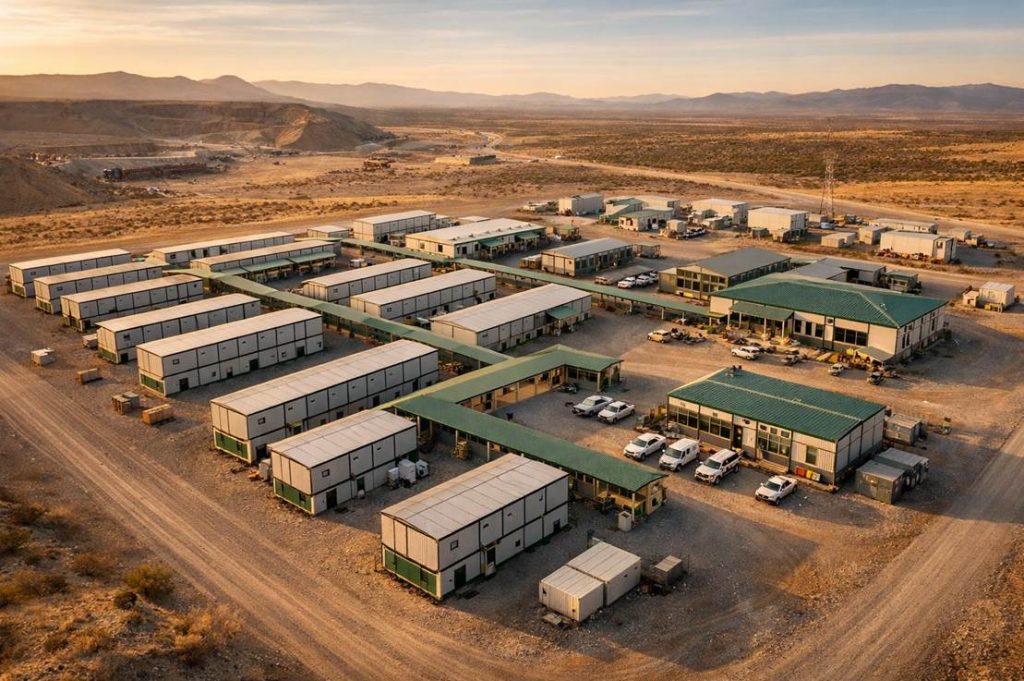
Container camps are made up of individual modular buildings, which may be manufactured off-site for quick assembly on location (within days) and have the flexibility to accommodate (20 to 2000+) at the same time. Over the last 10 years, container requirements have been escalating, particularly in the mining, oil and gas, construction, and emergency services industries, due to tighter deadlines as well as increased ESG obligations from clients.
However, there is no universal design for container camps. Various types of container camps are available to meet different logistical & operational challenges (such as flat packing/ unfoldable/expandable/container modules). The wrong type of container camp will impact your freight budget, delay worker deployment or keep workers living in undersized shelters.
This detailed Guide describes all Major Types of Container Camps & summarises their construction and provides assistance on how to select the best container camp design for your project based upon its application in real-world scenarios.
What Is a Container Camp?
A container camp is a complex of modular living quarters and facilities that are all self-sufficient, made out of steel prefabricated units. Unlike traditional temporary buildings which are made using timber frames or masonry, container camps are well-designed in the factory under control, then transported to the place and put together, sometimes within just a few days.
Components of a Fully Equipped Container Camp
A full container camp is more than a line of sleeping containers. Based on the size and length of the project, a camp can include:
- Dormitory Units — single or multi-occupancy sleeping rooms with beds, storage, and climate control
- Office Modules — workstations, meeting rooms, and command centers
- Canteen and Kitchen Blocks — industrial cooking facilities and dining halls
- Bathroom and Sanitation Modules — WC blocks, shower facilities, and wastewater management
- Medical Room — first aid stations or fully equipped clinic modules
- Recreation Areas — gyms, lounge rooms, TV areas, and outdoor spaces
Core Features That Define a Container Camp
There are several defining engineering characteristics that distinguish a container camp from traditional temporary structures:
Modular: Each unit follows the same standard, being a completely independent block that is able to interlock with others through the use of specially designed and tested interlocking systems. So, the camp can be assembled just like children’s building blocks, simply increasing the number of units without the need to completely replan the whole layout.
Portable: The units are built for international freight. Flat-pack delivery drastically reduces the shipping volume by up to 70%, which makes shipping to a distance more cost-effective.
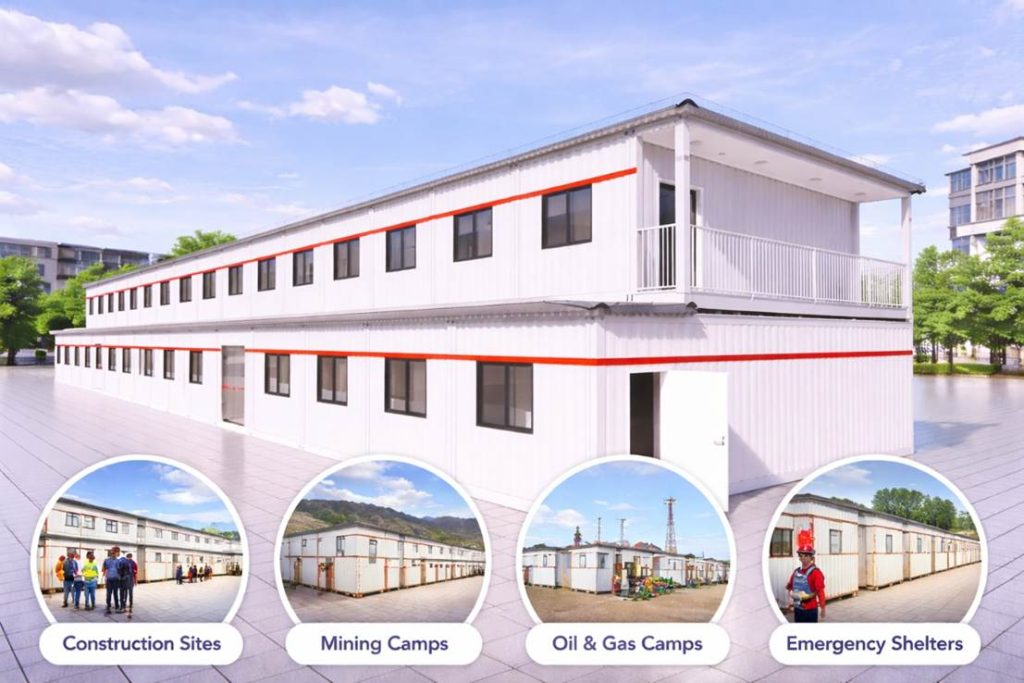
Fast Installation: Factory-prefabricated construction signifies that up to 90% of the work involved in finishing the units happens before the units actually get to the site. Assembling on site usually only needs a few people with ordinary tools.
Scalable: It is very much possible for a 50-person exploration camp to transform into a 500-person permanent village simply by incorporating modular blocks – no need for structural reinforcement or construction downtime.
Container Camp vs. Traditional Temporary Camp
| Feature | Container Camp | Traditional Temporary Camp |
| Construction Time | 3–14 days | 3–6 months |
| Weather Resistance | Wind loads up to 193 km/h | Limited |
| Lifespan | 20–25+ years | 3–10 years |
| Mobility | Fully relocatable | Largely fixed |
| Cost vs. Masonry | 30–50% savings | Baseline |
| Material Recovery | 95% reusable | Low |
Main Types of Container Camps
The right type of container camp is important for comfort and logistics. Nowadays, there are four main types in use in the industry.
Flat Pack Container Camps
Flat pack containers are the preferred choice for projects which are expected to last for a long time. These units are sent as a “kit” where the roof and floor frames are pre-assembled, and the wall panels, doors, and windows are packed inside.
Structural Features: The main frame consists of very strong galvanized steel, and the walls are made of sandwich panels filled with either Rockwool or PU.
Transportation Advantage: You can put 4 or 6 units inside one standard shipping container, which will greatly lower the freight expenses.
Applications: Mainly used for construction sites, mining camps, and oil & gas workforce accommodation where the schedule is for several years.
Stackability: The standard is 3 layers high, so that high-density housing can be done even in very small areas.
Foldable Container Camps
In case every second is so important that storage containers have to fold, then the best option would be a foldable (or collapsible) container.
Ultra-Rapid Deployment: A whole unit can be expanded and secured with the help of a small crane in just 4 to 10 minutes – that’s what ultra-rapid deployment means.
High Mobility: They fold down flat, so it is extremely easy to transport them from one site to another.
Suitable Scenarios: Emergency relief, disaster housing, and temporary shelters. Such housing is a lifesaver for displaced populations after a disaster, as it offers them immediate, decent shelter.
Expandable Container Camps
As a regular feature on top-end mobile offices or luxury employee accommodation, expandable containers provide the largest floor space related to their transport dimension.
Design: The sides slide or “wing” out from the centre core, thereby tripling the living area at the destination.
Experience: They are more appropriate for extended stay as they give you a feeling of a wider interior space, quite like a regular apartment.
Applications: Remote residential camps, leisure/glamping sites, and field control centres.
Modular Connected Camps
This is not just a unit of one type but a building method. Without walls but with specialized connection kits, several flat pack or modular units can together form giant buildings with open plan layout.
Large-Scale Capability: Suitable for military camps and big mining communities that require accommodation for 500+ people.
Versatility: Enables the making of large industrial kitchens, gymnasiums, and conference rooms that a single container won’t be able to provide.
Temporary vs. Permanent Container Camps
Depending on the project timeline, you can choose a temporary setup or a semi-permanent installation.
| Feature | Temporary Camps | Semi-Permanent Camps |
| Lifespan | 2–5 years | 15–20+ years |
| Mobility | High (Foldable/Flat Pack) | Moderate (Modular Connected) |
| Infrastructure | Minimal site prep | Concrete pads, integrated utilities |
| Best Use | Disaster relief, short-term roadwork | Mining, long-term oil rigs, schools |
Common Applications of Container Camps
The adaptability of prefab labor camps makes them a must-have in many sectors:
Construction Worker Camps
Construction sites require prompt accommodation, a small footprint and the capability to expand as the workforce fluctuates. Flat-pack or modular connected camps are often the best option as they combine shipping efficiency with stackable layout options. ZN House, in particular, advocates the use of rapid-deploy construction camps for site workers with plug-and-play utility connections.
Recommended structure type: Flat pack or modular connected, depending on headcount.
Mining Camps
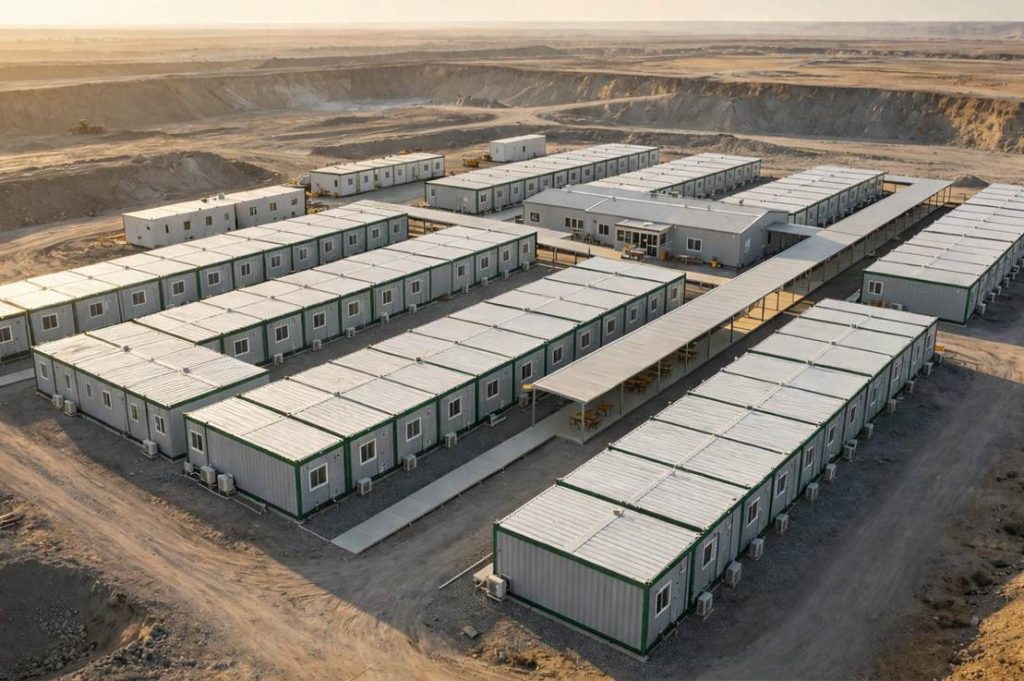
Mining camps face extreme temperatures, strong winds, and remote access constraints. ZN House notes that its mining solutions are engineered for harsh environments, including temperatures from -30 °C to +55 °C and strong wind resistance. Modular connected or flat-pack camps are often the best structural options for mining because they combine durability with scalable capacity.
Recommended structure type: Modular connected for large permanent operations; flat pack for exploration and smaller extraction sites.
Oil & Gas Camps
In many cases, oil and gas projects necessitate dependable housing, offices, and support facilities in remote and high-risk locations. Container camps are ideal as they can be designed with high-quality insulation, complete MEP systems, and interiors that are controlled for weather. For long-term operations, modular connected camps tend to be the most feasible option.
Recommended structure type: Modular connected (permanent operations); flat pack (temporary phases).
Emergency Relief Camps
Emergency work needs rapid installation, protective shelter, and scalability, among other essential needs. Foldable container camps, which can be moved and set up quickly, have proved to be very efficient in this context. Also, ZN House believes that its humanitarian shelters were made for quick, massive deployment and are protected against any type of weather.
Recommended structure type: Foldable (maximum speed); flat pack (large-scale, multi-week deployment).
Remote Site Camps
Remote projects frequently suffer from issues like transportation, weather, and labour shortage; So, the camp system needs to be very easy to transport and quick to set up. Both expandable and flat-pack solutions can work very well, given that the priority is comfort or freight efficiency. ZN House’s plug-and-play concept is mainly suitable for these areas since it minimizes the need for labour on-site.
Key Benefits of Container Camps
One of the reasons why container camps have gained so much popularity is that they are quick to install, easier to budget, and more flexible than traditional temporary buildings. Based on ZN House, its modular systems can not only minimize on-site labour but also decrease transport costs by using flat-pack and foldable shipping formats. Besides being reusable, which makes them more sustainable during several project cycles, they have other significant advantages, like modular growth, simpler moving, and excellent adaptability even in the most difficult climates.
For businesses dealing with fluctuating workforce requirements, this kind of flexibility could result in a reduced lifecycle cost and better project management.
How to Choose the Right Container Camp?
You will need to systematically evaluate six key areas to select the optimal container camp configuration.
Project Scale
If there are fewer than 50 people living in a project area, the quickest way to set up units with the highest level of living comfort is to have expandable or foldable units. When 50-200 people are involved, flat pack camps are the ones with the best freight efficiency and the cheapest cost per unit. When exceeding 200, the proper solution would be a modular connected camp with integrated functional zones.
Usage Period
You can choose foldable or flat pack formats for short-term deployments of a few weeks to months, as speed and mobility are the main priorities. A full modular connected camp with higher specification and infrastructure integration is more suited for long-term or permanent deployments.
Climate Environment
Standard insulation packages cover the range from -20 to +45°C. When it comes to specialized environments like arctic mining, equatorial oilfields, or high-altitude locations, it would be necessary to ask for things like 100mm rockwool insulated walls, vacuum-glazed windows, and HVAC systems that are capable of handling the thermal loads typical of the area. Coatings that reflect sunlight and better ventilation systems are some of the ways in which tropical installations can be improved.
Budget
Flat-packed units have the lowest capital cost per unit and are mainly very cost-efficient for large-volume shipments internationally. Though fully modular units have a higher factory cost come with lower onsite labour and installation costs. The overall cost of owning a 5-year project often supports the high specification modular solution.
Transportation Conditions
Flat pack and foldable units give a big logistics advantage for sites where only small trucks, helicopters, or small vessels can reach. For sites where heavy standard freight is possible, modular connected units can be delivered almost fully assembled, which means less time for on-site assembly.
Installation Efficiency
If the timelines for site mobilization are critical – as they usually are with disaster relief or fast-track construction, priority should be given to foldable or expandable units. Though if the main worry is the operational cost over the long term, the extra setting-up time of a fully modular camp can be considered as a very reasonable investment.
How to Choose: Quick Reference
| Requirement | Flat Pack | Foldable | Expandable | Modular Connected |
| Maximum freight efficiency | √ | √ | — | — |
| Fastest deployment | — | √√ | √ | — |
| Most living space per unit | — | — | √√ | √ |
| Largest camp capacity | √ | — | — | √√ |
| Long-term permanent use | √ | — | — | √√ |
| Emergency/disaster relief | √ | √√ | — | — |
| Best worker comfort | — | — | √ | √√ |
Why More Companies Are Choosing Modular Container Camps
It is an increasing trend among companies to opt for modular container camps as a method of accommodation while carrying out projects globally. As per ZN House, the reason is that project execution is becoming faster, more geographically spread, and budget-conscious globally So, aligning this trend with the development of infrastructure, mining and energy sectors, and industrialized construction. And, modular camps have a positive impact on environmental, social, and governance (ESG) goals as production in factories often means less waste and better material recovery.
Aside from this, companies desire to have accommodation facilities that can be moved, enlarged, or even used differently when project requirements change, instead of being destroyed after a contract. With this, modular camps can be viewed as business assets, making them more strategic rather than just being temporary shelters.
Conclusion
Container camps were initially just a niche temporary solution but now, they have become a well-established multi-decade asset class that some of the largest infrastructure, mining, energy, and humanitarian organizations in the world utilize. The four main container camp families are flat pack, foldable, expandable, and modular, connected to totally different, specific operational needs. Learning the differences is the basis of making the right camp procurement choice.
Project developers mainly consider deployment timeline, shipping conditions, workforce size, duration, and climate when deciding. Humanitarian organizations prioritize fast and dignified deployment. Industrial operators who require long-term camps focus on the overall cost of ownership, structural strength, and camp expansion ability to support operational changes as their main points.
ZN House has been designing container camp solutions since 2005, with over 3,000 projects completed in sectors such as mining, oil and gas, construction, and humanitarian worldwide. Each solution comes from an ISO 9001 manufacturing process, has CE, UL, and BV certifications, relies on a 7-stage integrated delivery system, and offers lifetime post-installation support.
If you are planning a container camp project and want expert guidance on the right configuration for your specific site, workforce, and budget conditions, contact ZN House for a free technical consultation and customized quote.
FAQs
What is the best type of container camp for construction sites?
In general, flat pack container camps are more advisable. Actually, they have a combination of sturdiness, reasonable cost, and the feasibility of stacking units to save space on crowded sites.
How long do container camps last?
Container camps can last for more than 20 years with proper maintenance and good quality materials (e.g., galvanised steel frames).
Are container camps suitable for extreme climates?
Yes. These units can be used at temperatures between -40°C and +50°C by using different thicknesses of Rockwool or PU insulation and reinforced frames.
Can container camps be customized?
Absolutely. Layout, interior finishes, window placement and even exterior cladding can be customized to suit a particular project or brand requirement.
What is the difference between flat pack and foldable container camps?
Flat pack units need more assembly time (approx. 2-4 hours per unit) but are more durable for long-term use. Foldable units can be unfolded in a matter of minutes but they are generally meant for short-term use or emergencies only.
How many people can a container camp accommodate?
Depending on the design of the camp and the size of the project, container camps can accommodate from a few workers to thousands of people.
Similar Posts

Modular Container Houses: Smart, Scalable Solutions for Modern Living
As cities grow denser and housing needs evolve, more people are turning to unconventional yet highly…
Buying Container Houses from China: Factory vs Trader, QA & Incoterms
Pros: direct engineering, better control of BOM, easier mock-ups, faster line changes.Consider: MOQs, limited English documentation at smaller…
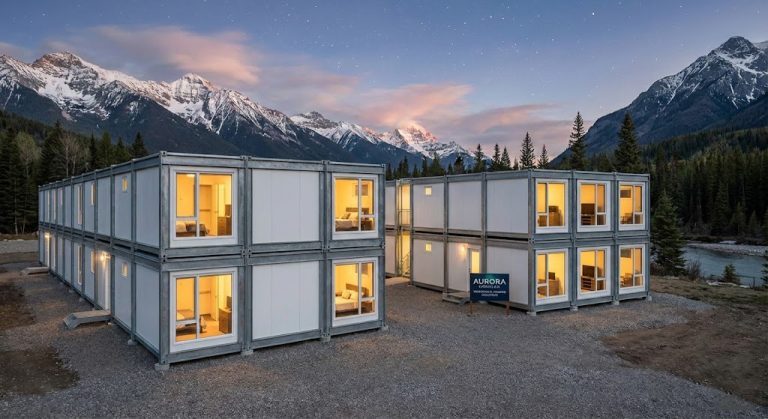
Strategic Modular Workforce Housing Solutions: Efficiency and Comfort for Remote Sites
Managing remote operations in industries such as mining, oil, or construction demands much more than a…
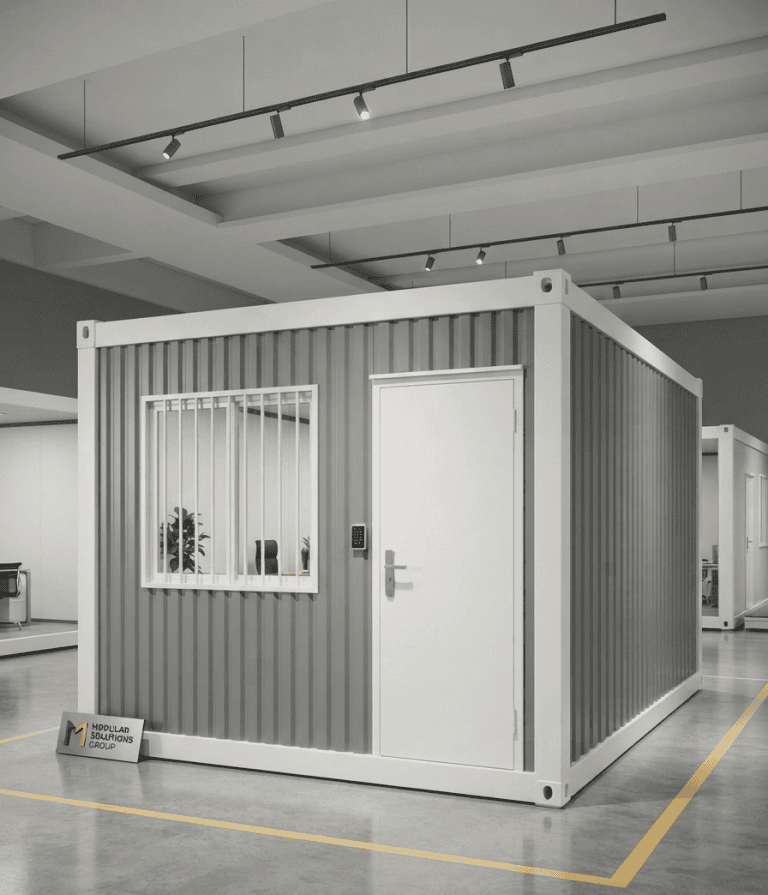
How to Choose a Container House: A Complete Buyer’s Guide
When selecting a container house, the first step is to make five important decisions: selecting the…
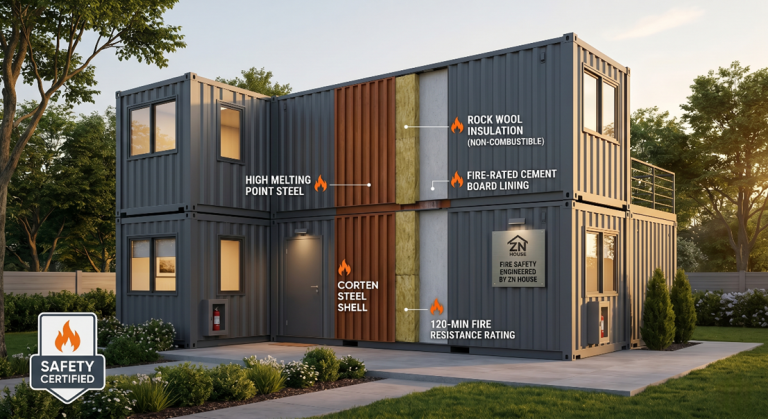
Are Container Homes Fireproof? Everything You Need to Know
Container houses have been a good alternative to buy a new house recently. These have become…
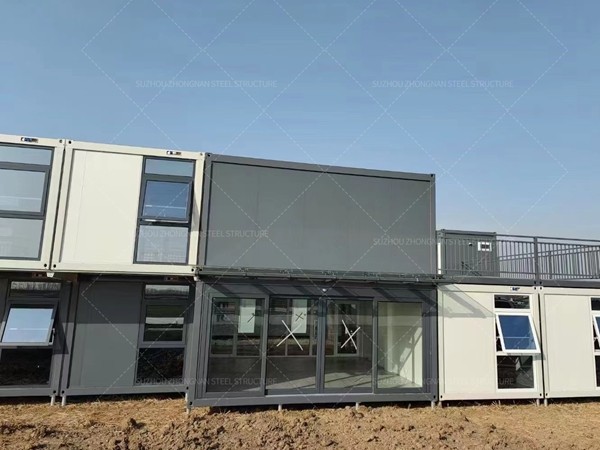
Compact To Spacious: Expandable Modular House Transformations
The dream of flexible, affordable, and sustainable living is reshaping modern architecture. Gone are the days…


