



How Much Does a Modular Classroom Cost?
School populations are growing at a rate that outstrips the ability of traditional construction to keep up. Regardless of whether you have a suburban school district, an isolated rural community or a campus rebuilding from a natural disaster, in most cases, the need for additional classroom space doesn’t wait until traditional construction can be completed. Traditional construction is slow, disruptive and getting more costly, in many cases taking from 12 to 24 months and often exceeding the tight budgets of educational institutions.
And this is exactly why schools across the globe are opting for modular classrooms: quickly erected, factory-produced and more affordable than traditional construction. Still, a glaring question always seems to be at the top of the list: what is the actual cost of a modular classroom?
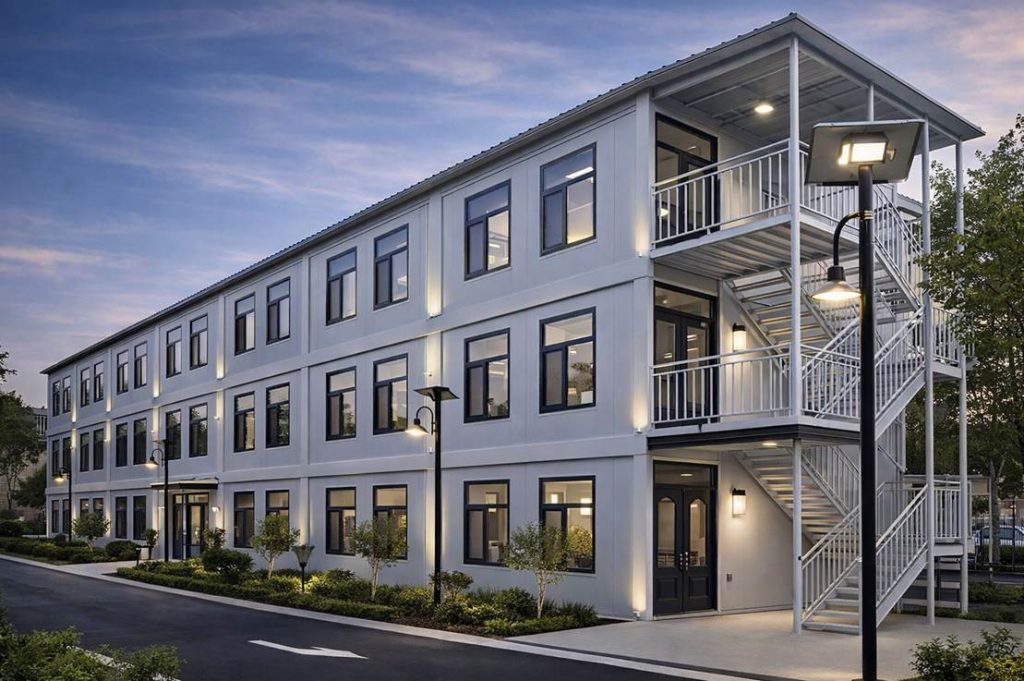
A comprehensive overview of the full picture, average modular classroom price ranges and building costs for temporary classroom buildings, additional charges most buyers fail to consider, and a down-to-earth approach to minimize your school construction budget without sacrificing quality will be explained in this handbook.
What Is a Modular Classroom?
A modular classroom is an educational building that is manufactured before being sent to the site in a factory-controlled environment. In contrast, traditional constructions are usually built where they will ultimately be placed; modular classrooms are constructed as a unit (or panel systems) before being shipped and then assembled much more quickly.
Key characteristics include:
- Factory Prefabrication: Units are built under quality-controlled conditions, reducing weather delays and construction errors
- Rapid on-site Installation: Most single-classroom units can be installed and ready for occupancy within days or weeks
- Flexible End Use: Modular buildings can be used temporarily or permanently, and reconfigured as needs change
The words modular classroom, portable classroom, and temporary classroom are used interchangeably. Although there are some distinctions for instance, portable classrooms are more likely to be skid-mounted to allow for movement whereas permanent modular classrooms tend to sit on foundations, the idea remains the same: prefabricated, rapid and cost-effective.
Average Cost of Modular Classrooms
Typical Modular Classroom Price Ranges
Prices for modular classrooms can range from very affordable to extremely expensive depending upon the type of structure, finishes, and location of the project. The table below may help to benchmark your budget.
| Classroom Type | Estimated Cost |
| Small temporary classroom | $10,000 – $20,000 |
| Standard modular classroom | $20,000 – $50,000 |
| Portable classroom building | $30,000 – $70,000 |
| Multi-classroom modular building | $100,000+ |
Note: These prices are indicative of the ranges you might expect. Cost will vary greatly with classroom size, configuration level of complexity, the materials you choose, the delivery address, and your level of customization. A basic single-room unit sold to the domestic market will be A lot cheaper than a fully insulated, air-conditioned, multi-classroom complex shipped abroad.
Contact ZN House directly for a customized modular school pricing proposal to get a precise quote for your project.
Cost of Temporary Classrooms
The most affordable option for entry into modular education construction is via temporary classrooms. Temporary classrooms are designed to be quick and economical, yet they do not provide the same long-term permanence as other types of modular buildings. That’s why temporary classrooms are perfect for:
- Short-term enrollment surges that may stabilize within a few years
- Emergency school replacement after floods, fires, or natural disasters
- Fast-track expansion while a permanent building undergoes planning approval
- Growing student populations in developing communities
| Temporary Classroom Type | Typical Cost Level |
| Portable classroom (single unit) | Lower — most affordable option |
| Flat pack modular classroom | Lower — reduced shipping costs |
| Semi-permanent modular classroom | Mid-range |
| Permanent modular classroom | Higher upfront, lower lifecycle cost |
Although short-term classrooms have much lower initial costs than permanent classrooms, you should do careful evaluations of the long-term needs before making a decision. On average, modular-designed, permanent-walled, and site-built classrooms give much more value over a 10–20-year horizon than continuously scheduling or replacing temporary classroom modules.
What Factors Affect Modular Classroom Costs?
Schools can make wiser purchasing decisions by understanding the cost drivers. Here are six key factors that influence modular classroom pricing.
Classroom Size & Layout
The most visible cost driver is size. A one-room portable classroom occupying around 3040 m 2 of space will cost really less than a multi-room building with multi-purpose rooms, science labs, administrative offices and a lounging area.
Layout complexity also matters:
- Single-room units are the simplest and cheapest to produce and ship
- Multi-room combined buildings require more structural engineering and on-site connection work
- Multi-story modular schools involve crane lifts, stairwell modules, and reinforced structural systems — adding significantly to both factory and site costs
Buyers should ask for a phased modular layout that allows for staged budget deployment over a number of years for large campus expansions.
Temporary vs Permanent Structures
The expected life of the structure has a basic effect on its specification — and hence on its cost.
Temporary modular classrooms are built for a specific short-term use, usually 2–10 years. They typically feature:
- Lighter framing systems
- Basic insulation
- Standard electrical hookups
- Simplified interior finishes
Permanent modular classrooms are constructed to the same standards as conventional construction and are designed to last 30-50+ years. They require:
- Higher insulation ratings to meet long-term energy codes
- Stronger structural systems that meet local building standards
- Fire-rated materials and acoustic treatment
- Complete MEP (mechanical, electrical, and plumbing) integration
The difference in upfront costs for temporary vs permanent buildings can be anywhere between 30% and 60%. Permanent buildings generally also have lower maintenance costs and don’t require any kind of replacement cycle.
Interior Finishes & Equipment
Specifications for interiors affect finished product pricing significantly. An example of this would be a base-level classroom, which may consist of 4 empty walls, basic light fixtures and limited electrical power available. The difference in cost between a complete smart classroom to its base level counterpart (including interior systems) is 2-3 times greater.
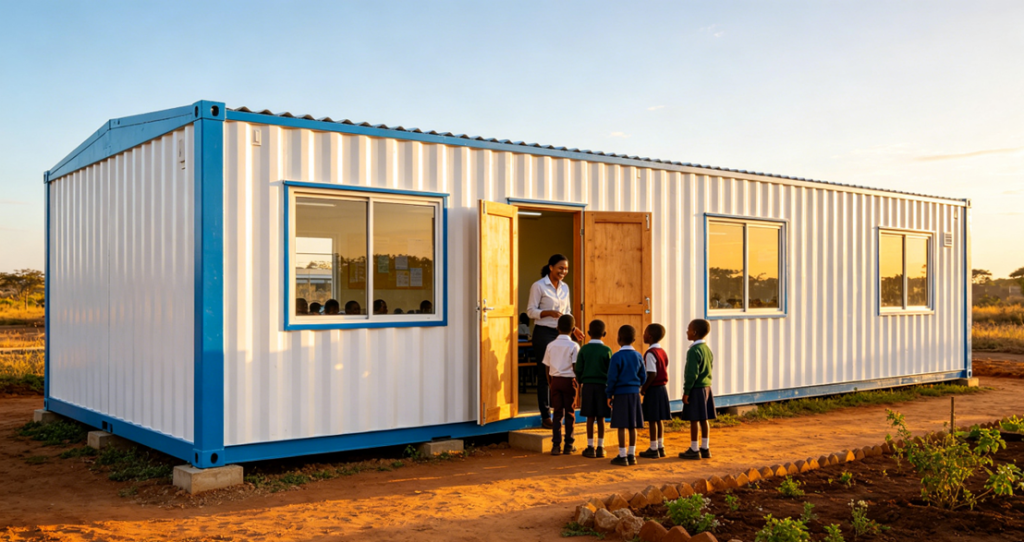
Common interior additions that affect pricing:
- HVAC Systems: Essential in tropical or extreme climates
- Flooring: Vinyl, timber, or carpet all carry different price points
- Smart Classroom Systems: Interactive displays, projectors, AV infrastructure
- Electrical and Data Cabling: Particularly important for modern digital learning environments
- Furniture and Fittings: Desks, chairs, whiteboards, storage units
With ZN House modular school projects, the buyer has complete flexibility in selecting the quantity and the level of interior finish for each classroom, giving them complete control of the budget on each classroom unit.
Transportation & Installation
Transportation and installation costs represent a major expense component for international clients to source and develop products from overseas suppliers, like ZN House.
Factors include:
Sea freight: Container shipping from China to the destination port; flat pack modular classrooms reduce shipping volume and cost substantially
Inland Haulage: Moving modules from the port to the school site
Crane Hire: Required for multi-story or heavy modular units
Foundation Preparation: Concrete pads, steel footings, or screw piles depending on site conditions
Site Connection Work: Linking multiple modules, connecting utilities, installing external walkways and ramps
Flat-pack modular classrooms are mainly favored on international projects due to their ability to be delivered in a highly cost-efficient flat-pack form, which can reduce freight rates by up to 60% over volumetric modular units. ZN House offers various flat pack containers and prefabricated modular designs, in particular tailored for shipping efficiency.
Climate & Insulation Requirements
Climate suitability is a key and often overlooked cost factor, especially for schools in tropical, coastal or extreme weather zones.
For tropical and Southeast Asian climates, specifications should include:
- High-performance thermal insulation to reduce cooling loads
- Moisture-resistant wall panels and cladding systems
- Anti-corrosion coatings on all steel structural components
- Enhanced ventilation design to improve natural airflow
For typhoon and cyclone-prone regions, structural reinforcements are required:
- Wind-rated connections between modules and foundations
- Reinforced roof anchorage systems
- Impact-resistant windows and door systems
ZN House constructs modular school buildings made of pre-galvanized steel framing and tough curtain wall systems, all designed for tropical and marine conditions (projects completed in the Philippines, Brazil and Australia).
Modular Classroom vs Traditional School Building Costs
Once the full picture begins to emerge, the comparison between modular construction and traditional site-built construction is typically a decisive one for schools looking at their options.
| Feature | Modular Classroom | Traditional Construction |
| Construction speed | Weeks to months | 12–24+ months |
| Initial cost | Lower | Higher |
| Labor cost | Lower (factory efficiency) | Higher (site labor) |
| Budget predictability | High | Lower (subject to delays) |
| Expansion flexibility | High (add modules as needed) | Low (structural changes expensive) |
| Site disruption | Minimal | Significant |
| Relocation potential | Yes (portable options) | No |
| Quality control | High (factory QC) | Variable |
Modular construction is more than just a cost-effective way to build; it is a unique method of delivering services that allows schools to have better control over their timeframe and funding as well as more options for future use. Because this style of building offers so many benefits, schools that are growing quickly or building in underdeveloped areas can usually absorb the premium cost of using traditional building methods compared to modular building.
Why Schools Choose Temporary Classrooms
While permanent modular solutions exist, temporary classrooms remain a popular procurement option. That is why.
Fast School Expansion
Prefabricated modules can be shipped, installed and ready to use within weeks, so schools can quickly react to unexpected enrollment increases before the new school year begins.
Lower Upfront Investment
Schools can respond to short-term crowding issues without having to launch megabucks capital campaigns for new buildings by focusing on critical architectural footprints and temporary foundation systems.
Minimal Campus Disruption
Traditional construction zones present continuous safety hazards, noise and dust. Modular components come pre-assembled, reducing crane time on-site for easier and quieter installation within a learning environment.
Flexible Relocation & Expansion
Temporary classrooms can be taken apart, moved to a transport chassis, and then relocated to a different district school to accommodate increasing demand as demographics change over the next ten years.
Hidden Costs Schools Should Consider
School administrators often overlook expanded project costs incurred in the delivery and installation of technology after only accounting for the initial cost of a classroom technology purchase, typically listed as the cost per classroom. The use of transparency surrounding these items when budgeting assists in creating better budgets and reduces the number of surprises.
Site Preparation Phase
You usually need to level the ground and add drainage improvements to make sure you have access roads to put any modular units in place. The costs of this vary greatly from one site to another based on what’s present at the site.
Foundation Phase
You may need a concrete slab, screw pile system, or a steel bearer frame as defined by your local building code and the soil conditions they created to meet these requirements. The costs for your foundation/footing for a standard classroom can range from several hundred dollars to several thousand dollars.
Utility Connections
Once you have your modular unit(s) in place, you will have to connect them to the existing electrical, water, sewer and data networks. The connections require licenced trades and depending on your site, may require trenching, a new switchboard or a booster system.
Local Permits and Approvals
Many municipalities will require either planning consent, building permits or fire safety inspections to be able to occupy any of your modular classroom units. You will also experience wide variances in the time it takes to process these requests and the related fees.
Ongoing Maintenance
As with any building, you will need to maintain your modular units periodically; this includes regular exterior inspections, replacing the exterior cladding, servicing HVAC systems, and repainting the inside/outside of each modular unit. It is important to budget for life-cycle maintenance right from the start to protect the long-term value of the asset.
Addressing these costs up front leads to far more reliable total project budgets — and, ultimately, speedier approval from school boards and government funders.
Best Modular Classroom Solutions for Different Budgets
Not all schools have the same needs or the same financial situation. Here’s a practical framework for matching modular classroom solutions to common budget scenarios.
| Budget Level | Recommended Solution |
| Low budget/emergency need | Temporary portable classroom — fast, affordable, basic finish |
| Medium budget / standard expansion | Standard modular classroom — full fit-out, durable for 10–20 years |
| Large campus expansion | Multi-classroom modular building — configured to campus masterplan |
| Remote/international project | Flat pack modular classroom — optimized for sea freight and local assembly |
| Long-term permanent replacement | Permanent modular school building — full structural standard, 30+ year lifespan |
All five of these solutions are available from ZN House, with the ability to tailor specification, size and finish to perfectly suit project requirements and available budget.
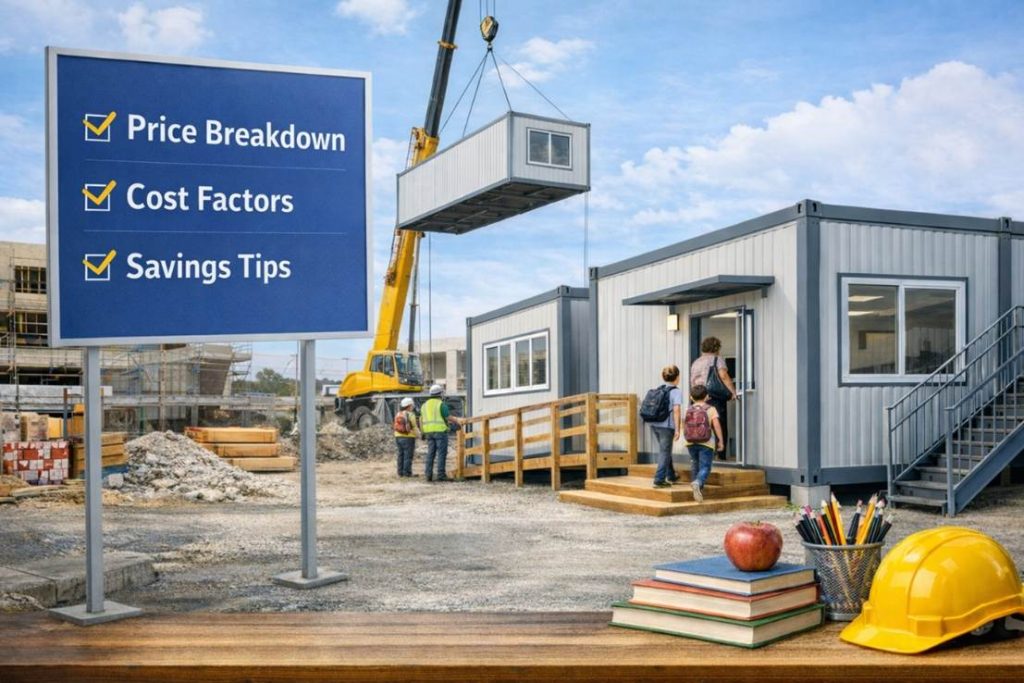
How to Reduce Modular Classroom Costs
Making smart decisions during the design phase can go a long way toward cutting your total cost per square foot dramatically, without cutting corners on safety or comfort inside.
Implement Standardized Layouts
Using standard sizes (factory standard, i.e., standard 20ft or 40ft container increments) eliminates custom structural re-engineering costs and speeds up assembly lines.
Commit to Bulk Modular Projects
The procurement models that combine multiple classroom needs into a single purchase order reduce per-unit cost through volume material discounts.
Opt for Simplified Interior Finishes
Choose materials that are tough and commercial grade, with high wear resistance, but without the cost premium associated with luxury architectural details.
Leverage Flat-Pack Transportation
Maximize logistical savings with modular flat pack configurations that maximize shipping volume and minimize overall delivery costs.
Incorporate Future Expansion Planning
Design your initial foundation systems and structural framing connections to allow for future vertical stacking or horizontal expansion, avoiding costly tear-outs later.
Are Modular Classrooms Worth the Cost?
For most schools, the answer is a resounding yes, and the evidence extends beyond simple price comparisons.
Faster return on Investment
A module classroom will produce income after 9 weeks and serve students after 9 weeks, while the traditional building takes 18 months before generating any revenue and produces net costs throughout site supervision, interest expense, and financing.
Long-term Flexibility
A modular school that can be modified according to changing demographics and moved, if necessary, is fundamentally superior to a rigid, concrete building in terms of being a resilient asset. This flexibility provides real financial value in an environment where school populations are constantly in flux and urban forms of land development change frequently.
Lower Construction Risk
Using factories to prefabricate components will greatly reduce the potential for some of the more common construction cost overruns associated with traditional construction – such as delays caused by inclement weather; disputes between subcontractors; volatile material prices; and complications with access to the job site. Modular projects also have a significantly higher rate of being completed on time and within the budgeted amount.
Reusable Structures
Buildings made either permanently modularized or modularized into the style of temporary building exhibit great flexibility during their whole life cycles through changing conditions. Specifically, container-based modularized schools (students utilizing containers) deliver value after the end of their operational time and thus allow alternative usages beyond that of being a school.
Modular classrooms are a more cost-effective way to expand a school compared to traditional methods because they don’t just provide lower costs; they also help schools eliminate the problems that have historically caused delays and cost overruns in the construction industry.
Conclusion
In terms of flexibility, practicality, cost-effectiveness, and adaptability, modular classrooms are an ideal solution to meet the needs of schools that want to accommodate increased enrollments, rebuild campuses, or provide temporary space in an emergency. Whether your requirement is for a single portable classroom for a temporary expansion or you are building an entire modular school campus with multiple buildings, modular construction provides speed, budget certainty, and long-term adaptability that cannot be achieved by conventional construction.
Pricing is affected by total square footage, distance for shipping materials, finishing selections of the interior, and the climate codes of the area that needs to be built. If schools use standard layouts for their designs and flat-packed shipping, they will be able to stretch their construction dollars further.
Ready to Get Started?
Contact ZN House today to discuss your modular classroom project. Our team will provide:
Customized modular classroom pricing based on your exact requirements
Tailored modular school building solutions for your campus size and budget
Modular classroom layouts and quotations — ready to present to your board or funder
Request a Free Quote from ZN House
Frequently Asked Questions (FAQs)
How much does a modular classroom cost?
The cost of a modular classroom is dependent on the style, size, materials, number of modules and site conditions. In general, the price of a small temporary modular classroom starts at approximately $10,000-$20,000, while standard modular school rooms built out of fully-fitted materials are $20,000-$50,000. Costs for multi-classroom modulars begin at $100,000. For a project-specific quote, please contact ZN House.
What is the cost of temporary classrooms?
Temporary classrooms are typically the most cost-effective alternative compared to other structures available today. Portable units will cost you anywhere between approximately $10,000-$20,000 for basic offerings, while flat pack units can save even further by allowing you to ship internationally via freight. The total cost of building a temporary classroom depends primarily on the following factors: size of the unit, level of specifications (finish), and site preparations to include both immediate and long-term needs such as foundations and utilities.
Are modular classrooms cheaper than traditional buildings?
Yes, modular classrooms have a much lower overall cost than traditional classrooms, with total project cost differences between 20% and 40%. Savings through factory efficiency, less on-site labour, shorter construction time, and lower financing costs (due to quicker delivery) lead to large savings.
How long do modular classrooms last?
Modular classrooms built with quality materials can last decades with the proper maintenance.
What affects modular classroom pricing?
The main cost drivers are classroom size, insulation requirements, transport range, interior finishing decisions, and local installation specifications.
Can temporary classrooms be relocated?
Yeah. Many portable and modular classrooms are mobile and expandable
Are modular classrooms suitable for tropical climates?
Yes. The modern modular classrooms can be built with moisture protection, heat insulation, a ventilation system and typhoon-resistant structure for tropical areas.
Similar Posts
Maximizing Workplace Efficiency with a Modular Container Office
The present-day working environment requires the ability to adapt quickly. Generally, the conventional office setups come…
Benefits of a Modular Classroom
Introduction A common challenge throughout the world for all types of schools is the dramatic increase…
Buying Container Houses from China: Factory vs Trader, QA & Incoterms
Why source from China (and what you can actually buy) Container Houses from China are becoming…
Container houses China bring nature closer to you
Container houses China offer eco-friendly living, blending modern comfort with nature, flexible design, and sustainable features for a healthier lifestyle.
How Much to Build a House from Shipping Containers?
The idea of owning a home is changing. With traditional housing costs still going up in…
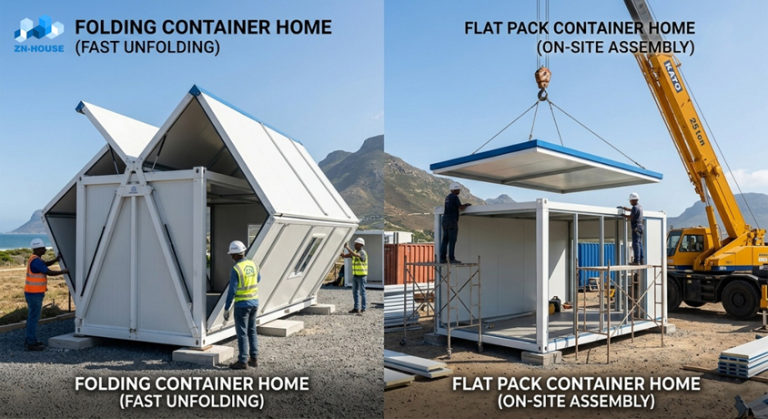
Flat Pack vs. Folding Container Homes: Which One Is Better for Your Project?
Introduction Modular building is globally revolutionizing the construction industry through speed of construction time, eco-sustainability, and…


