



20ft vs 40ft Container House: Which Size Is Right for Your Project?
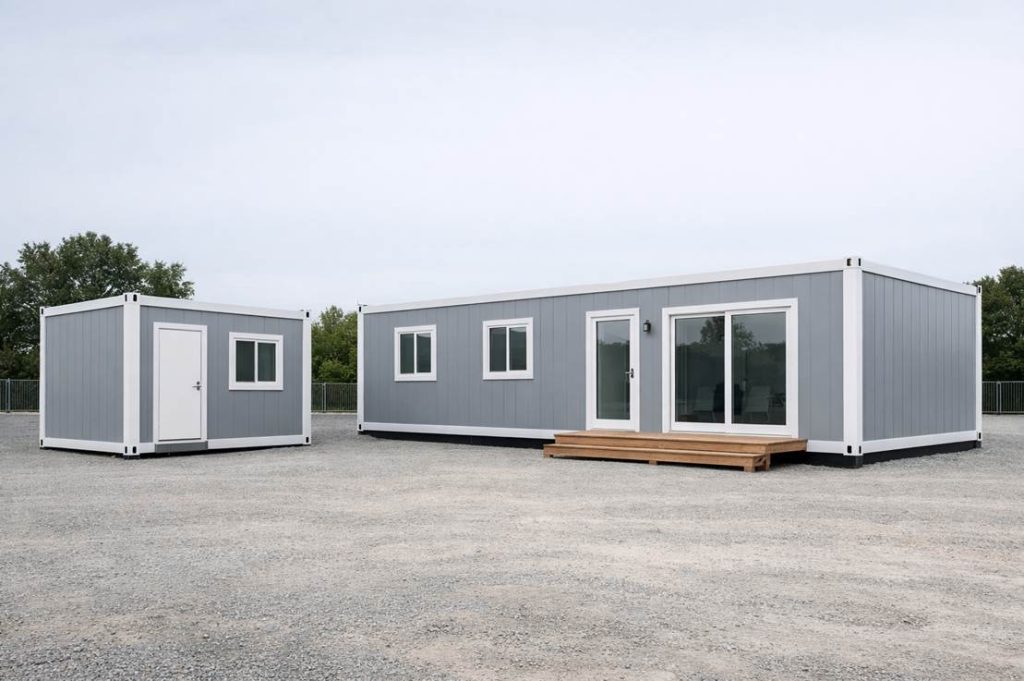
20ft and 40ft container houses mainly differ in the amount of usable space. A 20ft container house can be easily packed and transported and it is the best choice for small rooms, offices or single accommodation units. A 40ft container house is approximately twice as long and offers more layout options, so it’s a great choice for bigger houses, offices, dormitories and project accommodation. However, the right decision is determined by your application quantity, site conditions and budget.
For project buyers, going for a 20 ft or 40 ft decision is not merely a size issue. Besides, it will also influence the shipping costs, installation layout planning, on-site handling, and long-term usability.
Quick Answer: Should You Choose a 20ft or 40ft Container House?
Here is a quick decision table to point you in the right direction before we get into dimensions and cost breakdowns.
| Choose 20ft Container House If You Need | Choose 40ft Container House If You Need |
| Compact single-room space | Larger interior space |
| Lower initial cost per unit | More complete functional layout |
| Easier transportation and handling | Larger office, home or dormitory layout |
| Site office, guard room or small accommodation | Family housing or multi-person accommodation |
| Small quantity or flexible relocation | Fewer but larger units |
| Budget-friendly temporary building | Better long-term comfort and usability |
In short, 20ft containers are the best solution for compact and flexible use. But, 40ft container houses are more suitable for those cases where additional space is really necessary, like a family home, a dormitory or larger commercial premises.
20ft vs 40ft Container House Size Comparison
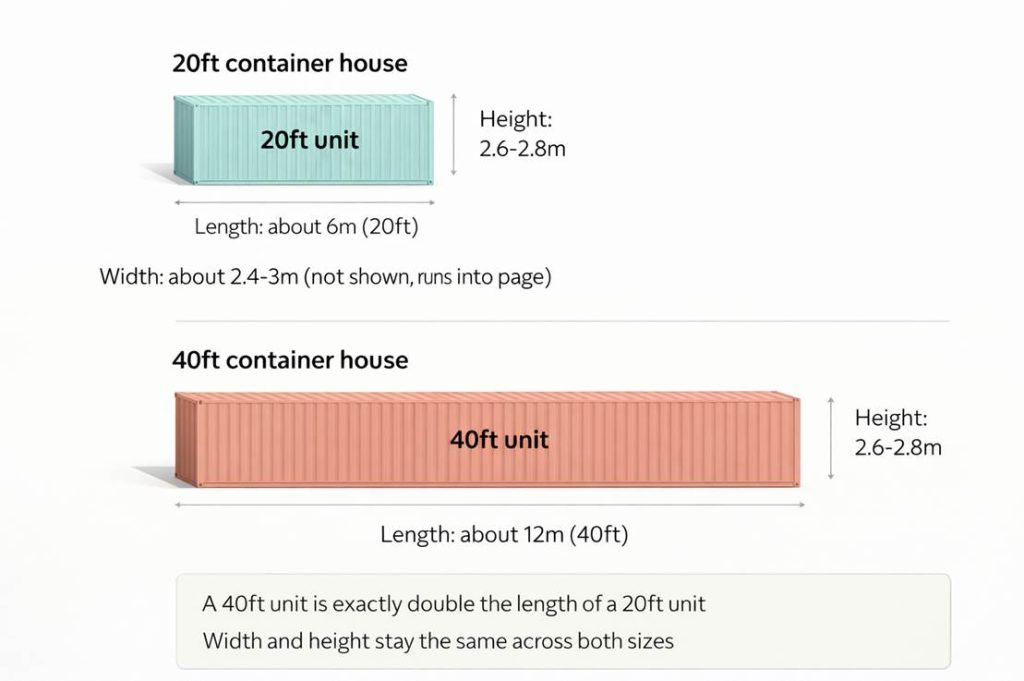
As both the small and large versions are based on the same structural module system, they have similar width and height. The main difference is length and the amount of usable floor area that the additional length gives.
| Item | 20ft Container House | 40ft Container House |
| Typical Length | About 6m / 20ft | About 12m / 40ft |
| Typical Width | About 2.4m–3m | About 2.4m–3m |
| Typical Height | About 2.6m–2.8m | About 2.6m–2.8m |
| Usable Space | Compact single-room space | Larger multi-function space |
| Best Layout | Studio, office, room, small unit | Office suite, family unit, dormitory, accommodation |
Typically, traditional steel shipping containers are about 8 feet wide. But prefab or flat pack container houses for living are made in different widths by various suppliers. Because of this, the data above shows typical habitable dimensions rather than strictly adhering to ISO shipping container specifications.
Space and Layout Differences
Length is the key factor in determining what kind of internal layout a container house can have. Let’s see how that works for each size.
20ft Container House Layout
Generally, a 20ft container house is suitable for one single open room. You may convert it into a studio office bedroom, or a small living unit. Still, there is hardly any space for a separate bedroom, kitchen, and bathroom in the same area. Meaning making the right furniture selections and having an intelligent layout design is of greater importance in a 20ft unit than a bigger one.
Common 20ft layout examples include:
- Small site office
- Single accommodation room
- Guard house
- Tiny home
- Backyard room
- Storage + office unit
40ft Container House Layout
A 40ft container house gives a lot of space for different functional areas. It is easy to design a bedroom, bathroom, kitchen and living area or a bigger office with various workstations. So, it can be more suited for people who want to live there for a long time and more than one person, or for a project accommodation that takes more than just a single room.
Common 40ft layout examples include:
- Family container home
- 2-room accommodation unit
- Large site office
- Meeting room + office
- Dormitory unit
- Worker accommodation
Cost Comparison: 20ft vs 40ft Container House
Because it needs less material, a container house that is 20ft long will typically be a cheaper option. Although a 40ft container house is more expensive to buy at the beginning, it could be a more cost-effective choice per square meter for large projects that really need additional space.
| Cost Factor | 20ft Container House | 40ft Container House |
| Unit Price | Lower | Higher |
| Cost per Square Meter | May be higher for some small units | Often more efficient for larger space |
| Interior Finish | Lower total finish area | More doors, windows, partitions may increase cost |
| Shipping | Easier for smaller orders | More space per unit, but logistics must be planned |
| Installation | Faster for single unit | More handling and site planning needed |
| Best Budget Use | Small rooms, temporary use | Larger layouts, long-term use, project buildings |
It would be an oversimplification to think a 20ft container is simply “cheaper” and a 40ft container is just “more expensive.” Another way to look at it: a 20ft container will generally have a lower overall cost per unit, though a 40ft container could offer better value once you consider how much effective area the project really calls for.
Transportation and Installation Differences
Logistics plans differ quite dramatically when comparing the two sizes. 20ft containers are generally more maneuverable and easier to work with on typical sites, whereas 40ft containers necessitate thorough transportation and lifting arrangements due to their length. With flat pack container homes, how they are packed and the loading quantity of 40HQ in the container can majorly influence the overall shipping cost. Also, fully assembled 40ft containers might need additional floor space and heavy lifting equipment on the site, but flat pack designs offer great enhancement in shipping efficiency, particularly for international projects.
| Factor | 20ft Container House | 40ft Container House |
| Handling | Easier | Requires more planning |
| Relocation | More flexible | Less flexible due to size |
| Site Access | Better for narrow or limited sites | Needs wider access and lifting space |
| Overseas Shipping | Depends on packing method | Depends on size, packing, and configuration |
| Installation | Easier for small projects | Better for larger planned projects |
For buyers ordering in bulk, might want a look-see at the 40HQ loading quantity of flat pack container houses to make a decision on container sizing, as loading efficiency can alter the per-unit landed cost at the end of the day.
20ft vs 40ft Flat Pack Container House
When it comes to choosing between 20ft and 40ft flat pack container houses, it is not only a matter of bigger floor area. Buyers also have to consider the size of the packing, the number of units loaded, assembly time on-site, project configuration and total shipping cost. Generally, a 20ft flat pack container house is more suitable for offices, dormitories and accommodation units, while a 40ft flat pack house may be a better option if a big single space is really required.
- 20ft flat pack units are easier to standardize across multiple sites.
- 40ft layouts provide more space but may affect shipping and handling complexity.
- Project buyers should compare total landed cost, not just unit size or unit price.
- For container camps, a combination of 20ft and 40ft units is often the better approach.
Best Applications for 20ft Container Houses
| Application | Why 20ft Works |
| Site Office | Compact and easy to deploy |
| Guard Room | Small footprint and practical layout |
| Single Accommodation | Suitable for one room or small living unit |
| Temporary Room | Lower cost and easier relocation |
| Storage + Office | Good for small project sites |
| Backyard Unit | Suitable for limited land |
A 20ft container house is best when a project needs compact, repeatable and flexible units. It suits small offices, single rooms, temporary accommodation, and projects where site space or budget is limited.
There are 40ft container houses that can be perfect solutions if you want a larger interior space and different functional zones. They are well suited for family homes, office spaces, dormitory accommodation buildings, and long-term project buildings that are long-term.
Case Study: Remote Site Office and Living Quarters, South Africa
David Chen, a project leader in a global infrastructure division, required several levels of a provisional office and living quarters for a remote South African area. ZN House manufactured modules that were about 80% ready when they arrived and it took only a few days to put them together, which enabled the project to continue on schedule. The office that was finished turned out to be nicely insulated and suitable for immediate occupancy. It showed that a mixed-size strategy (large units for offices, small units for supporting spaces) can work quite well in remote infrastructure projects.
When to Combine 20ft and 40ft Container Houses
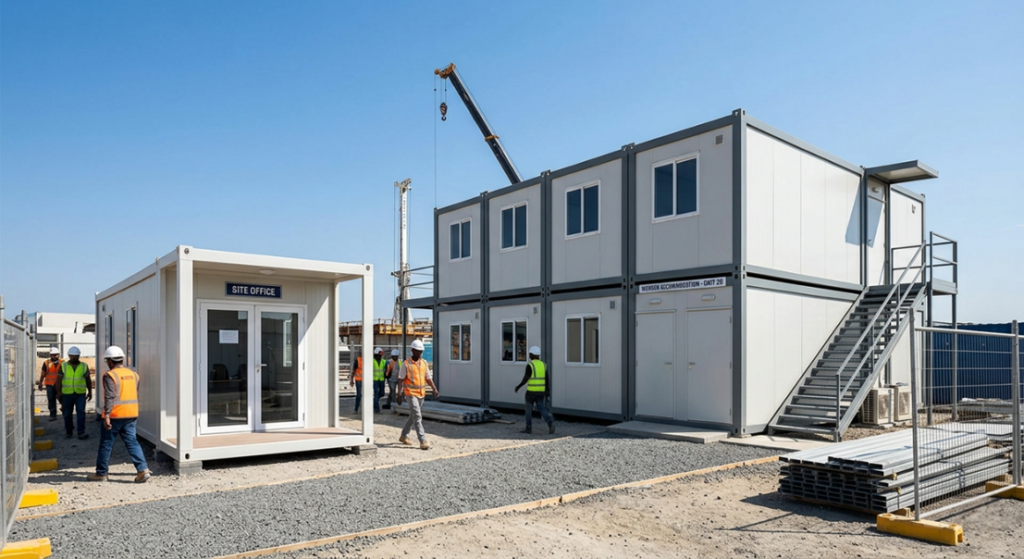
Not all projects require only a single size. For example, a container camp or a construction site can be a mixture of both, each size being used where it is most effective.
| Project Area | Suggested Combination |
| Worker Camp | 40ft dormitories + 20ft offices |
| Construction Site | 20ft site office + 40ft accommodation |
| Container Camp | 40ft housing + 20ft toilet/shower units |
| Commercial Project | 40ft main room + 20ft support unit |
| Temporary Site | 20ft flexible units + 40ft shared spaces |
Many project buyers consider the best answer to be a mix of 20ft and 40ft container houses. Small 20ft boxes can be used as offices, toilets or supporting areas, whereas big 40ft boxes are used as dormitories, living rooms or shared rooms.
How to Choose the Right Size for Your Project
| Question | Why It Matters |
| What will the unit be used for? | Home, office, dormitory, camp, storage or accommodation |
| How many people will use it? | Determines required space and layout |
| Is it temporary or long-term? | Affects finish level and comfort |
| How much site space is available? | Smaller sites may prefer 20ft |
| Is relocation needed? | 20ft is easier to move |
| What is the shipping method? | Flat pack or fully assembled changes logistics |
| What is your budget? | Unit price and total project cost differ |
| Do you need private facilities? | Bathroom and kitchen require more space |
Common Mistakes When Choosing Between 20ft and 40ft
- Choosing only based on unit price, without factoring in total project cost.
- Ignoring shipping and installation costs until after the order is placed.
- Choosing 20ft when a private bathroom and kitchen are actually required.
- Choosing 40ft when site access is too limited for safe delivery and lifting.
- Forgetting to plan for future expansion needs.
- Not considering insulation and ventilation requirements for the climate.
- Not asking for layout drawings before finalizing an order.
Why Choose ZN House for 20ft and 40ft Container House Projects?
ZN House offers container home solutions in 20ft and 40ft sizes for different uses: homes, offices, dormitories, accommodation and container camps. We have flat pack, folding and modular container homes with custom layouts. Our staff is ready to guide customers through an analysis of plans, specs, loading scenarios, and costs given the usage, volume and destination. Besides, we give quotations, loading, and shipping assistance to overseas buyers on a project basis.
Browse our entire collection of layouts and configurations on the Container Home solutions page to get inspiration from the completed 20ft and 40ft container home projects.
If you are thinking about a multicomponent project mixing different sizes, there is a separate page for Container Camp solutions.
For needs of worker or student housing, the Container Dormitory solutions page is the right place that shows the layouts developed mainly for multi-person accommodation.
FAQs About 20ft vs 40ft Container Houses
What is the main difference between a 20ft and 40ft container house?
The key difference between these two lies in size and space available for use. The 20ft container house is smaller and, because of this, more convenient to transport, whereas a 40ft container house can offer quite a bit more room for bigger designs, such as offices, dormitories and long-term accommodation.
Is a 20ft container house cheaper than a 40ft container house?
Generally, a 20ft container house has a lower per-unit price as it calls for fewer materials. On the flip side, if you are looking for more living space, a 40ft container house might give you better value for your money per square meter.
Which is better for a site office?
A 20ft container will generally serve quite adequately as a small site office on its own. Still a 40ft container offers more comfort for large offices, meeting rooms or combined office-accommodation layouts.
Which is better for worker accommodation?
Most of the time, single 40ft container houses will be better for multi-person accommodation or dormitory-type layouts. 20ft ones can be used for single rooms or small accommodation units.
Can 20ft and 40ft container houses be combined in one project?
Yes. Many container camp and construction site projects mix 20ft and 40ft containers to set up offices, dormitories, toilets, kitchens and other common areas.
Which size is easier to transport?
A 20-foot container house is usually more manageable and can be moved around easily as it is smaller in size. Transport, lifting and planning for site access of a 40-foot container house need to be more precise and cautious.
Are 20ft and 40ft flat pack container houses different from shipping container homes?
Yes. Flat pack container houses are manufactured components, shipped in a flat condition and then installed at the construction site. However, shipping container homes are usually old steel shipping containers that have gone through some conversion.
How can I get the right size recommendation?
Send your project usage quantity, layout requirements, site conditions, and destination. ZN House can assist in suggesting whether 20ft, 40ft, or a combination of both is the best fit.
Get a Custom Container House Size Recommendation
Are you confused about which container house – a 20ft or 40ft is suitable for your construction? Share with us your plans, necessary layout, quantity and destination. ZN House may offer you a side-by-side comparison of different options and the recommendation of a container house solution that fits your budget, location and other project-related factors.
Ready to move forward? Get a Free Quote
Similar Posts
Quickly Build 20FT Container House
A 20 feet container house is a very desirable type of housing that can be constructed…
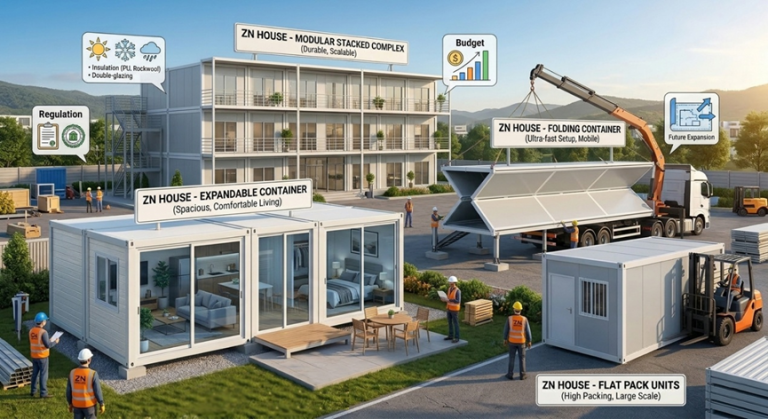
How to Choose the Right Container House for Your Project
Introduction Container house solutions are rapidly changing how we construct buildings on a global level, allowing…

What Is a Container Camp? The Complete Guide to Modular Workforce Accommodation
All major construction sites share one relentless challenge: Where are workers supposed to sleep while they…
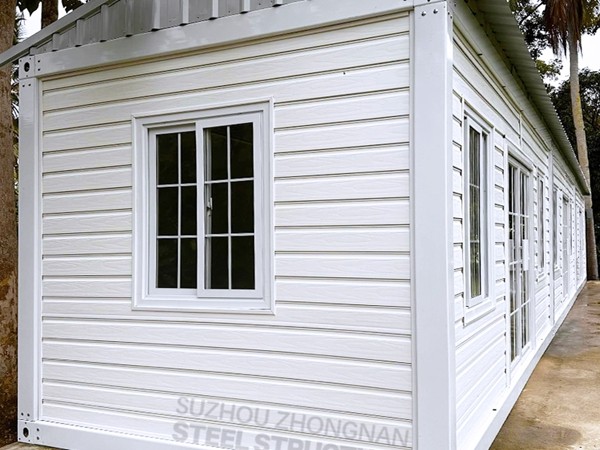
Upcycling Shipping Containers into Modern Homes
The rise of modular container homes for sale marks a transformative shift in sustainable architecture. By repurposing…
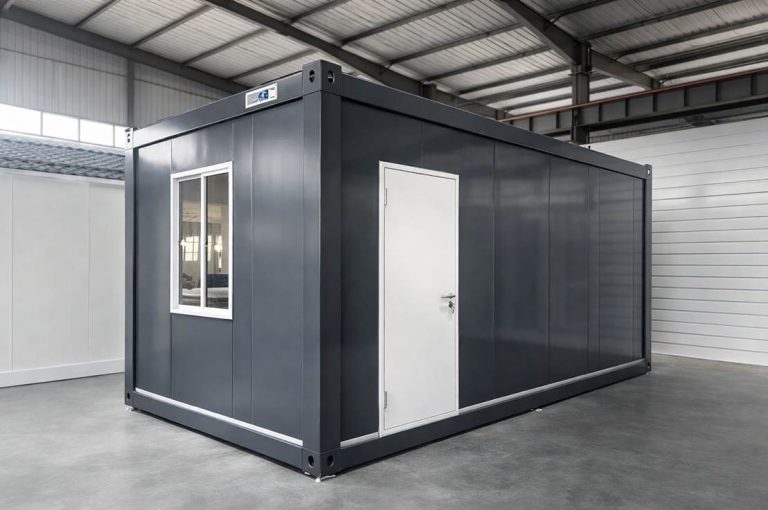
How Much Does a Flat Pack Container House Cost?
A standard 20ft flat pack container house price generally ranges from $1,850 to $2,150 per unit….

Modular container house is long-lasting
The architectural landscape is witnessing a paradigm shift, moving towards construction methodologies that prioritize efficiency, sustainability,…


