



Container Office vs Modular Office:Which Is Better for Your Project?
When comparing a container office vs modular office, the best option is determined by factors like the duration of the project, budget, the speed of installation, the condition of the site, the level of comfort required, and the needs of future relocation. Container offices are very durable, can be deployed very quickly, and are the most suitable for construction sites, mining camps, and temporary project offices. On the other hand, modular offices offer more design freedom, larger space, and a high-grade work environment which makes them ideal for long-term or semi-permanent use. If it is a heavy-duty construction site office that can handle the daily activities of your field workers that you need, or a large, multi-level business center, understanding the differences between these two types of prefabricated systems will definitely lead you to the right decision for your business.
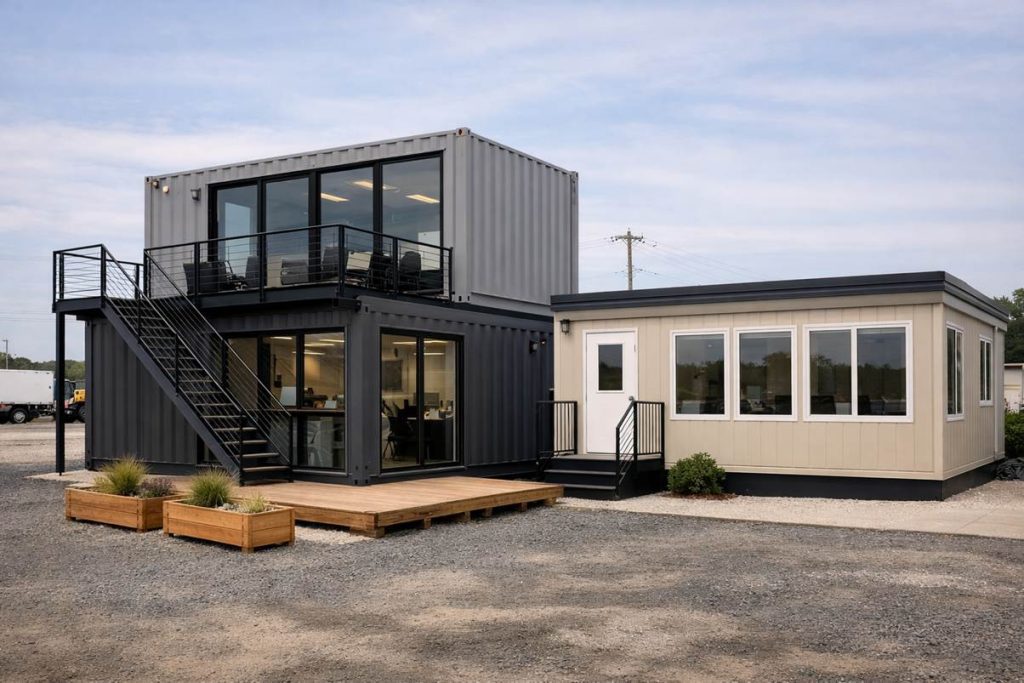
Quick Answer
Generally, a container office will be a better choice for a temporary site office, construction sites, mining projects, remote camps, and fast-deployment workspace needs. A modular office would typically be more suitable for large office buildings, long-term project offices, comfortable interiors, and multi-room layouts. For offshore construction camps, flat pack container offices might also provide better shipping efficiency and easier bulk delivery.
What Is a Container Office?
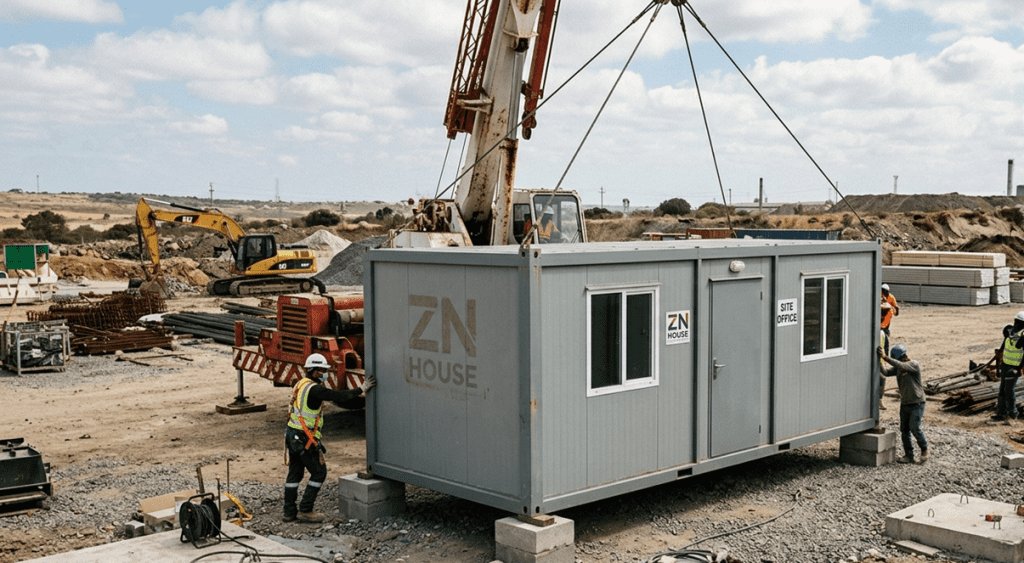
A container office is a prefabricated office unit made from a container-based steel structure or a modified shipping container. It is engineered specifically for rapid deployment and tough environments, making it ideal as a temporary site office, construction office, mining site office, project management office, meeting room, security office, or container camp office.
Today, container structures are not just confined to the use of standard decommissioned sea containers. High-tech industrial containers may, for example, be a flat pack container office, a folding container office, or a detachable container office. These units are completely outfitted with doors, windows, wall panels with insulation, an electrical system, lighting, and HVAC arrangements. Internally, the space can be divided into dedicated meeting rooms, private executive desks, restrooms, or secure storage zones. They are highly effective in rough work sites, infrastructure projects, and isolated industrial environments.
What Is a Modular Office?
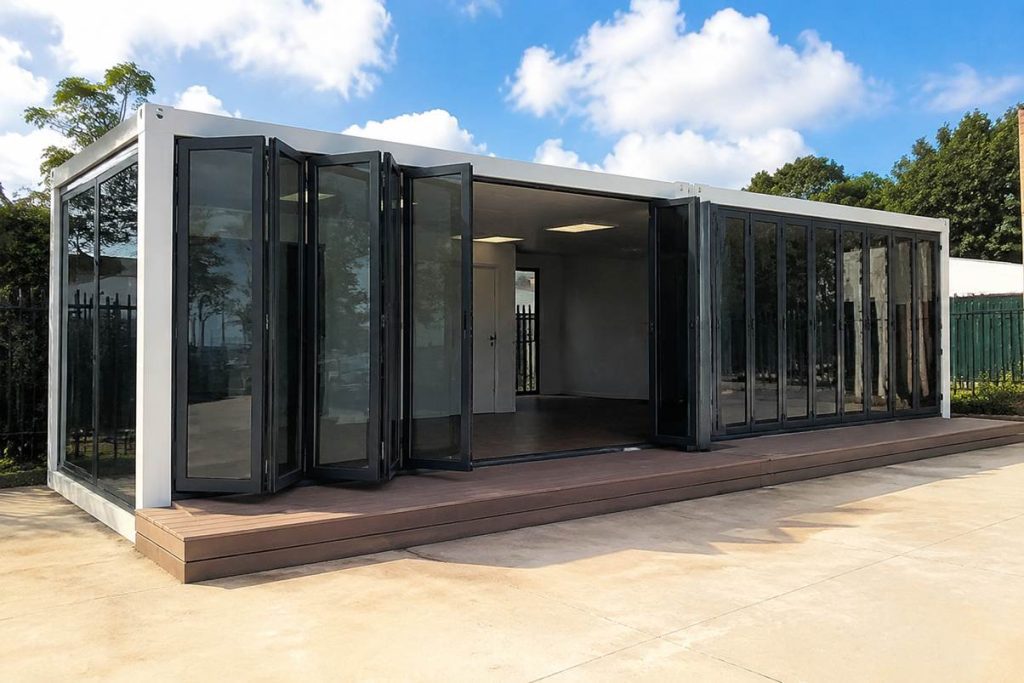
Sometimes a modular office is simply a prefabricated office building made of factory-built modules or structural elements that are carried to the location and assembled into a full office. But, given the framing, foundation type, and structural requirements, modular offices can be made up for temporary, semi-permanent, or permanent installations.
Unlike self-contained container blocks, modular construction focuses on joining volumetric sections or wall-and-beam assemblies to remove interior columns. This design allows you to build single rooms, multi-office rows, wide conference halls, open-plan workspaces, reception areas, and multi-story management complexes. They resemble traditional commercial buildings but benefit from faster factory production timelines. They are heavily utilized in long-term infrastructure programs, corporate relocations, government facilities, educational centers, and healthcare hubs.
Container Office vs Modular Office: Key Differences
| Factor | Container Office | Modular Office |
| Structure | Container-based steel frame or modified shipping container | Factory-built modules, panelized lines, or prefab components |
| Installation Speed | Very fast for single units; rapid for flat pack configurations | Fast, but larger buildings need structural planning and assembly time |
| Durability | Rigid, self-supporting steel structure; excellent for harsh sites | Durable, heavily dependent on selected materials and foundations |
| Design Flexibility | Ideal for standard layouts; bounded by container dimensions | Higher flexibility for expansive, open-plan, and multi-room layouts |
| Comfort | Highly practical; governed by insulation type and HVAC setup | Naturally easier to create a polished, traditional office feel |
| Shipping Efficiency | High for flat pack container systems; lower for fully pre-assembled units | Varies based on component sizes, packing volume, and panel style |
| Relocation | Simple to crane up, load, and relocate multiple times | Possible, but complex multi-unit assets require careful disassembly |
| Scalability | Easily stacked horizontally or vertically (up to 3 floors) | Better suited for large-scale, interconnected office complexes |
| Security | Hardened steel perimeter; great for unmonitored sites | High security achievable, but depends on wall panel/locking choices |
| Best Use | Construction jobsites, mining blocks, remote outposts, camp offices | Semi-permanent campuses, corporate annexes, medical centers, schools |
Cost Comparison: Container Office vs Modular Office
Initial Cost
Containers usually cost less upfront for standard site configurations. As they make use of standard dimensions and efficient factory lines, production costs are kept well-optimized. Modular buildings, then again, are typically more expensive at first because they have non-standard sizes, different architectural finishes, and large open interior spaces.
Shipping Cost
For international initiatives or remote bulk shipping, logistics significantly impact your budget. Traditional fully assembled offices occupy substantial shipping space. However, choosing a flat pack container house design allows you to pack up to 4 complete units inside a single 40HQ shipping container, lowering freight costs per square meter.
Installation Cost
Labor and machinery costs vary based on assembly mechanics. A folding container office requires minimal crane time and can be erected in minutes, lowering site labor costs. A modular building, especially a multi-room or multi-story complex, demands more field coordination, heavier cranes, and an extended crew schedule to seal joints and run utilities between structural modules.
Foundation and Site Preparation
Every building needs a level, firm base underneath. Container offices are built with steel base frames which provide an even distribution of the loads. So, they can be placed on straightforward concrete blocks, gravel piers, or timber footings for temporary projects. However, big modular office buildings exert various loads onto the ground and usually demand properly designed concrete slabs or strip deep foundations for maintaining the structure over time.
Long-Term Value
If your business manages rolling project schedules, container units offer exceptional repeat value. They can be broken down, transported to a new site, and reassembled multiple times without losing structural strength. Modular buildings offer distinct long-term value by functioning as semi-permanent assets that enhance property value or serve as fixed corporate workspaces for decades.
Total Project Cost
Total Project Cost = Factory Price + Shipping Freight + Foundation Work + On-Site Installation + HVAC/Utilities Integration + Ongoing Maintenance + Future Relocation
Installation Speed and Project Timeline
When a project timeline is tight, your structural design choices directly dictate your operational launch date.
- Folding Container Office: This provides the fastest deployment setup. The walls, roof, and floor are pre-hinged at the factory. Once craned upward on-site, the structural panels lock into place within 10 to 15 minutes, allowing for immediate interior hookups.
- Standard / Detachable Container Office: These designs rely on interchangeable frame parts and quick-bolt panels. They are perfect for fast assembly and simple teardowns when a project concludes.
- Flat Pack Container Office: Highly recommended for large overseas initiatives. The roof and floor structures are completed at the factory with integrated electrical wiring. The remaining wall panels pack between them, allowing local crews to build complete camps rapidly upon delivery.
- Modular Office Building: This method fits larger corporate complexes. While parts arrive prefabricated, joining individual modules, establishing waterproof seals, and finishing interior surfaces requires a scheduled, multi-week assembly window.
Durability and Site Conditions
Container Office Performance
Container offices are made of thick, cold-formed galvanized steel profiles and coated with anti-corrosion finishes, this way optimized for heavy-duty environments. They are durable enough to handle the vibrations, heavy dust, and rough treatment commonly found in mining areas, oil and gas fields, and infrastructure sites. If combined with high-density rockwool or polyurethane sandwich panels, they will offer superior wind resistance, structural stability, and dependable thermal insulation.
Modular Office Performance
Modular designs can be engineered for high durability, but their longevity depends heavily on the chosen panel systems and framing specifications. They are ideal for high-traffic administrative complexes, schools, and commercial properties. However, unless explicitly engineered for rugged environments, standard commercial modular structures are less suited for frequent relocation across unpaved terrain or exposed jobsites.
Comfort and Interior Environment
Throughout a long field deployment, an office’s environment really affects staff productivity and retention.
Working in a modern container office is extremely comfortable since virtually no expense has been spared with the features and equipment provided. For example, the walls are well insulated, the air conditioning is provided through split units, the windows are double-glazed, the lighting is bright LED, and the flooring is made of hard-wearing PVC. These offices are fully capable, even on the functional side, for on-site managers, engineers’ safety teams, etc. There is only one major layout difficulty: the width, because the individual offices follow standard container structural lines.
Switching to modular offices greatly expands the interior space and opens up greater possibilities in how it can be arranged and decorated. If you want, you can demolish the partition walls inside to make very large single spaces suitable for open-plan office or luxurious executive suites and soundproof conference rooms similar to commercial real estate of a traditional type. Modular engineering can effortlessly deal with your requirements for high-end interiors, recessed lighting, and large creative spaces.
Design Flexibility and Layout Options
Container Office Configurations
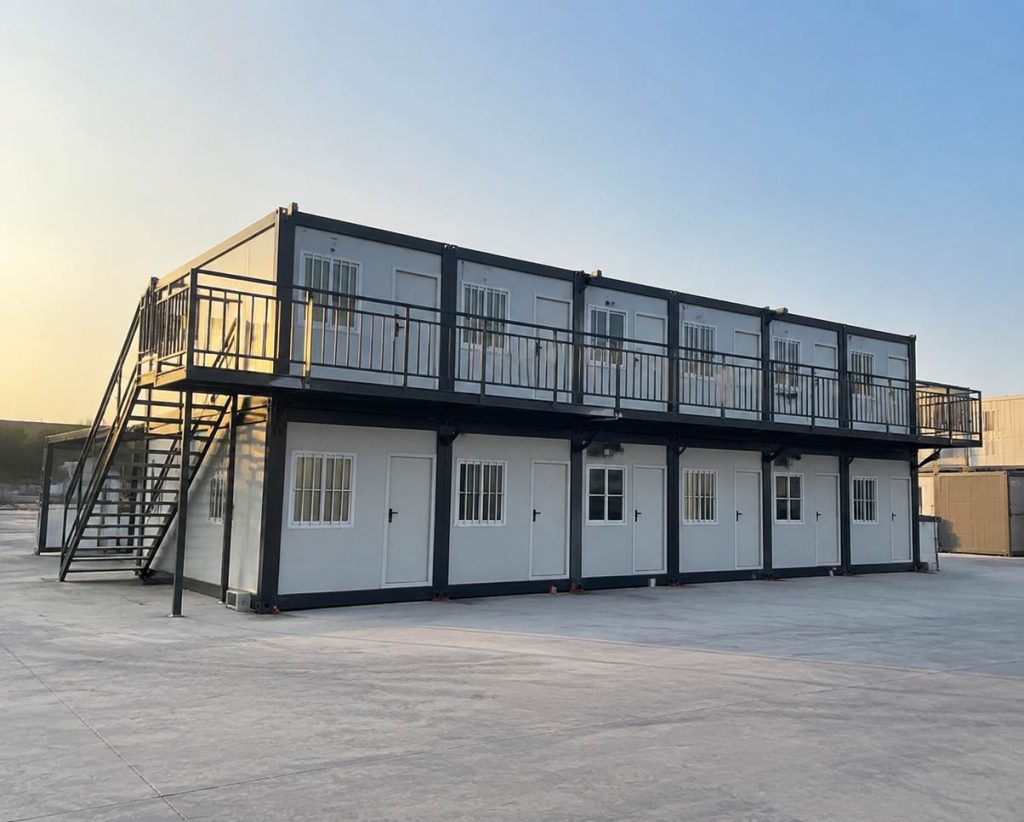
Container units act as modular blocks that can either be stacked one on top of the other or placed side-by-side to increase your area. Regular configurations consist of single executive office containers, open-plan office work areas, double-office split designs with central entrance, hybrid office + secure tool storage arrangements, office + private restroom standalone units, specially designed multi-person meeting rooms, two-story staggered project management blocks with outside stairs, and large worker accommodation and canteen complexes.
Modular Office Layouts
Modular framing provides total control over your floor plan, allowing you to design expansive open-plan clerical areas, multi-room corporate layouts with dedicated hallways, formal corporate reception areas, full-size training rooms and lecture spaces, multi-story corporate headquarters complete with interior stairwells, and shared employee breakrooms, cafeterias, and locker facilities.
Mobility and Relocation
If your business is run on temporary contracts, then moving your assets around becomes a reason to consider. Container offices dominate the market with complete mobility. They have corner castings and strong floor joists that enable lifting by crane and transportation on a regular basis. When a job is finished, a flat pack or dismantlable container office can be broken down or loaded onto a flatbed truck and physically moved to the next site without weakening the structural frame.
Several modular office configurations are capable of being relocated, though moving a large modular complex is quite a different story. You have to very carefully disconnect the joint seals, separate the integrated utility lines, and replace the foundations that are supportive at the new place. Because of this, modular buildings are generally intended for semi-permanent or permanent installations where the building is not expected to be changed for a number of years.
Security and Storage
Remote construction sites, work zones in the middle of the city, areas where the mining of metals is being carried out- all of these require dependable and reliable asset protection. Container offices offer a securely enclosed space. Their tough frames are made of steel, while the panels on the walls are covered with steel which together form a very sturdy construction resisting even a person breaking in by force. If they are also equipped with security doors made of steel and heavy deadbolts, shutters for windows, or security bars integrated inside, then one can safely store very valuable testing equipment, structural floor plans, computer servers, and important project files without a risk of theft.
Container Office Options from ZN House
Flat Pack Container Office
Engineered for international projects, industrial mining camps, and large-scale construction builds. The top and bottom frames are completed at the factory with pre-integrated electrical setups. The wall panels pack flat inside the frame assembly, allowing you to ship up to 4 units within a single 40HQ container to lower ocean freight costs.
Folding Container Office
Designed for rapid deployment on emergency sites and short-term construction projects. The wall panels are pre-assembled with durable, heavy-duty hinges. Once delivered, a crane lifts the roof section, the walls unfold into place, and the joints are secured within 20 minutes per module.
Detachable Container Office
A practical solution for multi-year projects that require regular relocation. This system uses completely independent structural components, including columns, beams, and interchangeable wall panels. It can be easily taken apart and packed down into component bundles when a project concludes.
Frequently Asked Questions About Container Office vs Modular Office
What is the difference between a container office and a modular office?
A container office is usually made from a container-based steel structure or modified shipping container, while a modular office is made from factory-built modules or prefabricated building components assembled into an office building.
Is a container office cheaper than a modular office?
A container office may have a lower initial cost for simple site office units, but total cost depends on size, customization, shipping, foundation, installation, HVAC and project duration.
Which is faster to install, a container office or modular office?
Standard container offices and folding container offices are often faster for small temporary offices. Modular offices can also be fast, but larger buildings need more design and site assembly planning.
Which is better for construction sites?
Container offices are often better for construction sites because they are strong, fast to deploy, relocatable and suitable for temporary project use.
Which is better for long-term office use?
Modular offices are often better for long-term use when the project needs larger layouts, better interior comfort and a more professional office environment.
Similar Posts
Top 10 Benefits of Container Camps for Modern Living Solutions
When construction starts on new infrastructure projects in remote desert regions, a new mine is developed…
12 Types of Prefabricated Houses
Prefabricated houses refer to fully or partly factory-built houses that are shipped to the site where…
Flat Pack Container Houses vs. Traditional Housing: What’s the Real Difference?
Introduction Increasingly, modern construction projects require building systems that can respond to the changes based on…
Expandable Container House vs Folding Container House: Which One Is Better for Your Project?
Introduction Modular building has grown very rapidly as a choice for new buildings in the majority…
What is Mine Site Accommodation?
Accommodations for mine site personnel refer to specially constructed, onsite lodging with and without lodging and…
20ft vs 40ft Container House: Which Size Is Right for Your Project?
20ft and 40ft container houses mainly differ in the amount of usable space. A 20ft container…


