



Prefabricated Workers’ Quarters for Remote Workforce Accommodation
Prefabricated worker quarters refer to the factory-produced housing units that can accommodate workers and project staff, mainly around job sites, remote work zones, and temporary project locations. These units are among the common means of the workers sector in projects such as construction, mining, oil and gas infrastructure, agriculture, and disaster relief where conventional buildings are not only slow but also costly or difficult to build.
Simplified prefabricated worker quarters, unlike traditional houses, can be manufactured elsewhere, transported to the project location, and installed within a short period. Besides this, they can also be expanded, relocated, or combined into complete worker camps. For this reason, many project owners opt for modular accommodation over on-site construction.
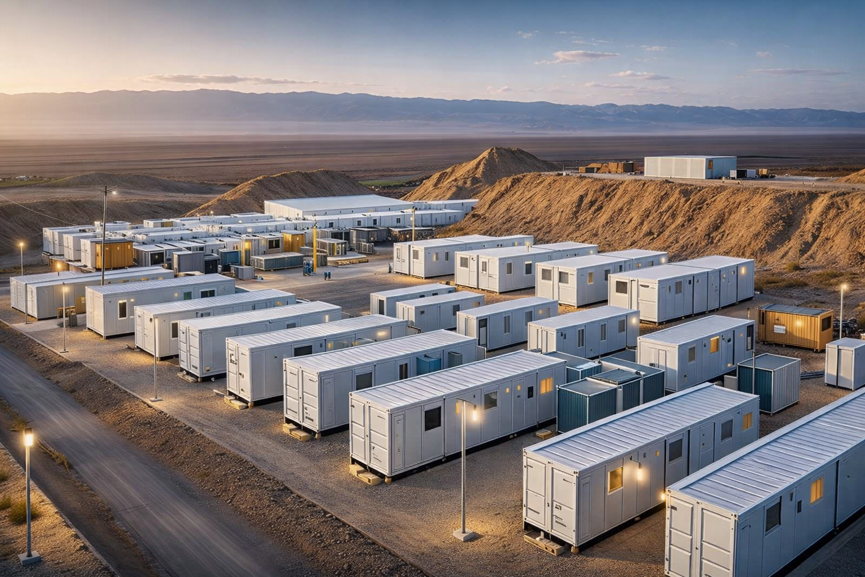
What Are Prefabricated Workers Quarters?
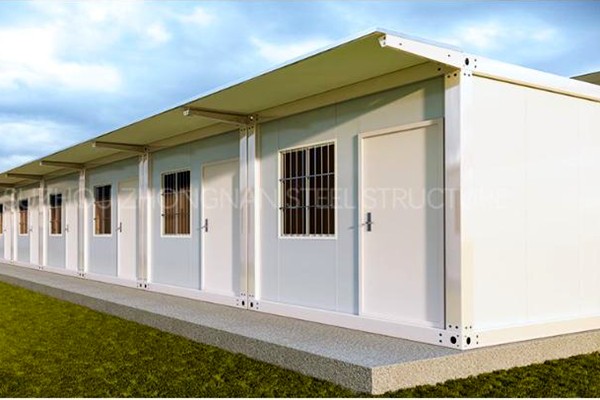
Prefabricated workers’ quarters are basically factory-produced units of worker accommodation intended to be used temporarily, semi-permanently or as a housing option for remote workforces. They can take the form of container dormitories, flat pack container houses or modular buildings, and they are created to be suitable for workers, site managers, engineers and project staff alike. These units can be used as single rooms for a small crew or put together to form complete camp layouts for a large workforce.
Prefabricated workers’ quarters do not necessarily have to be sleeping rooms only. A complete worker accommodation project can incorporate dormitories, offices, toilets, showers, kitchens, dining halls, laundry rooms, storage units and recreation areas, all designed to be used as one accommodation system.
Why Are Prefabricated Workers Quarters Used?
Many project locations are remote from urban centers or existing local housing, and the conventional method of construction is very time-consuming and may not be able to meet the project deadlines. Besides, temporary projects may not always warrant the cost of constructing permanent buildings, and since the size of the workforce often fluctuates from one project phase to another, fixed buildings become even less suitable.
For industries that rely heavily on projects, accommodation for workers needs to be delivered fast and changed per the conditions of the sites. Modular workers’ quarters enable companies to provide safe and efficient living arrangements right at the worksite, at the same time decreasing the time for construction and increasing project flexibility because the units can be moved, erected, and extended when the workforce increases.
Key Benefits of Prefabricated Workers Quarters
Faster Project Deployment
Producing units in a factory greatly shortens the duration of on-site construction work because most of the structural and finishing work is done before the units even leave the factory. Since the units are transported and set up in a much shorter time compared to conventional buildings, they are quite ideal for urgent projects of urgency, and mining, oilfield, and infrastructure sectors with limited time for construction.
Lower On-site Labor Requirements
As the greater part of components are finished at the factory, the amount of construction work to be done on-site gets quite a bit reduced when the units arrive. And, factory-made units contribute to greater production uniformity from one unit to another, which not only helps in lessening the disruption caused on-site but also makes managing labour easier on project sites that are busy.
Flexible Layouts for Different Workforce Sizes
Prefabricated workers’ quarters can be designed for small teams or large camps depending on project needs. Room capacity can be customized, and layouts can include single rooms, multi-person dormitories, offices and shared facilities arranged to match the size and structure of the workforce.
Scalable Camp Planning
More units can be added to the project as it expands, so prefabricated accommodation is really suitable for a project’s phased development. A single initial layout can be later complemented with dormitories, offices, toilets, showers, kitchens and dining areas if the camp is enlarged.
Relocatable and Reusable
Prefabricated workers’ quarters fit very well the temporary and project-based uses. Besides the design and method of installation, the units can be moved to another site after the completion of a project, which is advantageous for contractors and project owners because they can reuse the same assets in different projects instead of treating worker housing as a one-time cost.
Cost Control for Project Buyers
Using standard layouts can help increase production efficiency, while bulk ordering could lower the price per unit for bigger workforce projects. Buyers may wish to look at the overall project cost instead of just the unit price since shipping, installation and utility connections are the elements that determine the final budget.
Better Site Organization
Apart from cutting down commute time, housing workers near the project site will also lead to better overall site organization. In fact, a nicely planned workers’ quarters project will not only bring accommodation, sanitation, dining, and office areas together in a coherent layout but also help in their organization more efficiently.
Common Units in a Prefabricated Workers Quarters Project
It is a common misconception to only design worker quarters as dormitory rooms. In fact, they must be a sustainable living and support system overall. Below is a table presenting some typical units of a workforce accommodation full project.
| Unit Type | Function |
| Worker Dormitory | Sleeping rooms and shared accommodation |
| Supervisor Room | Private or semi-private accommodation for managers |
| Container Office | Site management, administration and meetings |
| Toilet Unit | Sanitary facilities |
| Shower Unit | Worker washing facilities |
| Kitchen Unit | Meal preparation |
| Dining Hall | Shared dining space |
| Laundry Unit | Washing and drying area |
| Storage Unit | Tools, equipment and supplies |
| Recreation Room | Rest area for workers |
| Clinic / First Aid Room | Basic medical support |
| Security Room | Site access control |
Common Layout Options for Workers’ Quarters
Single-Room Worker Accommodation
This arrangement works well with, among other things, small teams, supervisors, short-term projects and temporary site housing. It normally presents a small footprint, simple sleeping space, and communal toilet and shower facilities that are close by, though not inside every unit.
Multi-Person Dormitory
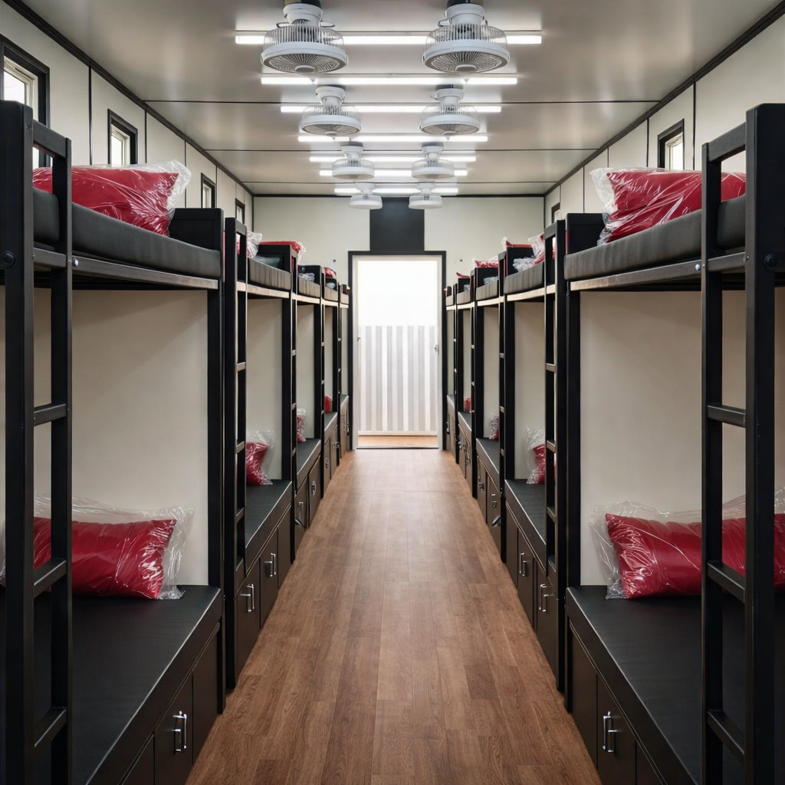
Multi-person dormitories are a good fit for construction workers, mining workers, large teams, and projects where cost-controlled accommodation is the priority. Generally, these types house several beds, lockers and shared facilities. Plus, the layout design of one can be repeated many times to scale a camp very quickly.
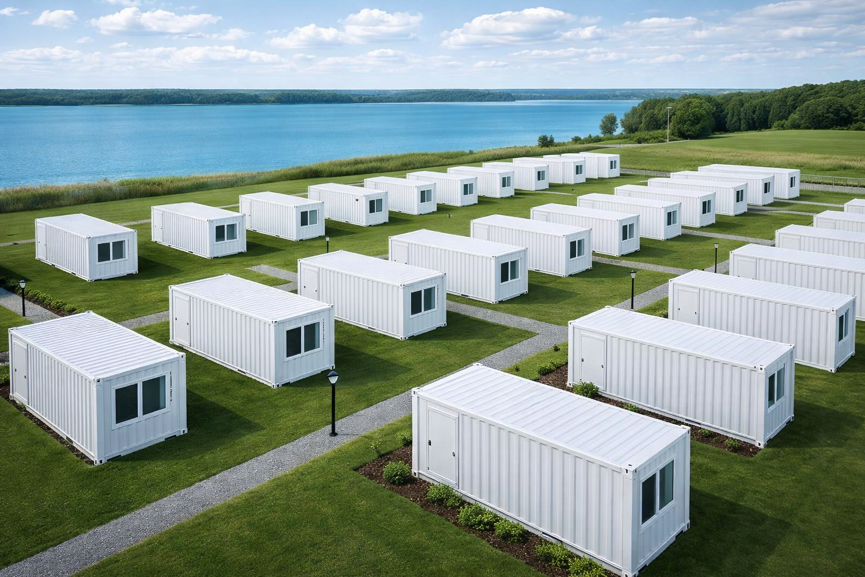
Office + Accommodation Unit
This dual-purpose layout is perfect for site managers, engineers, supervisors and even remote project teams who require not only a working area but also a resting area. Usually, it merges a working area with a resting area, and an optional bathroom or a small meeting and administration area can be added.
Complete Worker Camp Layout
A complete camp layout is suited for large construction sites, mining camps, oil and gas fields, and infrastructure projects with sizable workforces. It brings together dormitories, offices, toilets and showers, a kitchen and dining area, laundry, recreation, storage and security into one coordinated site plan.
Industries That Use Prefabricated Workers Quarters
Construction Sites
Construction projects require worker accommodation, site offices, temporary dormitories, supporting toilets, showers and dining areas to be set up quickly as per the schedule of the construction.
Mining Projects
In remote mine sites, camps must be highly functional and the living quarters should be made up of robust dormitory units. Besides that, kitchen dining, laundry and recreation facilities must also be well designed to endure the long, harsh, isolated conditions.
Oil and Gas Fields
Living accommodations for oilfield workers, pipeline lodging for the project, remote labor force camps and man camp layouts are standard examples, mostly when locations are so isolated that there is no town or settlement nearby.
Infrastructure Projects
Building highways, bridges, rail networks, and power facilities usually entails the establishment of temporary labor camps combined with engineer offices and residential units that can be relocated together with the construction phases.
Agriculture and Plantation Projects
Seasonal workers’ housing and temporary homes near farms or plantations, supported by lunch and hygienic facilities, make it possible for farm businesses to increase or decrease their labor force as the harvest calendar.
Disaster Relief and Emergency Housing
Fast deployment is the top priority in such a scenario, as the need for temporary shelters, emergency staff accommodation, as well as medical or support units, is to have them ready within a few days rather than months.
Prefabricated Workers Quarters vs Traditional Worker Housing
| Comparison Point | Prefabricated Workers Quarters | Traditional Worker Housing |
| Construction Speed | Faster | Slower |
| On-site Labor | Lower | Higher |
| Relocation | Easier | Difficult |
| Expansion | Easier to add units | Less flexible |
| Project Use | Suitable for temporary and remote sites | Better for permanent local buildings |
| Cost Control | Easier for repeated layouts | More affected by local labor and material cost |
| Site Disruption | Lower | Higher |
| Reuse | Possible depending on structure | Usually limited |
When looking for accommodation for a remote, temporary or project-based workforce, prefabricated workers’ quarters usually offer better flexibility and quicker delivery than traditional construction.
What to Consider Before Buying Prefabricated Workers Quarters
| Information Needed | Example |
| Project Location | Country, port, city or remote site |
| Industry | Construction, mining, oil and gas, agriculture |
| Crew Size | Number of workers and managers |
| Project Duration | Temporary, semi-permanent or long-term |
| Unit Types | Dormitory, office, toilet, shower, kitchen, dining |
| Room Capacity | Single room, 2-person room, 4-person room, multi-person dormitory |
| Wall Panel | EPS, rock wool, PU, PIR or custom |
| Climate Conditions | Hot, cold, rainy, windy, dusty or coastal |
| Utility Needs | Electrical, plumbing, drainage, HVAC |
| Quantity | Number of units or total camp capacity |
| Shipping Destination | Destination port or project site |
| Installation Plan | Self-installation, local team or project support |
If you decide to purchase prefabricated workers’ quarters, you need to start by collecting basic project information like the number of crew members, types of units needed, room layout, site climate, and destination. Having these details allows suppliers to give you a more precise quote and design a camp layout.
Cost Factors for Prefabricated Workers Quarters
The overall cost of a prefabricated workers’ quarters project varies based on a range of factors such as the size of the unit, layout type, wall panels used, steel structure, interior finish, bathroom and kitchen configurations, electrical and plumbing systems, order quantity, shipping destination, installation requirements and climate specification.
| Cost Factor | How It Affects Price |
| Room Layout | Multi-person dormitories may reduce cost per worker |
| Wall Panel | Better insulation or fire resistance may increase cost |
| Bathroom / Shower | Plumbing and waterproofing increase cost |
| Kitchen / Dining | Requires more equipment and utility planning |
| Quantity | Bulk orders can improve cost efficiency |
| Shipping | Flat pack loading can reduce transportation cost |
| Installation | Foundation, labor and equipment affect total project cost |
Every project is different: its scope, climate and destination will vary so pricing cannot be fixed – it must always be checked with the supplier. No estimation from general figures.
What ZN House Can Provide
ZN House specializes in providing container-based and prefabricated workers’ quarters for foreign projects. We can assist different projects with their requirements, starting from simple workers’ dormitories to fully furnished container camp layouts with offices, toilets, showers, kitchens, dining rooms, and support units.
In ZN House’s container dormitory product line, there are single-unit dormitories available for small crews as well as multi-story modular dormitory buildings that can be scaled up to large camps. The units are constructed on a galvanized steel frame with fire-rated insulation and electrical and plumbing systems that are factory-installed. Also, 20ft and 40ft standard container sizes can be combined with offices, command centers, and dining facilities for more complex projects.
In case of complete workforce camps, ZN House’s container camp solutions can turn the same dormitory units into entire site layouts, which include separate construction camp and mining camp arrangements. There are also quick-deployment refugee and disaster relief camps that can be used for emergency housing needs. Container offices and container toilets are some of the supporting facilities that can be added to a complete worker quarters project.
Apart from dormitories and camps, ZN House offers flat pack container houses, kitchen and dining units, laundry and storage units, modular container camp layouts, and custom worker accommodation solutions. We also provide bulk order and loading support, as well as project-based quotations for buyers who are planning anything from a small crew housing project to a large multi-phase camp.
Why Choose ZN House for Worker Accommodation Projects?
ZN House can help you work out the best plan for workforce accommodation regardless of whether you need a small dormitory project or a full worker accommodation camp. Besides the crew size, project duration, application and destination factors, they also take into account your budget. Flexible layout planning that is suitable for construction, mining, oilfield and infrastructure projects is one of their main strengths. In addition, they offer custom dormitory and camp solutions, support for bulk orders, export shipping support, flat pack and modular container options, project-based quotation, and the ability to combine accommodation, office and sanitary units into one coordinated project.
FAQ About Prefabricated Workers Quarters
What are prefabricated workers quarters?
Prefabricated workers’ quarters are factory-built accommodation units that work as housing for workers in the vicinity of construction sites, mining areas, oilfield infrastructure projects, and other remote work locations.
Where are prefabricated workers’ quarters commonly used?
They are typical in construction, mining, oil and gas infrastructure, agriculture, disaster relief and other remote workforce projects.
Are prefabricated workers’ quarters the same as container dormitories?
Container dorms are a kind of prefabricated workers’ housing. Besides the living units, a full workers’ quarters project may involve offices, toilets, showers, kitchens, dining areas, laundry facilities, and stores.
Can prefabricated workers’ quarters be relocated?
Most prefabricated workers’ quarters are designed to be moved or reused. In fact, it totally depends on the kind of structure, installation method and the conditions under which it was maintained. This feature actually makes them perfect for temporary or project-based use.
Can they include toilets, showers and kitchens?
Yes. Prefabricated workers’ quarters can be linked together with toilet units, shower units, kitchen units and dining halls to form a fully functional workforce accommodation camp.
Are they suitable for oilfield or mining camps?
Yes. Prefabricated workers’ quarters are suitable for mining camps, oilfield housing, pipeline projects and other remote workforce accommodation needs.
What information is needed for a quote?
Buyers should provide the project location, crew size, required unit types, layout, wall panel necessity, utility requirements, quantity, destination, and installation plan.
Can ZN House provide a complete worker accommodation camp?
Yes, ZN House is capable of facilitating the entire planning for a worker accommodation camp that can include dormitories, offices, toilets, showers, kitchens, dining units, laundry rooms, and other support buildings as per the project needs.
Similar Posts
Get your Container House from China: Things You Need to Know Before Purchase
This article will inform you about questions that people concern most about getting container houses in…
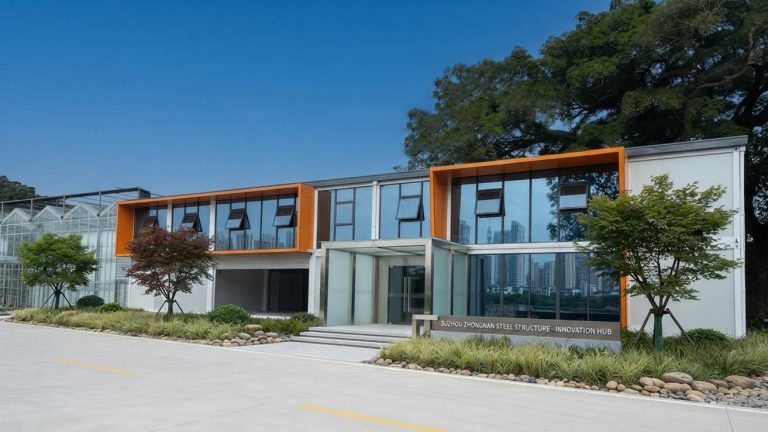
The Role of Technology in Modern Assemble Houses
In the ever – evolving construction industry, modern assemble houses have emerged as a revolutionary force, and…
How Are Modular Buildings Constructed?
Modular buildings are structures constructed from one or more sections, each of which is commonly called…
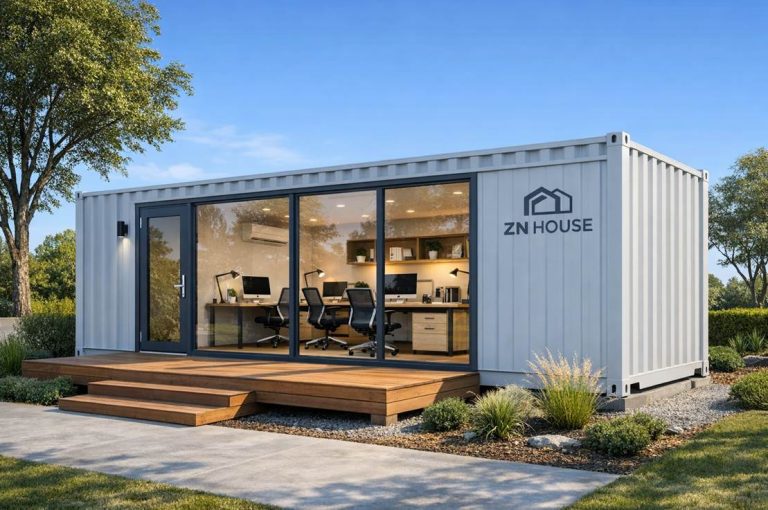
How To Convert a Shipping Container into an Office
An office created using an enclosed metal recycling system from original shipping vessels provides an environmentally…
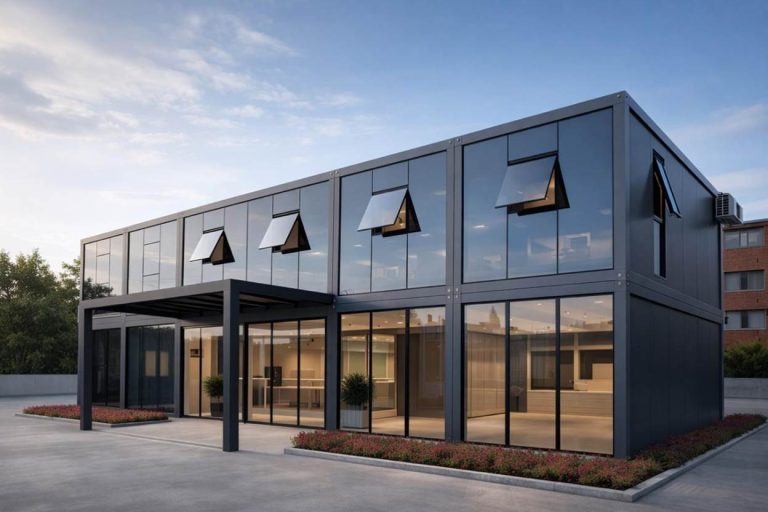
What Are Prefabricated Office Buildings? The Complete Guide for Businesses
Construction sites, factories, warehouses, mining projects, and remote work camps often need office space faster than…
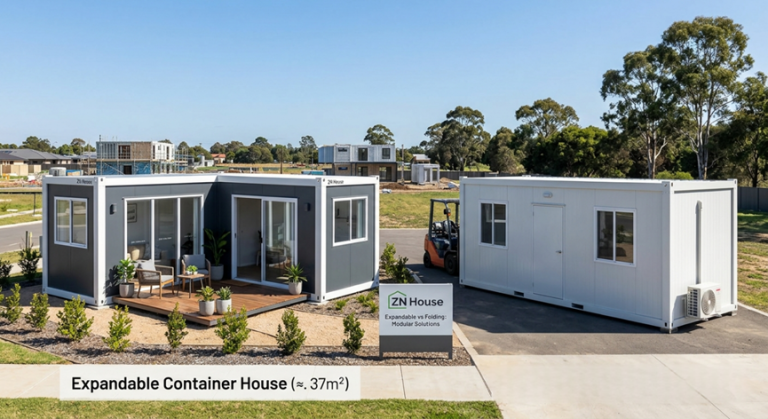
Expandable Container House vs Folding Container House: Which One Is Better for Your Project?
Introduction Modular building has grown very rapidly as a choice for new buildings in the majority…


